
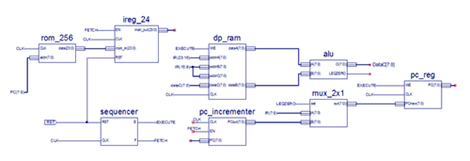
Building A One-instruction Computer

[Hasith] sent in this project where he goes through the process of designing a one instruction CPU in Verilog. It may not win a contest for the coolest build on Hack A  Day, but we really do appreciate the “applied nerd”  aspect of this build.

With only one instruction, an OISC is a lot simpler than the mess we have to deal with today. There are a few instructions that by themselves are Turing-complete (like Subtract and branch if negative, and Move). Designing an OISC with one of these instructions means it can also emulate a Turing machine.
Continue reading “Building A One-instruction Computer”

J1: A Small, Fast, CPU Core For FPGA

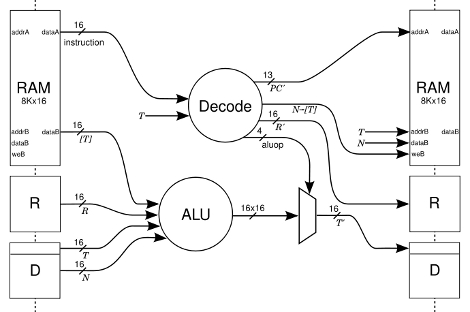
[James Bowman] of the Willow Garage published a paper on his J1 CPU core for field-programmable gate arrays. This was originally developed and used for the Ethernet cameras on the PR2 (you know, that incredibly expensive beer delivery system?) robot. It uses a 16-bit von Neumann architecture and lacks several processor features you’d expect a CPU to have such as interrupts, multiply and divide, a condition register, and a carry flag. None-the-less, its compact at just 200 lines of Verilog and it can run at 80 MHz. [James] compares the J1 to three different FPGA CPU Cores commonly used and discusses how the system is built in his 4-page paper that has the details you’re interested in but won’t take all day to dig through.









