The Oldest Windows App To Still Run On WIndows 11

In the open source world we are used to software being compiled from source for our particular distro, so while in a few cases an ancient release may still be in use, it’s just going to run on the latest distro version. But in the Windows world it’s rare for software to come with the source, so you’re left with a binary that will only run if your Windows version has the right APIs for it. Since the more recent versions of Windows dropped 16-bit support a while back, that means there must be a hard date set on the earliest Windows GUI application that can still run today. [Enlyth] decided to investigate.

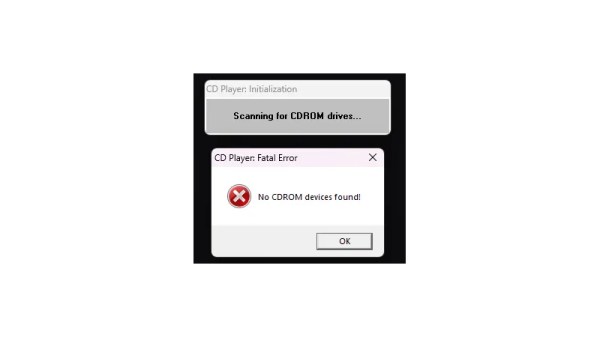
Given that the earliest API supported in WIndows 11 is the 32-bit version, the hunt led straight to either the first Windows NT release and ancestor of Windows 11, or the Win32s extension for WIndows 3.1. Thus a 1993 Win32S version of Freecell runs happily, but that want’s the end of the trail. Somewhere in the pre-release builds of Windows NT 3.1 would be the requisite binary, but there’s a snag. Early Windows NT 3.1 APIs were incompatible with later ones. This led through a lot of crashing binaries to a November 1992 version of the CD player app, that ran because it called a DLL which happens to still be present. The need for another DLL to emulate a CD drive speaks volumes about the progress of the PC world, back then they were the last word in storage but who’s got one now?

That’s the earliest official binary to run, but the story’s not quite over. Windows 11 may not have a VDM to run 16-bit apps, but there’s a WINE VDM for that. Behold, Reversi from Windows 1.01 in November 1985, in Windows 11. Your ancient software may yet be saved.

C#, The Language For All Platforms – Now Including Windows 3.11 And DOS

The Microsoft .NET framework has been with us in one form or another since the millennium, and though it has remained largely the preserve of the Microsoft universe, it has found its way since then through a variety of implementations to other platforms including MacOS and GNU/Linux. In Microsoft terms though its history goes back only as far as Windows 98, earlier MS operating systems remain off-limits.

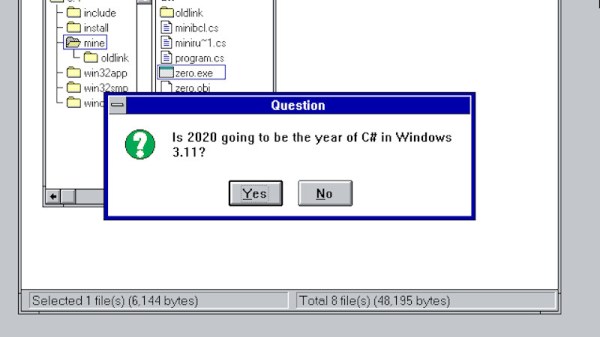
Just a glimmer of .NET in DOS and Windows 3.11 comes courtesy of [Michal Strehovský], who has successfully compiled .net C# code for both Windows 3.11 and DOS. An in-depth explanation comes courtesy of [Scott Hanselman], and it involves some tricks spanning the decades since the early 1990s. The .NET Core compiler’s object files can be fed into the linker that shipped with an ancient version of Microsoft’s C++ compiler, which when used with Microsoft’s Win32s compatibility layer that brought some of Windos NT’s APIs to the 16-bit OS, allows C# from 2020 to run as though it were 1992 again. Meanwhile the DOS version uses .NET Core’s ability to produce self-contained executables along with some very significant tricks to pare down the size of the finished program from many megabytes to an eventual DOS-suitable 27k. Remember the apocryphal Bill Gates quote, that “640k should be enough for anyone“, that refers to the maximum memory available to DOS without extra memory-extending tricks.

Neither piece of software is especially useful, and we can’t see a rush of C# coders to these new platforms. But we applaud him for his ingenuity, and getting old hardware to do new tricks is right up our alley. It’s certainly dredged up a few memories from back in the day for us. Meanwhile we’ve featured .NET in a few projects over the years, most recently on an FPGA.

Playing StarCraft On An ARM

Starcraft

Except for the really terrible Nintendo 64 port, StarCraft has always been bound to desktop and laptop PCs. Blizzard could take the code for StarCraft, port it to an ARM platform, put a version on the Google Play an iTunes store, and sit there while the cash rolls in. This would mean a ton of developer time, though, and potentially years tracking down hard to find bugs.

Or one random dude on the Internet could port StarCraft to an ARM platform. Yes, this means all the zerg rushes and dark templar ambushes you could possibly want are available for tablets and Raspberry Pis.

This godlike demonstration of compiler wizardry is a months-long project of [notaz] over on the OpenPandora team. Without the source for StarCraft, [notaz] was forced to disassemble the Win32 version of the game, convert the disassembly to C with some custom tools, and recompile it for ARM while linking in all the necessary Win32 API calls from the ARM port of Wine. Saying this was not easy is an understatement.

If you have an OpenPandora and want to relive your heady days of youth, you can grab everything you need here. For anyone without an OpenPandora that wants to play StarCraft on a Raspi, you might want to get working on your own recompiled port. Video below.

Continue reading “Playing StarCraft On An ARM” →