
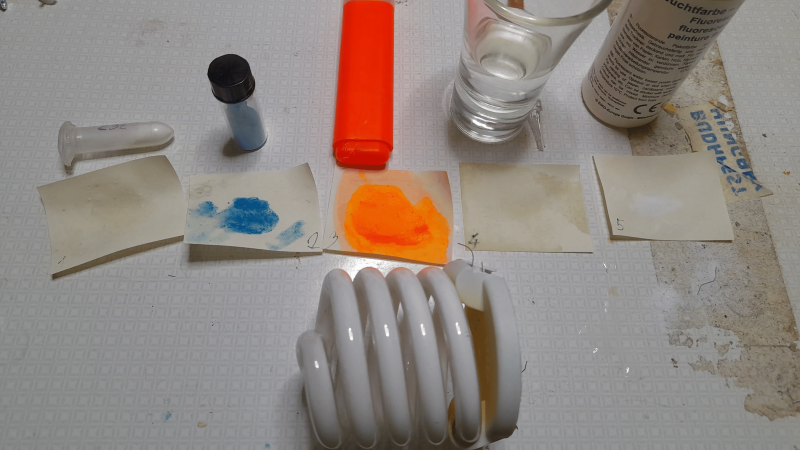
A selection of materials sits on a counter. There is a fluorescent light bulb, two papers stained with dyes, and a few other pieces of paper with no obvious staining.

Building Your Own X-Ray Detector Screen

Fluoroscopy is probably the best-known method of X-ray imaging: an X-ray beam passes through the subject to be imaged, and the transmitted X-rays illuminate a phosphor screen. Dense objects, such as metal or bone, cast a shadow on the screen, which provides a real-time image of the subject’s interior. Already having access to X-ray sources, [MarcellF]’s next step was to investigate common phosphor materials, then synthesize his own.

Most common materials that fluoresce under ultraviolet light showed no activity under X-rays: fluorescein, quinine, UV fluorescent paint, and common fluorescent minerals emitted no noticeable glow under 80 kV X-ray stimulation. However, strontium aluminate phosphors did fluoresce well, with a strong afterglow, as did the phosphors in a fluorescent light bulb, some LEDs, and an electroluminescent panel. The electroluminescent panel, which used a zinc sulfide phosphor, was almost as bright as the gadolinium oxysulfide screen from a CT scanner’s detector and had no noticeable afterglow.

Continue reading “Building Your Own X-Ray Detector Screen”

Painted Over But Not Forgotten: Restoring Lost Paintings With Radiation And Mathematics

An intrinsic property of paintings, that makes them both wonderful and very annoying, is the fact that they are physical objects. Sometimes they survive across the ages as amazing artifacts of their era, but they are also susceptible to being lost and even destroyed. Sometimes this destruction is deliberate, such as when a painting is painted over.

Artists reuse canvas all the time — painting over what was already there. Sometimes they might be coerced by a client into altering a painting, or removing entire elements from a scene. Fortunately, nowadays we have many techniques, involving x-rays and infrared radiation, that can analyze paintings to determine not only the composition of what we can see with the naked eye, but also that what lies underneath.

In some cases, we can then reconstruct what was previously hidden, returning to physical reality paintings and sketches which haven’t seen the light of day for sometimes centuries. Continue reading “Painted Over But Not Forgotten: Restoring Lost Paintings With Radiation And Mathematics”








