

atom drawing

The Eulogy Of Local Hidden Variables

During the early 1900’s, [Einstein] was virtually at war with quantum theory. Its unofficial leader, [Niels Bohr], was constantly rebutting Einstein’s elaborate thought experiments aimed at shooting down quantum theory as a description of reality. It is important to note that [Einstein] did not disagree with the theory entirely, but that he was a realist. And he simply would not believe that reality was statistical in nature, as quantum theory states. He would not deny, for example,  that quantum mechanics (QM) could be used to give a probable location of an electron. His beef was with the idea that the electron doesn’t actually have a location until you try to measure it. QM says the electron is in a sort of “superposition” of states, and that asking what this state is without measurement is a meaningless question.

So [Einstein] would dream up these incredibly complex hypothetical thought experiments with the goal of showing that a superposition could not exist. Now, there is something to be said about [Einstein] and his thought experiments. He virtually dreamed up his relativity theory while working as a patent clerk at the ripe old age of 26 years using them. So when he had a “thought” about something, the whole of the scientific world stopped talking and listened. And such was the case on the 4th of May, 1935.

Continue reading “The Eulogy Of Local Hidden Variables”

Arduino Video Over 2 Wires For Under $50: Mesa-Video

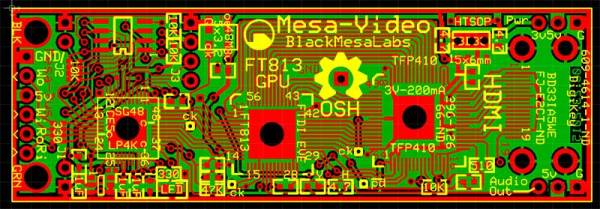
If you want video support on your project, you might start from a device like a Raspberry Pi that comes with it built in. [Kevinhub88] doesn’t accept such compromises, so he and his Black Mesa Labs have come up with a whole new way to add video support to devices like the Arduino and other cheap controllers. This project is called Mesa-Video, and it can add digital video at a resolution of up to 800 by 600 pixels to any device that has a single serial output.

The video is created by an FT813, a low cost GPU from FTDI that offers a surprising amount of video oomph from a cheap, low power chip (he has demoed it running from a lemon battery), meaning that he is hoping to be able to sell the Mesa-Video for under $50.

UPDATE: [KevinHub88] let us know that he didn’t actually power the device from a lemon battery, as you would need a lot of lemons to make 50mA at 5V. Apologies for any confusion!

However, Mesa-Video is just the beginning. [Kevinhub88] wanted to get around the problem of stacking shields on Arduinos: add more  than one and you get problems. He wanted to create an interface that would be simpler, faster and more open, so he created the Mesa-Bus. This effectively wraps SPI and I2C traffic together over a simple, fast serial connection that doesn’t require much decoding. This means that you can send power and bi-directional data over a handful of wires, and still connect multiple devices at once, swapping them out as required. You could, for instance, do your development work on a PC talking to the prototype devices over Mesa-Bus, them swap the PC out for an Arduino when you have got the first version working in your dev environment. Is the Arduino not cutting it? Because Mesa-Bus is cross-platform and open source, it is easy to swap the Arduino for a Raspberry Pi without having to change your other devices. And, because all the data is going over a simple serial connection in plain text, it is easy to debug.

It’s an ambitious project, and [Kevinhub88] has a way to go: he is currently working on getting his first prototype Mesa-Bus devices up and running, and finalizing the design of the Mesa-Video. But it is an impressive start and we’ll be keeping a close eye on this work. Hopefully he can avoid that head crab problem as well because those things are as itchy as hell.








