Creating Temporal Light Reflections With Metamaterials

Owing to the wave nature of light there are many ways that such different waves can interact with each other, but also with materials. Everyone knows about reflecting light with a mirror, which is a property of materials like metals, but specific structures can cause the light to behave in a way that creates rather amazing results.

Examples of this are cases of iridescence in nature (like butterfly wings) and eye color, where the perceived colors are the result of environmental light interacting with these structures rather than pigmentation or dyes. An even more interesting interaction has now been demonstrated by reflecting multiple microwave radiation beams off each other, creating a time reflection.

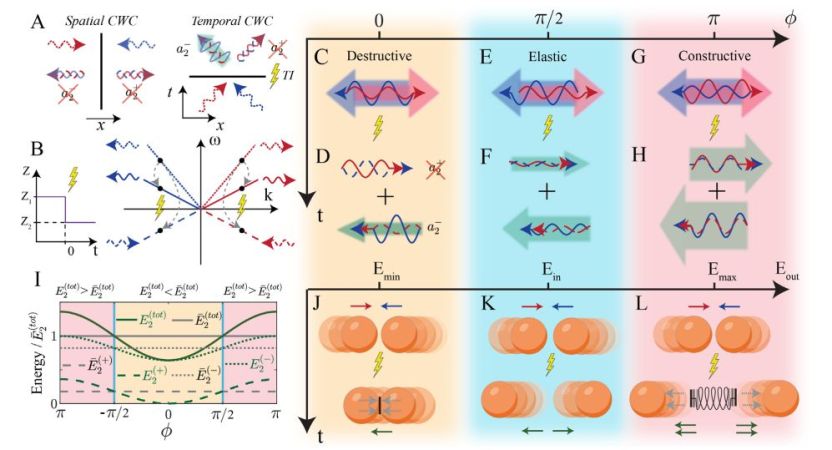
The study by [Emanuele Galiffi] et al. (shared copy) was published in Nature Physics. By creating a metamaterial that allows for temporal coherent wave control (CWC) the electromagnetic radiation was controlled to where it allowed for this kind of unusual interaction. The key here being that there is no major constructive or destructive interaction between the two waves as with spatial CWC, rather the wave reflect off each other, or more specifically the time interface.

Although the popular reporting talks about ‘turning back time’ and ‘watching the back of your own head in a mirror’, the impact is far less dramatic: in the article conclusion the researchers mention unveiling new light-matter interactions in the microwave- and other parts of the spectrum, as well as new ways to control and shape light.


Top image: Temporal coherent wave control and photonic collisions enabled by time-interfaces. (Credit: Emanuele Galiffi et al., Nature Physics, 2023)

Turning A Lada Into An EV With 50 Cordless Drills, Because Why Not?

[Garage 54] is no stranger to vehicle-related projects of the “because why not?” variety, and their latest is using 50 cordless drills combined into a monstrous mega-motor to turn a gutted (and extended) Lada into an electric vehicle (EV).

Doing this leans on some of [Garage 54]’s earlier projects, such as replacing the aforementioned Lada’s engine block with a frame containing sixteen chainsaws. That means they don’t need to start completely from scratch, and have a frame design that can drop into the vehicle once the “engine” is constructed.

Fifty cordless drills won’t set any efficiency records for EV engines, but it’s got a certain style.

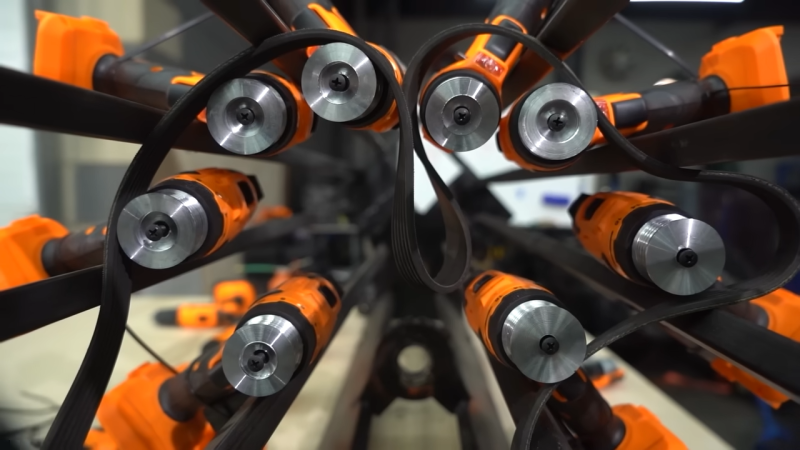
Here’s what’s in the new engine: each of the drills has its chuck replaced with an aluminum pulley, and belts connect each group of drills to an output shaft. Ideally, every drill motor would run at the same time and at exactly the same speed, but one works with what they have. [Garage 54] originally worked to synchronize the drills by interfacing to each drill’s motor control board, but eventually opted to simply bypass all controls and power each drill’s motor directly from the batteries. Initial tests are done by touching bare cable ends with a turned-away face and squinted eyes, but we expect “Just A Big Switch” to end up in the final assembly.

It looks wild and we can think of more than a few inefficiencies present in a system like this, but the output shaft does turn and torque is being transferred, so the next step is interfacing to the car’s factory gearbox.

If it powers the car in any meaningful way, that Lada might very well become the world’s most gloriously hacked-together EV. And hey, if the power output of the EV motor is disappointing, you can just make your own.

Continue reading “Turning A Lada Into An EV With 50 Cordless Drills, Because Why Not?”