
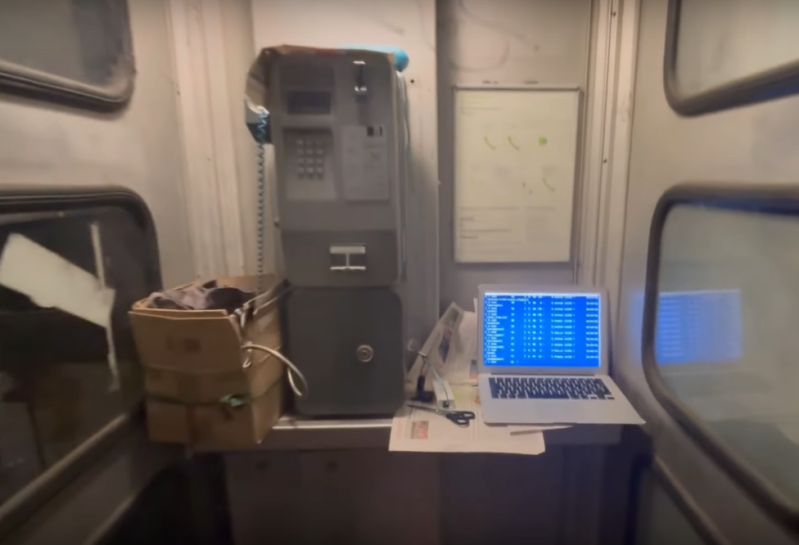
Before the days of mobile broadband, and before broadband itself even, there was a time where Internet access was provided by phone lines. To get onto a BBS or chat on ICQ required dialing a phone number and accoustically coupling a computer to the phone system. The digital data transmitted as audio didn’t have a lot of bandwidth by today’s standards but it was revolutionary for the time. [Nino] is taking us back to that era by using a serial modem at his house and a device that can communicate to it through any phone, including a public pay phone.
As someone in the present time can imagine, a huge challenge of this project wasn’t technical. Simply finding a working public phone in an era of smartphones was a major hurdle, and at one point involved accidentally upsetting local drug dealers. Eventually [Nino] finds a working pay phone that takes more than one type of coin and isn’t in a loud place where he can duct tape the receiver to his home brew modem and connect back to his computer in his house over the phone line like it’s 1994 again.
Of course with an analog connection like this on old, public hardware there were bound to be a few other issues as well. There were some quirks with the modems including them not hanging up properly and not processing commands quickly enough. [Nino] surmises that something like this hasn’t been done in 20 years, and while this might be true for pay phones we have seen other projects that use VoIP systems at desk phones to accomplish a similar task.









Ah, the old days of putting Blu-Tak around the ends of the headset, wrapping the acoustic coupler in a towel to isolate vibration, and playing Status Quo on the headphones too loud.
Hi! I wouldn’t call it “good”, though – but I’d imagine it was interesting, exciting era for sure. 😎
IMHO, in terms of signal quality/reliability using such a coupler roughly was the equivalent to using AFSK (audio FSK) and a radio transceiver’s microphone/ear phone jack
In amateur radio (for Packet-Radio/RTTY) instead of using proper, direct FSK.
Traditional acoustic couplers had a switch for 300/1200 Baud and answer/originate mode.
That’s important for making out a connection.
Hayes modems normally (unless forced) must talk to each others to find out which tone pairs and modulation schemes are used? I don’t know.
Anyway, the higher end acoustic couplers had been built into wooden boxes,
so the handset could be locked inside the box and would be acoustically insulated against environmental noise.
Example: https://collection.sciencemuseumgroup.org.uk/objects/co8411189/acoustic-data-coupler
Of course, in the hacker scene the cheaper plastic Dataphon (?) couplers had been used instead.
So it’s understandable that there’s not same kind of mental bond for the “professional” acoustic couplers. They had been used by business dudes, rather.
But that’s just my opinion. I didn’t mean to criticise the article or video in any way.
It was well done, I think. Also love the use of the different laptops! Kudos!
At home, I would have use an DOS-based BBS software, though.
Some had ANSI graphics and featured online games, such Trade Wars. Maybe next time? :)
I never saw a 300/1200 acoustic coupler. 1200 baud is a whole different animal, and doesn’t work reliably through an acoustic coupler (the carbon microphone in the handset is the issue). Supposedly, they existed, but I never saw one, and when 1200 became a thing, it was 99% direct connect Bell 212. It used a different set of tones, but they were usually also capable of Bell 103 operation (see below).
You’re probably thinking of an originate/answer switch, which would change the tone frequencies. I have seen those. Every acoustic coupler I have ever seen used Bell 103 tones and the good ones worked up to 300 baud: 1070/1270 for originate and 2025/2225 for answer (but most of them were originate only).
Ah, okay. Makes sense.
I assume that in some countries with a large infrastructure
the signal quality on landline must been largely varying, also.
So it makes sense if 110 and 300 Baud were more common, thus.
– Which is not that bad if it meant that the error rate was lower than with 1200 Baud.
We had similar situation with Packet Radio on ham bands, I guess.
9600 Baud FSK wasn’t always faster than normal 1200 Baud if many packets were lost due to noise.
Personally, I was thinking of this particular model:
https://www.c64-wiki.de/wiki/Akustikkoppler#dataphon_s21-23d
In my country of the 1980s we had an Minitel like service that operated at 1200/75 Baud.
Meaning 1200 Baud download, 75 Baud upload (keyboard input). It used V.23 standard (full duplex).
Maybe that’s why some of our couplers had added ordinary 1200 Baud (1200/1200 half duplex) as another option, as well.
I wished I knew better, I do own an acoustic coupler but this was a bit before my time to be honest.
I guess I was more of an fax modem user (with slow “data” support as an extra). 😅
Never saw that model, but, yes, it does seem to be capable of 1200 baud over a telephone handset. Perhaps it was a Europe-only product? Quite a trick! 1200 half duplex would have been Bell 202 standard here in the US, and to my knowledge that was never available for consumer dialup, though it was popular for remote job entry for mainframes. I do recall the Minitel type terminals being in the trade press, but we never saw that here in the US.
My first job, I worked on a video data terminal. It was built around a Motorola 6802 8-bit processor, and coded in assembly. We were able to tune it to do 9600 baud, full duplex. So, that was likely the top end for home computers using 8 bit processors.
I assembled my own PC from discarded parts at work (motherboard upgrades were fairly frequent, and nobody wanted the “old” ones…I bought successively faster dial-up modems as they became available. I remember buying a Bell 212 modem (1200 baud), then I think the next one might have been 14.4k, and then a loooooong wait until the US Robotics 56k modems came out with v.90. There was, I recall, a period where USR and someone else were running competing standards for 56k and I believe I waited until that had shaken out and everyone was comatible. Fortunately, by that time, all the higher speed modems were using DSP and it was a simple firmware upgrade to change standards.
I have two of what we here call TDD — acoustic coupled terminals with a single line display and thermal printer output used by deaf people to communicate over the phone. They run half duples and use 5-level Baudot code at 45.45 or 50 baud, 1400/1800 Hz tones, acoustic coupled or hardwired. They’re pretty much obsolete now, what with the Internet and cell phones. I bought them so my grandkids could play with them and so I could perhaps convert them to use with my genuine Baudot Teletype (it’s actually a TT-253/UG military typing reperforator — prints and punches 5-level paper tape)
That being said, I believe that 1200 Baud was anyway the upper limit that
many 8-Bit home computers could still handle reliably with their usual serial ports (no UART FiFos yet).
The C64 had a broken kernal routine for 1200 Baud setting, I vaguely remember.
A workaround was to configure a custom speed setting through the kernal to make it work properly.
All in all, 300 Baud probably was more reliable thus, I guess.
So nothing lost, really. 1200 Baud if available might have caused frustration, even.
Hm. Except for journalists, maybe?
They had laptops and were always on the go, around the globe?
There had been portable fax machines, also, which could be used in the telephone booth.
Looked like a tiny laptop crossed with an acoustic coupler.
Then there were mute people which used text machines for communications?
They had a single line LC display and an built-in acoustic coupler, I think.
DSL started in 1999 in my country, got mainstream ca. 2001 to 2004.
Before that, in the 90s, some permanent connections (T1 kind of) and ISDN (2x 64KB) were all there was in terms of high-end.
Cell phones had 9600 Baud in mid-90s, I think.
Right, Hunter S. Thompson refers to such devices in one (or both) of the Fear and Loathing books.
I had gotten a proper coupler back in the day and had troubles getting it to reliability function at 14.40 and that was in the mid 90’s
Those things were old hat 30 years ago made for 300 baud
Wow! I thought those were limited to 300 or maybe 600. You had any functionality at all at 14.4k? Amazing!
It was just a device that plugged into your modem not a modem itself
But yea even in a quiet house it was sketch
I had an Omnitec 701B – used it at 110 with my Teletype and then 300 with my DEC VT-05. Living the dream!
Just the other day, I was testing the ARC COMSTATE I serial data analyser I repaired, and set it to Baudot mode. I hooked the RS-232 TXD line through a resistive divider to the VCo input of my Wavetek and the output of that went to a 3″ speaker. Sat that on the coupler of a TDD terminal, and sure enough, I got readable text.
No. ICQ took off in the days most still had 14.4k and were jealous of that one friend’s 28.8k. 33.6k was still on the way and 56k was a dream. ICQ was losing ground to AIM by the time 56k was common!
And yes, acoustic coupling was long dead for home use. And the vast majority of us did not use any sort of mobile access. But those who did use the internet on the go would have still required payphones and acoustic couplers. I suppose that might have been a journalist or a business person stuck in an airport.
Had a 300 baud modem for my TRS-80 but no acoustic coupler. It was just in series with my landline.
My first was a Hayes 300 baud modem in college. I ‘think’ I bought one more later for ‘fast’ 1200 baud. When I was younger, my dad brought home an acoustic (rubber cups for phone) coupler. Really cool to see it ‘connect’ to the Prime computer at dad’s company.
Grüße nach Ottakring von Canberra
” ICQ ”
I think you mean IRC. ICQ was 1990s long after *most people stopped using accoustic coupled modems.
*There were still lot of fringe use cases for this but ICQ was not one of them.
That’s a reasonable conclusion, indeed. 🙂👍
Though I wonder if C64 users didn’t stuck to acoustic couplers somehow.
I mean, the C64s had been still sort of popular until mid-90s according to what I was told.
A time in which mailbox systems (BBSes) and things like Fidonet were very popular.
And 1200 Baud was the maximum these machines could handle without loosing characters.
Not even a real smart modem could have changed that.
In early 90s, so I read online, these 8-Bit machines still sold like hotcakes in places like Germany. Along with Amiga wedge computers.
Supermarkets of the kind of ALDI and typewriter/office shops still sold them and their accessoires about same (’94) time when “Hackers” or “The Net” were new to the US Movies (’95).
Mind blowing, I know. To me, too. I had a humble DOS PC by then (next to an 8 bitter).
If someone told me in the 90s about C64s still being sold,
I wouldn’t have believed how backwards some parts of the world were.
Including my own little corner were I was living.
On other hand, I got my last NES game in 1995/1996. In a store in the city. New.
I guess, in order to find out the truth, it’s necessary to read old magazines and catalogs from the 90s.
Not retro magazines, but the period-correct ones from back then.
They may give a clue how the situation really was.
Though not all users kept upgrading, some stuck to what they had got years before.
Catalogs and price lists don’t always reflect reality, they’re merely indicators.
You guys must be younger! In high school (~ 1975) we used computers via Cleveland time-sharing, using a 150 baud acoustic modem, feeding prepared programming via a punch tape reader. It was…fun.