Payphone Tag Is Australia’s New National Sport

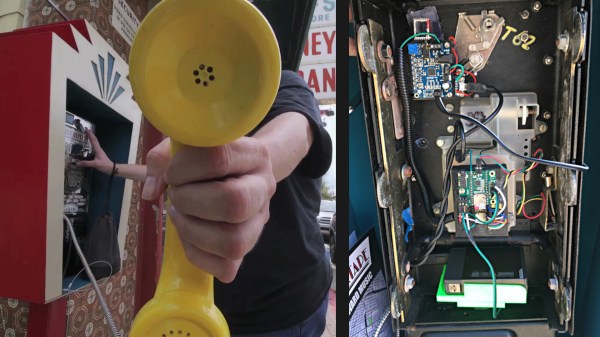
Australia’s payphones are an iconic part of the national landscape, even if they’re not as important as they once used to be. However, they’re having a resurgence of late, in part thanks to a new national pastime—the sport of Payphone Tag!

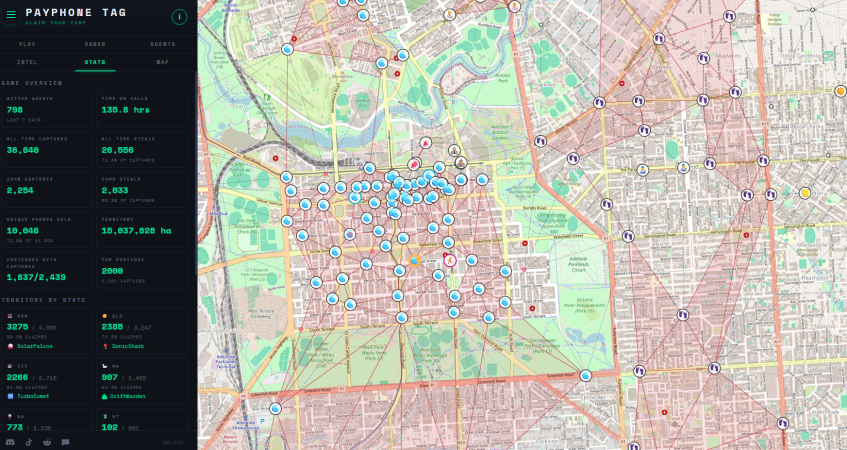
Created by [Alex Allchin], the game is simple. To play, you first sign up on the website and get your emoji and 5-digit PIN. You then go out and find a payphone, dial the Payphone Tag number, and enter your PIN when prompted. This lets you “capture” the phone, raising your score in the game. If a phone is already captured, no matter—just head out there, dial the number, and key in your own PIN to steal it. You can also push your score even higher by capturing three payphones in a triangle on the map to get bonus points.

It’s a fun geospatial game that’s also free to play, because Telstra made payphone calls free back in 2022. It might cost you a bit to get out to some phones, but there are plenty you can reach with the aid of free public transport at the moment, anyway. Protip—at the time of writing, there are a ton of easy captures to be had on Kangaroo Island. It might just cost you a pretty penny to get out there. Have at it!

We’d love to see some stats from Telstra as to whether this is making a dent in overall payphone usage rates. In any case, there were 800 players in the last 7 days and a full 36,640 captures so far, so a lot is happening out there. We fully expect to see this concept spread to other nations in turn, though it might be less attractive in places where you still need to dig out a coin to make a call.

We’ve featured a few payphone hacks over the years. If you’re doing something rad with these telecommunication devices of yesteryear, we’d love to hear about it on the tipsline.

Acoustic Coupling Like It’s 1985

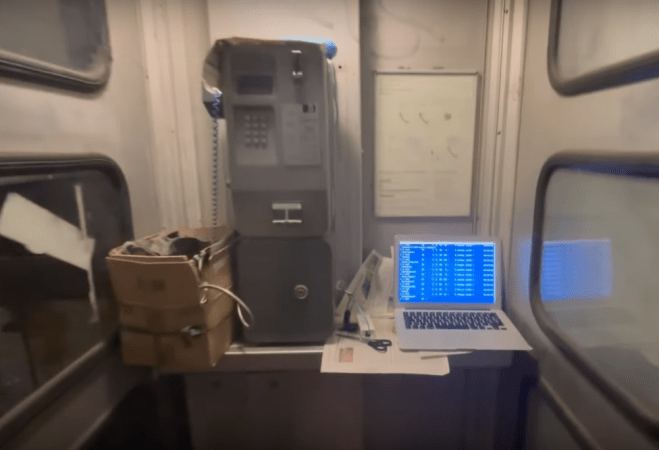
Before the days of mobile broadband, and before broadband itself even, there was a time where Internet access was provided by phone lines. To get onto a BBS or chat on ICQ required dialing a phone number and accoustically coupling a computer to the phone system. The digital data transmitted as audio didn’t have a lot of bandwidth by today’s standards but it was revolutionary for the time. [Nino] is taking us back to that era by using a serial modem at his house and a device that can communicate to it through any phone, including a public pay phone.

As someone in the present time can imagine, a huge challenge of this project wasn’t technical. Simply finding a working public phone in an era of smartphones was a major hurdle, and at one point involved accidentally upsetting local drug dealers. Eventually [Nino] finds a working pay phone that takes more than one type of coin and isn’t in a loud place where he can duct tape the receiver to his home brew modem and connect back to his computer in his house over the phone line like it’s 1994 again.

Of course with an analog connection like this on old, public hardware there were bound to be a few other issues as well. There were some quirks with the modems including them not hanging up properly and not processing commands quickly enough. [Nino] surmises that something like this hasn’t been done in 20 years, and while this might be true for pay phones we have seen other projects that use VoIP systems at desk phones to accomplish a similar task.

Continue reading “Acoustic Coupling Like It’s 1985”

NYC Hangs Up Its Last Pay Phone

It was a melancholy Monday this week in the Big Apple as the last public payphone was uprooted from midtown Manhattan near Times Square and hauled away like so much garbage. That oughta be in a museum, you’re thinking, if you’re anything like us. Don’t worry; that’s exactly where the pair is headed.

This all started in 2014 when mayor de Blasio pledged to move the concept of street-level public utility into the future. Since then, NYC’s payphones have been systematically replaced with roughly 2,000 Link Wi-Fi kiosks that provide free domestic phone calls, device charging, and of course, Internet access. They also give weather, transit updates, and neighborhood news.

There are still a few private payphones around the city, so Superman still has places to change, and Bill and Ted can continue to come home. But if you need to make a phone call and have nowhere to turn, a Link kiosk is the way to go.

Although your Cap’n Crunch whistle hasn’t worked in decades, it’s still a sad day in history for the Jolly Wrencher, whose maiden message was about ye olde red boxen. We’re already seeing pay phones live on as art, so that’s a good sign.

Images via PIX11 and CBS News

TréPhonos Calls Up History In Houston

Houston’s historic third ward, aka “The Tre,” is ripe rife with history, and some of that history is digitally preserved and accessible through an art installation in the form of repurposed payphones. We love payphones for obvious reasons and seeing them alive and kicking warms our hearts. Packing them with local history checks even more boxes. Twenty-four people collaborated to rebuild the three phones which can be seen in the video after the break, including three visual artists, three ambassadors, and eighteen residents who put their efforts into making the phones relevant not only to the ward but specifically to the neighborhood. One phone plays sound clips from musicians who lived or still live in the ward, another phone has spoken word stories, and the third has field recordings from significant locations in The Tre.

Each phone is powered by a solar cell and a USB battery pack connected to a Teensy with an audio adapter board, and a 20 watt amplifier. Buttons 1-9 play back recorded messages exclusive to each phone, star will record a message, and zero will play back the user-recorded message. Apps for smart phones are easy for young folks to figure out but the payphones ensure that these time capsules can be appreciated by people of any age, regardless of how tech savvy they are and that is wise as well as attractive. The coin return lever and coin slot also have associated sound clips unlike regular payphones so the artists get extra credit.

Did we say that we love payphones? Yes, yes we did. The very first post on Hackday was for a redbox and that got the ball rolling.

Continue reading “TréPhonos Calls Up History In Houston”