
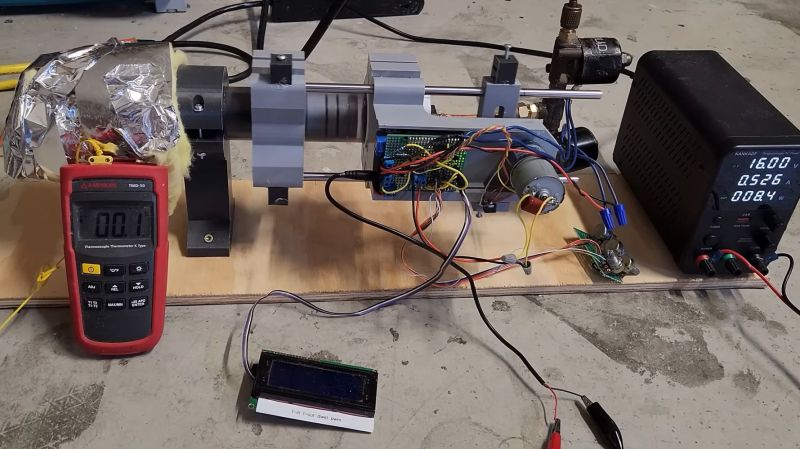
Although cryocoolers are capable of pretty impressive cooling, for many of them the underlying working principle is simple enough that you do not need any special skills or a big budget to make your own version. Take the Gifford-McMahon cryocooler for example, which works using nothing more than some kind of coolant gas and a piston in a cylinder that you can even 3D print, as demonstrated by [Hyperspace Pirate] in a recent video.
The lowest temperature reached across the two prototypes was only -84°C, but this was mostly due to some sub-optimal design choices, such as the use of regular air and a clear acrylic tube to get a good glimpse at the inner workings. The trickiest part of this type of cryocooler is probably that you need to move the piston containing the regenerator between both ends of the cylinder to get a cool and a hot side.
That particular problem was solved by using magnets to move the piston externally, which worked beautifully until the problem of using regular compressed air from the shop compressor caused massive ice formation that jammed up the piston. Obviously this was not an unexpected issue, and for the next step the coolant gas will be replaced by helium, as making that gas freeze up requires quite a bit more effort.











Would it be practical to have a smaller tube and make the pressure swing using a roller pump? Point being, you would have a short length of tube that you squeeze to increase the pressure and release to drop it suddenly. Closing the tube at the free end would create a sealed system without sliding piston rings. Or maybe some other kind of mechanical bellows pump.
The pressure swing would be relatively small, so the cooling capacity would be low, but then you would simply run it faster.
Today is a GOOD day! A few days (or was it weeks?!) back I said I’m looking forward to the first ever positive Dude post, without him trashing the idea presented in the post. Now here it is! Thank you for your attention to this matter, Jan_W :)
If you wish to see an actual trashing, consider the following quote:
“Great minds discuss ideas; average minds discuss events; small minds discuss people.”
Good news, i’m a great mind.
You do seem to lack a certain understanding of the underlying ‘philosophy’ of Hackaday, so here’s a quote for you to consider:
“Apes don’t read Philosophy”
“Yes they do. They just don’t understand it.”
It’s funny how people who try to appeal to social constructs or contracts as an argument, always seem to be defining them very unilaterally. It’s a roundabout way of telling the opponent to buzz off by defining them as an outsider to the group.
Btw. continuing this discussion just further demonstrates how talking about people turns into irrelevant noise. This is not going anywhere because the fundamental point is that you don’t like me, and I don’t mind.
Next you’ll be accusing me of being a Sociologist :)
I’ve asked an AI tool to vibe code a chrome extension that can hide or summarise comments on hackaday and will see what it produces.
Please don’t blindly run this as it is entirely vibe coded but it works for me: https://github.com/CampGareth/hackaday-comment-hider
Next building plan : quantum computer 😄👍
I like the way this is laid out and it is a tremendous explanation of the GM refrigeration idea…but a couple of caveats (big surprise, right?):
The working fluid (refrigerant) in any system ( air in this case), absolutely has to be as completely dry as is possible or frost formation will become a problem sooner rather than later. What has been demonstrated with the several variations is not only the capacity of different prototype sizes, but the certainty of the systems failing at an (approximately) similar temperature. This can be avoided with desiccants or other methods in the refrigerant charge.
The line between a GM and Stirling cryocooler is being blurred here with the external magnetic drive similar to the HF regenerator movement in a Stirling unit. Why not go all the way or at least look into higher speed drives?
Here is the patent on the air-powered Welch cryo refrigerator referenced in the video.
https://patents.google.com/patent/US2966035A/un
With all of that I love the idea and how this is progressing – I hope [Hyperspace Pirate] keeps going with it and keeps posting the results.
You could reduce icing and oil contamination from the shop compresser by running the air througha charcoal bed followed by a Drierite bed in a tube. CO2 is probably your next problem, but if you get to that point, N2 or Ar will be cheaper and good enough, even if there were not a world He shortage right now.
Robin has a point. Why waste helium if something else will work?
Aside: I’m really looking forward to the time when party balloons will be filled with hydrogen.