
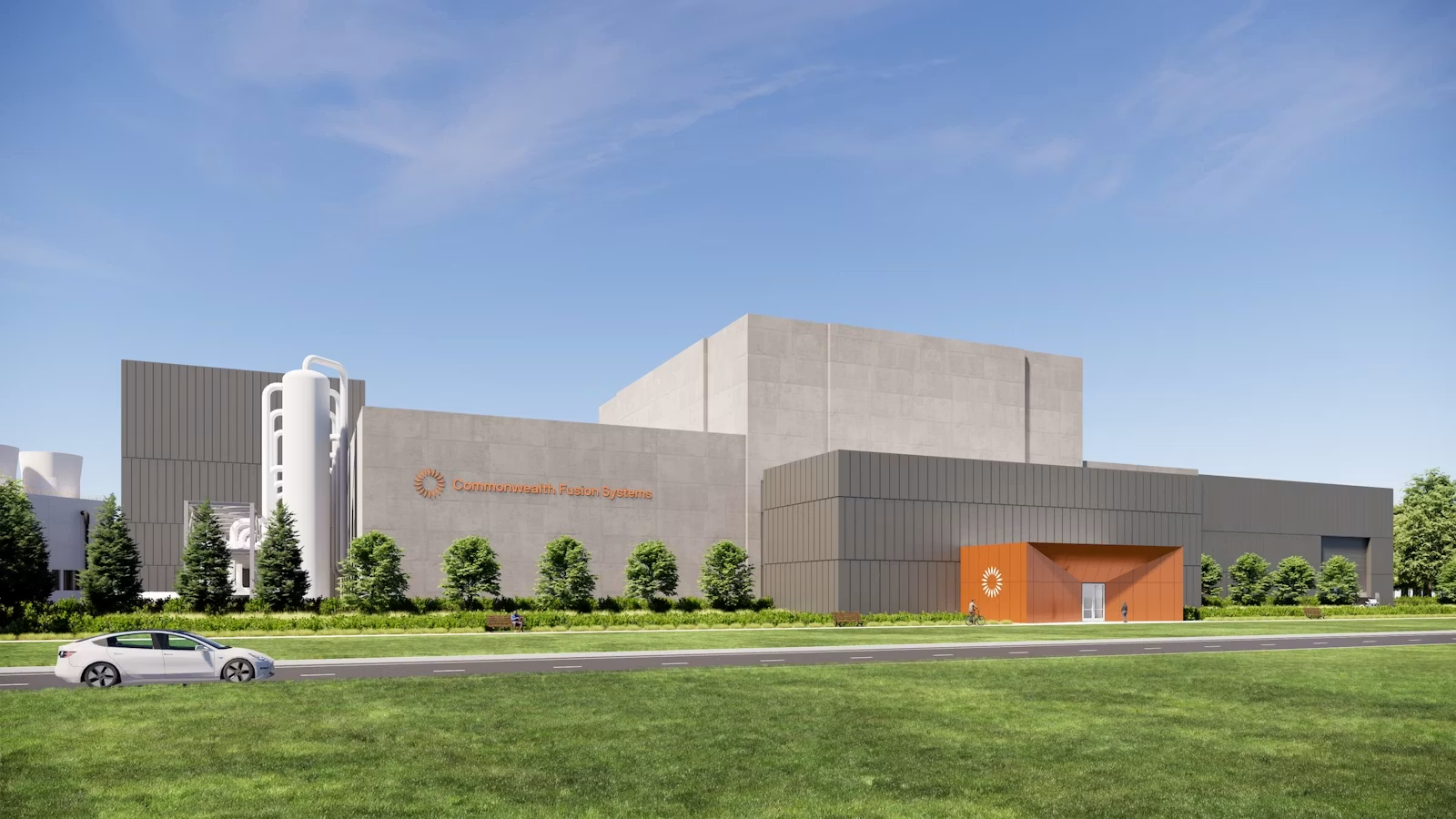
Whenever the topic of fusion power comes up, someone will say it’s only 10 years away from commercialization in an excited tone, and someone older or more cynical will point out that it’s been 10 years away since Eisenhower was president. So it’s with a certain-sized crystal of sodium chloride that we share the news here that the US-based Commonwealth Fusion Systems is applying to feed 400MWe into the grid there by the early 2030s.
The early 2030s is, notably, less than ten years from now.
Commonwealth Fusion Systems isn’t a bunch of nobodies out to suck up venture capital; they’re a talented group of researchers from MIT’s well-known plasma laboratory out to suck up lots of venture capital and hopefully build reactors along the way. So far, the second part is going better than the first: they’ve raised a couple billion dollars, which has let them make great strides in building their SPARC reactor– like crafting the big magnet we told you about in 2021. As that article describes, SPARC is the precursor to the later, larger ARC reactor they hope to hook to the grid in slightly under a decade. Alas, SPARC remains under construction as of this writing. ARC is evidently in the final planning stages, with a physical location determined and grid-tie applied for at the “Fall Line Fusion Power Station” in Virginia.
CFS’s reactors are of the Tokamak type that has been favoured at universities since the 1970s. From China to Europe’s ITER who are also planning to produce power before another decade passes— though not, notably, into a power grid. While promising, Tokamaks aren’t the only game in town, either– steampunk startup General Fusion started making plasma last year, though while if it works it has some big advantages, that one is probably the traditional “ten years away” still.
What do you think? Will fusion power be in the grid before humans make it back to the moon? Add the flying-car potential of eVTOL and we might finally get close to the future we were promised.









SPARC, huh?
It’s a RISC-y investment, to be sure.
I got this joke! (I work for CFS but used wrote hundreds of articles about Sun Microsystems in my previous career as a journalist.)
Well it’s their “second Sun” project
In a 2023 podcast (http://alternativlos.org/51/ in German) the project leader of the German Wendelstein 7-X stellarator was asked how fast one could build a working fusion rector if one throws enough money at it. His answer was “5 years”.
AFAIR He thinks there are no unsolvable technical problems at the moment and if they find new problems they will solve them.
Once the first fusion power plant is working nobody will care if it was a few years and a factor over budget.
I once saw a graph of funding vs expected time before commercial fusion. It held constant at “never” for funding levels at to significantly higher than they were at the time and then got dramatically shorter.
polywell wanted to yolo it too with a full size reactor. of course their reactor would have been a lot cheaper than a stellarator. instead we got 10 years of computer simulations.
The problem with asking scientific project leaders is that they massively underestimate the logistics issues. The technical problems with generating plasma and maintaining it: there’s a ton of research into that. The radioactive material handling, breeder blanket management and tritium production? Yeah, much less so.
Turns out that applying for a spot on the grid is one of those things you also have to do along with the science. (I work for CFS.) We have a mature teams for supply chain, materials, etc.; a running magnet factory; and many engineers working on the practical aspects of delivering fusion energy. You’re absolutely right that a lot has to be done beyond the science, but we’ve been looking past the core science for years.
Oh, I’m just referring to the “throw enough money at it and we can do it in 5 years” – logistics (and regulatory!) issues are very often impervious to the amount of money you throw at them. Keep in mind that comment was from 2023 – I don’t think any amount of money thrown at fusion would’ve gotten a reactor by 2028.
I mean, the SPARC design was what, late 2010s if memory serves? Going from initial design to actual construction in under 10 years for a project of that scale is anything but slow.
Who knows maybe they will. I am really cynical about MIT commercialization lately. I’ve seen so many things where the school spins out a company. On paper it sounds great. Then you interact with it, or the people doing it, and it’s slimier than your average VC funded fly-by-nighter.
I get that schools want to make money, but it also perverts what schools and research are for. If the goal of research is to make money then let’s accelerate it. MIT should become a military contractor that does mass surveillance under the guise of social media, and perfect the cigarette. Keep having the students pay if course.
id rather schools fund fusion reactors than sociology departments. hard science for the win.
Funding a reactor is cool with me too. But the asymmetrical power relationship between grad students working for a company through a university and say a full time advanced researcher is insane. We are talking 30k a yr working 70-80hr weeks vs 300k a year working 45-50. Also you might do a lot of work you cannot publish because it’s a companies IP and you have to publish to graduate. I’ve heard horror stories about this. People living out of their car to work the same job someone who has a mansion works in the same rooms.
Interesting take.
I worked as an undergrad researcher nominally doing same work as professional researchers on the bench next to me. I had a job with flexible hours and some extra gas and date night money. Was paid a bit over minimum wage and that was fine with me. When I graduated they hired me on the spot, gave me a raise and full benefits. Was probably still getting half of some of the other PhD staff, but again paid my rent on my own with a bit left over. It didn’t feel like exploitation even though I worked about 2-3x more hours when I went full time (~20hrs a week to 80+). That got old and I moved on.
Grad students get to pick their PI and project. Since they are doing it, they (like me) are clearly getting something out of that they see as beneficial. I’m not saying there aren’t predatory grad programs (specifically foreign grad students are very exploited and I’ve personally witnessed that) but I personally had no problems with the relationships and pay etc I’ve had over the years. And if I did, I walked.
Amen to that
MIT seems to excel at press releases if nothing else these days, I’ve seen so many groundbreaking technology stories coming out of MIT or spin-offs from MIT that get picked up by all the usual sci/tech reporters and repeated verbatim.
I’m sure MIT is full of smart people doing cool things but they do seem to be very quick to toot their own horn quite loudly.
Let me know when they actually HAVE something to plug in. Submitting applications is not the hard part.
Submitting applications isn’t the hardest part, but it is hard — lots of engineering and modeling work that goes far beyond just filling out a form — and you have to do it well in advance if you want to get your power plant on the grid on time. It takes about 4–6 years between application and power plant on the grid. (I work for CFS.)
Obviously, we have plenty of other work to do as well. We’re about 3/4 done building our fusion demonstration machine, SPARC, and expect to turn it on next year. (It won’t generate electricity, if that’s your threshold for checking back in, but I think many steps on the path to net electricity are pretty important, too.)
Hey, eventually one of those “15 years from plugging your electric razor into a fusion reactor” predictions has to be the one that is actually correct. Don’t succumb to cynicism completely
No mention of the W7X? They’ve been smashing records all over the place, from plasma time to confinement time without resorting to pulsed fusion.
The W7-X is a plasma research device: it can’t actually burn anything (it wasn’t designed for actual fusion). Making it so that it’s compatible with a tritium-burning plasma takes research which is still ongoing. Long-term it could be a better approach, but a lot of the tokamak design and technology is more mature.
Also, the entire point of the ARC design was that high temp superconductors are mature and available enough now that you can build smaller scale tokamaks and iterate faster. It’s a little harder to iterate faster with stellarators because the magnets are so integral to the design (W7-X made this a lot easier, though).
This isn’t trying to dismiss stellarators at all: the equivalent of CFS for stellarators is Proxima Fusion, and their timeline is a little behind CFS’s.
It has literally done fusion already in 2023. Being a research device doesn’t matter. ALL the fusion reactors that exist are research devices.
I’m not so sure that iteration will buy anything on a class of reactor that has the fundamental handicap of being unable to perform continuous fusion.
Sigh, I hate fusion media stuff.
W7X has never fused anything. It’s plasma physics. It has no mechanism to inject D-T into the plasma.
I don’t know what you’re thinking of, but it wasn’t that. In 2023 they entered the third phase where they pushed the triple product higher. Actually fusing things requires injecting D/T, and doing that is expensive (tritium is megabucks).
It’s not a knock on W7X that they didn’t fuse anything. Again, it’s a plasma machine, it’s entire point was plasma science.
There is small canadian startup that aims to accomplish similar goals with what looks like Z-pinch variant using rather genius ideas how to tame inevitable spillover of the Xray bursts. The scale of the project is nimble in comparison, but if they manage to make it modular (they aim to have entire enchilada to be compact enough to be hauled around on average rental truck), then we have a clear winner on a smaller budget.
I don’t want to see ANOTHER mega-project needing mega-managers with their mega-salaries and mega-bureaucracy that usually mega-accompanies both. I want to see municipal level reactor that stays put and works safely until the fuel runs out, period. Simple and reliable enough so any municipality can afford owning few dozens, placed strategically where they are needed, and replaced with better/later versions once fuel runs out. Low maintenance, reliable, simple.
Small, simple, low maintenance, cheap, reliable fusion.
I have no doubt that some mega-company (or government entity?) will buy the technology and kill it.
That type of energy has the power to change society (pun intended). Which is not what the NWO wants….
We have that already with solar, and they also don’t like it.
im still curious if that will be long term sustainable. the entire life cycle needs to be considered. what happens when all the current installations reach their mtbf. will we have panel recycling solved by then? will we have new cell chemistries with a wider bandgap? will we ever get low cost solar coatings that we can apply to every surface that faces sunlight? i suspect solar technology will solve its problems and improve with use. but that doesn’t mean we need to put all our eggs in one basket.
Exactly. That’s why I am omitting the name and hope Carney keeps it away from the deadly clutches of the US corporations (not an easy task, btw).
Z-Pinch is not exactly user-friendly approach either, it needs ungodly amount of power to ignite, but once ignited, one of the well-researched working prototypes were known to run safely mostly unguarded, as the moment they go out of alignment, the reaction extinguishes itself safely, no byproducts to shoot all around, no meltdowns, etc. One particular working prototype uses boron as fuel, so no need to mine and refine radioactive things for fuel that military prefers, and their enchilada is the size of a regular fridge with extras (it still needs proper infrastructure, control, etc). What stopped these things from proper scaling up was the government’s propensity to finance the most gargantuan kind that attract hordes of bureaucrats to regulate/overview, and I recall their stated annual budget for one project was under 50 mils, which was what most municipalities in the US could afford quite easily, if they wanted to (this is part-time R&D budget that would include engineer’s salaries, etc).
But we’ll see what comes out of this alltogether. I’d very much find myself mistaking, and see this project delivering as promised. I’d also very much see both mentioned projects succeed and deliver two viable solutions (and two paths forward) at the same time.
I’m one of the cynical older guys referred to in the post. For a long time my doubts came from the massive technical issues arrayed around fusion. But a year or so back I ran across a series of articles that switched the argument against fusion power in another direction. The argument is quite simple; even if fusion power ever happens it will be too expensive to attract any investment (this discounts massive government subsidies like nuclear, but the consumer is still paying the bill for that path).
Think about it. Fusion requires superconducting magnets, ultra high vacuum, powerful RF sources to ionize the plasma. Very expensive. Now look at solar. Put up a bunch of panels on a rack and wire in an inverter. It’s all solid state, very low repair or maintenance issues. And you don’t need highly paid plasma physicists, talented engineers and specialized technicians to run solar power.
With the cost difference between a potential new fusion plant and a bunch of solar panels no sane bank is going to lend money to build a fusion plant. The bank does not care one bit how the electricity is being made, they just want a good return on the money that they lend. If a herd of gerbils can make the cheapest power that is were the money will flow.
Cheers.
Great, now factor in the cost to STORE the solar energy which you conveniently omitted. Then get back to us on the required necessary investment.
Batteries are getting cheaper by the day. Nuclear is getting more and more expensive. Fusion will be even more expensive if it ever happens.
Look into it because it is true.
The common myth is that a bunch of greenpeace hippies protesting stopped nuclear power. Or the accident at Three Mile Island did it. The actual story is that investors stopped investing in it. As usual, to learn the real story you need to follow the money.
For one example China now supplies about 1/4 of all of it’s energy with solar and wind. They are doing this because it is the cheapest source of energy.
It is funny how people get so upset when their dreams of fusion power as a source of limitless energy are questioned. If solar and wind can supply much of our needed energy, what exactly is the problem?
Cheers.
And why? Because the public opposition and the high bureaucracy was risking their returns.
For instance, under the LNT/ALARA rules, you have to limit the risk of potential leaks of radioactivity and public exposure as low as reasonably achievable even after the risk becomes low enough to be meaningless.
To compare to the rest of the industry, even including other industries that handle radioactive materials, the rules for the nuclear power industry are like what mandatory walking helmets are to road safety.
It means adding more and more safety measures until you run out of money. If someone figures out a way to make it cheaper, that just means you must add even more safety measures because you can now reasonably add more. In other words, it’s an automatic bureaucratic ratchet to keep the costs from coming down by demanding the impossible.
I’d agree with what you are saying. The slow death of nuclear power is more complicated than a few lines of cynical explanation. And I have no inclination to go down the rabbit hole of finding out exactly why nuclear power is loosing despite significant government support for all of its history.
In any case it doesn’t make any difference. Right now solar and wind are cheaper than all the other alternatives. And the result is that it is being installed at a tremendous rate. For me, the climate emergency is actually a real emergency. Nuclear just can’t respond quickly enough and fusion is currently imaginary energy source despite what ever is being written on this page.*
Solar is winning because it is real. Texas, the most solar resistant state in the Union is fighting a loosing battle to stop solar. In 2020 solar supplied 2% of Texas. Today it is up to 14%. Doesn’t sound like the pro-oil legislators are winning that battle.
Cheers.
If you want to read about another fusion bottleneck this article from Science magazine points out that the fuel for fusion reactors is in short supply even before any “breakeven” fusion reactor has started up.
https://www.science.org/content/article/fusion-power-may-run-fuel-even-gets-started?utm_campaign=SciMag&utm_source=Twitter&utm_medium=ownedSocial
And all the ITER experiments to explore tritium breeding have been canceled due to funding shortages.
solar and wind are cheaper if you live somewhere sunny and windy. the california colored glasses problem. germany has had nothing but problems switching from nuclear to renewables.
Nuclear power is a net taxpayer. It pays more to the government in taxes collected on the sale of electricity than the government pays in subsidies to the industry. The nuclear industry is also forced to pay into a decommissioning and waste disposal fund that the government keeps, but refuses to spend for the intended purpose.
The opposition claims otherwise, but they’re counting the Manhattan project as a subsidy for nuclear power AND counting loan guarantees and insurance backing as already paid subsidies, when such guarantees simply reduce the risks and overheads paid by the company. In other words, it’s counting the money they save and costs they avoid as a subsidy paid by the government.
ITER is an international boondoggle. It was built to suck up funding and people from the field.
“And all the ITER experiments to explore tritium breeding have been canceled due to funding shortages.”
What the heck are you talking about? The TBM program hasn’t been cancelled. I mean, there was just an award put out for construction related to it a few months ago.
You haven’t stumbled upon some great mistake no one’s thought about. All of the actual fusion reactor company plans include breeder blankets.
Apparently there has been a re-evaluation of radiation exposure thresholds that should make it cheaper to build new reactors.
The safety thresholds are still the same as before, it’s just that they dropped the requirement to reach for absolute zero radiation emissions/exposure below the established limits.
Even tho, both panels and accumulators are here. Now. Especially when we “need” the power for stuff like cryptocurrency and AI. One you need to warm up the planet and the other to then buy property in polar regions.
Solar is great where it works and is consistent, but for it to be your only supply of power requires batteries or an alternate energy store (Salt was used successfully recently), or hydro electric. if you don’t have the height for hydro, or are looking at a smaller scale, it’s usually batteries. In that case you have a dependency on the supply of materials to make them and the countries that have those materials to sell them to you. For some countries that could be considered a risk they aren’t prepared to take at any serious scale. On a much smaller scale I completely agree with you as evidenced by the 60KwH of batteries sat behind me and the roof covered in solar panels
i suspect what will happen are the big expensive machines will be successful enough to be used in first world countries, but it wont be the global game changer we hope for. however this will give us the knowledge we need to pursue cheaper fusion down the line. breakeven isn’t the endgame, its the beginning.
cool stuff doesn’t happen until we improve containment enough that we can handle the aneutronic fuels. some of those reactors can be made quite small.
You don’t need highly paid plasma physicists to run a fusion reactor, they will have very small staff numbers and be routinely run by AGI and robotics. AI is already in the loop for real-time plasma control.
Cool, now we need TWO technologies that are perpetually ten years away.
Technically solar power comes from fusion ;)
Solar (and the amount of batteries involved (which would completely deplete Earth of rare earths btw)) is a manufacturing and sales scheme. It’s not real policy or scalable solutions.
And hippies did in fact sabotage nuclear. We could have solved climate change and all that junk half a century ago. Morons ruined that for everybody. Three mile island was a complete irrelevancy.
The hippies were just useful idiots, bought and paid for by the coal industry.
I’ve had a thought for awhile that maybe a Hackaday genius could help with.
Why couldn’t we do continuous fusion by running it like a particle accelerator with a stream going in to something like a cyclotron to get started then going into the modern magnetic machine and spiraling outward as it accelerates, then at the end while its going so fast it goes through a pinch then crashes directly into a water cooled target that breeds fuel, heats the water for power generation and prevents neutrons from damaging the main machine since they should primarily head in the direction of the flow.
You likely could, but it would use more energy then it would produce. That’s the main issue with fusion energy. Making fusion isn’t that hard (you could do it at home) making it energy positive is the difficulty part.
“it would use more energy then it would produce”. that bit applies to all current fusion reactors. one advantage of icf is you dont require the super conductors and all the associated cryo gear. now you use an accelerator that requires super conductors and all the associated cryo gear. icf can be initiated with a light gas gun if you really wanted (this would actually be useful as a rocket engine, initiating targets in a magnetic nozzel, you dont need breakeven for rockets).
Several problems. A particle accelerator isn’t as efficient as you might hope it to be. Even with superconducting resonators, the coupling factor between particle beam and applied field is small. While the superconducting resonators have extremely high Q factors (better than your average quartz crystal — millions), the loss is in fact nonzero, even for the best materials (spun and electropolished Nb I believe is the standard, or related alloys). The beam is really tiny, very little charge per bunch, even in the highest intensity accelerators. So, even with the high Q, a lot of power is lost to transmission through the resonators; and exponentially moreso to the cryocoolers.
Incidentally, a superconductor is only “super” at DC (though in a sense not even, for type II’s that have hysteresis loss (“flux pinning”) even at DC). The fact that a superconductor does not become a perfect 100% mirror at optical frequencies, when cooled below the transition temperature, is a sufficient condition to conclude that, somewhere between DC and light, the resistance rises (while going through some phase shift along the slopes). Where it rises (or whether it has peaks or valleys inbetween) is the real question. So it’s not surprising that superconductors do have AC loss; getting that first cutoff frequency high enough (so that the tan delta is low enough at the chosen frequency) is the real question. (Achieving ppm’s at ~800MHz, implies a cutoff frequency maybe in the THz; which probably tracks with the binding energy of Cooper pairs?)
It might well be that a higher density beam can be more efficient — offhand I don’t know the math behind luminosity and density and coupling and all of that. The self-repulsion within a bunch will limit luminosity, however. Obviously it’s not a regime of importance for fine technical applications (atom smashers) but whether it holds commercial value is another matter.
There’s also linac vs. circlotron (classical velocity) vs. synchrotron (relativistic). I think the resonator problem applies to all of them, but the papers I read years ago about resonators were probably installed in synchrotrons?
Fusion doesn’t need that kind of energy, it starts in the 10s keV and goes up from there, and versus a proton’s near-1GeV rest mass energy, that’s safely classical. But you can’t guarantee collisions, and even when collisions occur, fusion is a low cross-section (I don’t know offhand what rate vs. (center-of-mass reference frame) impact energy is, but that would be something to look up). Collisions scatter at all angles, the luminosity is all gone; you can’t just pick up the debris and regroup for another go. After braking against the chamber walls (and some bremsstrahlung and sputtering), they’re basically free gas to be picked up and removed by the vacuum pumps. If you do a scheme like two intersecting (counter-rotating) beams, particles that miss (which will be most of them) can be recirculated; but you still have the burden of the circulation in the first place, and it’s not lossless (deflection magnets cause some cyclo/synchrotron radiation; at these energies, probably much smaller than the cryocoolers’ loss though).
A single-beam solution, into a static dump (it’s not clear what you mean by “pinch”, maybe just a focus to maximize particle density?), has the problem that 1. most of the particles don’t hit for fusion anyway (see above) and 2. as they scatter, while there are additional opportunities for fusion, the energy level quickly drops and all that excess energy is dissipated as heat (plus you’ve [further] hydrogenated the target; a particle beam is basically the strongest possible Brønsted–Lowry acid).
Even on very small scales, you can’t dodge the problem of thermalization — a small population of particles colliding, quickly exchange energy amongst themselves, and the average energy is much less than the impactor energy. Not that average is needed, we could still ride the upper tail of the energy distribution (Maxwell-Boltzmann statistics, give or take), but the expected peak (at whatever upper percentile cutoff) is still very much lower than the incoming energy was.
Getting peaks high enough isn’t the problem — it’s very easy (relatively speaking) to obtain a detectable neutron flux from a Fusor in ones’ garage. An industrially-important flux, is a very different matter!
So it makes sense, to give in and play the game, and just cook the ever-glowing piss out of it, under whatever kind of confinement you can muster (very strong magnets). So we’ve had a lot of tokamak projects, and related things to try and wrangle the plasma, charge-balance it (or imbalance as the case may be) to play with density and distribution, or to wiggle it around in just such a way as to play the plasma game as well (and plasma is notoriously unstable, being fluid dynamics coupled to a whole additional field). And doing any of it for very long, and getting predictable results (the harder you squeeze, the more forcefully the plasma punches back?), is very difficult. Solvable, but it takes cleverness, time and money, so, we are where we are today, making steady yet uncertain progress.
icf can be done with a particle accelerator as the initiator. though i suspect modern diode pumped lasers would be more efficient. doesnt require superconductors and relevant cryo hardware. its worth noting that the lasers they use at nif are of an older less efficient type.
As people have said, fusion itself is deceptively easy. You can do it in your garage (you shouldn’t, unless you like X-rays).
Harnessing more energy than you put in is the tough part. For decades, the H-bomb was the only thing that could do it, although for several reasons this is considered sub-optimal for power generation (notable outliers: the engineers of Project Orion).
The sad thing is, whichever technology comes first, will likely be the only one used for a century or two. Because who would still invest billions for yet another way, if there’s already one?
Eh.. I think this is too reductive to accurately predict human behavior across centuries.
filing paperwork with a regulatory agency is a far cry from a functional breakeven++ fusion reactor.
No one tweaked to the term “ARC Reactor”?
And don’t kid yourself, the solar industry has had beaucoup gummint subsidies, Musk, Solyndra… I like solar, think it’s wonderful, but subsidies am subsidies.
solar is only a half solution so you need to couple the costs to battery storage. that include the total life cycle. if the panels cant be recycled and the batteries cant be recycled, then you got a finite resource. not against solar, you just have to look at it realistically. subsidies just muddy the waters when comparing energy sources.
“Renewables” is an industry racket, it’s a scheme to sell new hardware, which ironically is pretty polluting. We’ve had the solution since the 1950s.
See also Helion [https://en.wikipedia.org/wiki/Helion_Energy]