
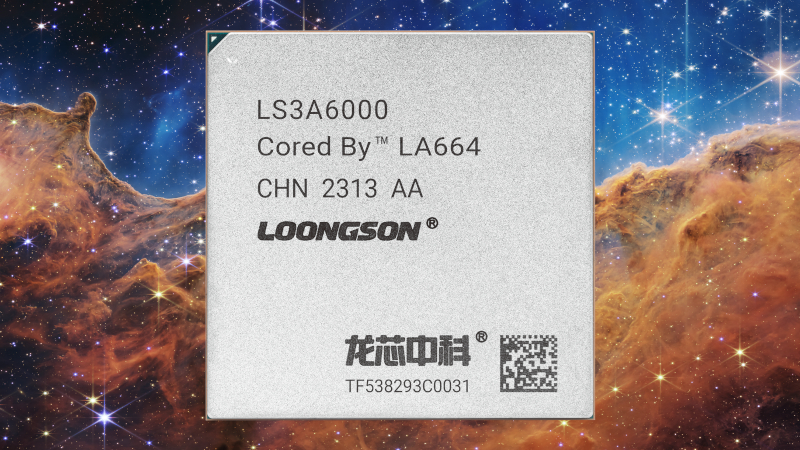
When it comes to PCs, Westerners are most most familiar with x86/x64 processors from Intel and AMD, with Apple Silicon taking up a significant market share, too. However, in China, a relatively new CPU architecture is on the rise. A fabless semiconductor company called Loongson has been producing chips with its LoongArch architecture since 2021. These chips remain rare outside China, but some in the West have been benchmarking them.
[Daniel Lemire] has recently blogged about the performance of the Loongson 3A6000, which debuted in late 2023. The chip was put through a range of simple benchmarking tests, involving float processing and string transcoding operations. [Daniel] compared it to the Intel Xeon Gold 6338 from 2021, noting the Intel chip pretty much performed better across the board. No surprise given its extra clock rate. Meanwhile, the gang over at [Chips and Cheese] ran even more exhaustive tests on the same chip last year. The Loongson was put through typical tasks like compressing archives and encoding video. The outlet came to the conclusion that the chip was a little weaker than older CPUs like AMD’s Zen 2 line and Intel’s 10th generation Core chips. It’s also limited as a four-core chip compared to modern Intel and AMD lines that often start at 6 cores as a minimum.
If you find yourself interested in Loongson’s product, don’t get too excited. They’re not exactly easy to lay your hands on outside of China, and even the company’s own website is difficult to access from beyond those shores. You might try reaching out to Loongson-oriented online communities if you seek such hardware.
Different CPU architectures have perhaps never been more relevant, particularly as we see the x86 stalwarts doing battle with the rise of desktop and laptop ARM processors. If you’ve found something interesting regarding another obscure kind of CPU, don’t hesitate to let the tipsline know!












Remember how
Removed by Redditbroke thousands of Iran’s centrifuges by doing hacking on hardware level? If you connect chinese CPU to your electricity or network connection don’t be surprised if in 10 years all your data is keylogged and available for puchase on Weixin.OK, I’ll bite. And you believe that these CPUs can secretly – and undetectably – somehow transmit information over… power lines.. ? Also – why would anyone be interested in your key logs? I’m assuming you must be quite important for people to bother trying to snoop on your activities. In fact, I’m surprised you’ve taken the time out of your important busy schedule to comment on a Hackaday article.
The CPU’s themselves probably won’t do that, but in order to be able to use them you need a MB, and TPM/etc are more or less ubiquitous, so it would be quite sensible to assume there are remote control functionality.
Whether it’s “better” to give remote access to China vs the US is another question.
There is a school of thought that suggests part of the reason Huawei gear got banned was because the western security services couldn’t hack it.
There is also another school of thought, that Huawei started to produce gear precisely because they could not hack western security
If you’ve had any experience with Chinese companies operating in the West you’ll understand that ever single expat is both an employee and a spy.
Good point, indeed. Are western chips made by, say, intel (US) any safer, though?
Seriously wondering. As far as rumors go, about every US software/device has backdoors and spyware for the three letter agencies.
And that ISPs have mandatory blackboxes connected they have no idea what they’re really doing.
It’s really confusing to figure out who’s the good guy/bad guy considering these (old) stories.
I still remember when Intel had serial number function added into Pentium 3 CPUs.
Gratefully, the European Parliament had intervened at the time.
The US apparently had no issue with it back then, so why should it have now?
https://en.wikipedia.org/wiki/Pentium_III#New_features
I’d be very surprised if the NSA isn’t able to load its own microcode into Intel CPUs. We have photos of them intercepting US hardware, installing backdoors, and shipping it on to customers.
I’ll take my chances with Loonsong. More worried about my own government than the Chinese one.
Intel’s embedded Management Engine has a kill switch for when the machine is ordered for government usage. Shows how much they trust it.
AMD equivalent to Intel ME is “AMD Secure Technology”. It is always running in the background.
Here’s the thing everyone seems to overlook with this though. Install all the covert sneaky data infiltration features in the chip you want. In the end it all still needs to cross the network interface on it’s way back to home base.
If these chips were doing this stuff firewalls will pick it up and flag it.
Motherboards can also snoop network traffic if the on-board NIC is used, even if the computer is “off”.
Some intel chipsets run a custom copy of Minix inside the chipset, for example.
It’s basically a computer in the chipset..
Same ways, the UEFI firmware can run in background and operate behind the operating system’s back.
https://en.wikipedia.org/wiki/Intel_Management_Engine
https://itsfoss.com/fact-intel-minix-case/
https://www.zdnet.com/article/minix-intels-hidden-in-chip-operating-system/
I’m waiting for the day when western and eastern gremlins in our chips fight another directly. Then the only duty we still have is to pay the power bill for that silly war!
Humans just suck!
And in most cases that won’t be a problem – if you are putting in dubiously trustable computers at the edge you are likely putting them in at every stage along the network too.
Plus there are plenty of ways to get data out more directly from the compromised machine – for instance a bit of mesh networking like behaviour out of the inevitably inbuilt Bluetooth or wireless antenna. Your router and network filters don’t matter at all then, and odds are it will be next to impossible to detect as there is so much traffic in those bands, quite likely some of your smartphones will be acting as data smuggling relays without the user even knowing etc.
so we should build multi cpu system with few intels and some chines cpus, lets see who will gets whom :D
i really enjoy how explicit this comment is that we should not trust the chinese supply chain because the western supply chain has been infiltrated by the CIA / Mossad
Hahaha yes, the irony didn’t escape me either
I’m going to say China doesn’t have a license for x86,”x64″. What kind of grey area would it be if it could run native RISC or ARM code and with a tightly bound software x86 layer run code. Then it could be sold worldwide.
I’m curious about the platform this is plugging into.
On the software side with FEX debuting on the Steam Frame are we approaching a nexus where ARM will run older programs well enough for most purposes?
Seperate note, I was on the Framework site and they have RiscV motherboards for their laptop, not sure how I missed it. They hasten to note this is beta/tinkerer level support. But at least it’s a real polished laptop on the hardware side.
The “emulate and run x86_64” was done at least twice – on Transmeta’s CPUs and later with Russian Elbrus (with binary translator).
“…They’re not exactly easy to lay your hands on outside of China…” because why would they care about the rest of the world, if they are just copying what Japan been doing for decades, keeping the latest and greatest local until it expires?
I mean, this makes perfect sense, and is not only expected, but predictable. What will happen next is predictable, too – with THAT many engineers graduating every year (easily trice the number of comparable engineers graduating in the US and Canada combined, oh, wait, Canada is no longer interested in exporting their engineers to the US, my bad), statistically speaking it is just a matter of time until China invents, builds and sells (locally) superior and cheaper processors that will be largely incompatible with anything US-invented. Because it just makes sense, and since they already have their own local fork of Linux, they no longer have a pressing need to look to the rest of the world.
Competition should be heating up, btw, but US companies had long forgotten how to compete with worthy competitors, so they’l’l just pretend it never happened.
so according to comments China= bad, America= good as usual Come on guys move on.The world is not black and white, time to grow up.
Not really, America FORGOT how to compete with worthy competitors (USSR was the last one it still remembers). China said, ha, try me, and US was like “you don’t exist, though, I WILL invest into your high tech”.
You can guess the stupidity of the actions that speak louder than words.
As a juicy historical tidbit, it was the US who invested into pre-WWII Germany the most. Reasons were plenty – one – Haber-Bosch reaction, and I’ll stop at that.
nice try tony mandarin.
I have no trouble going to loongson’s site at all.
Perhaps HaD is using LordNothing internet though.
Addendum: I bet I could order them too if I wanted.
As long as I don’t use UPS of course…
genuinely would like to get my hands on one of these, but havent found a way to import it without it costing an arm and a leg.