
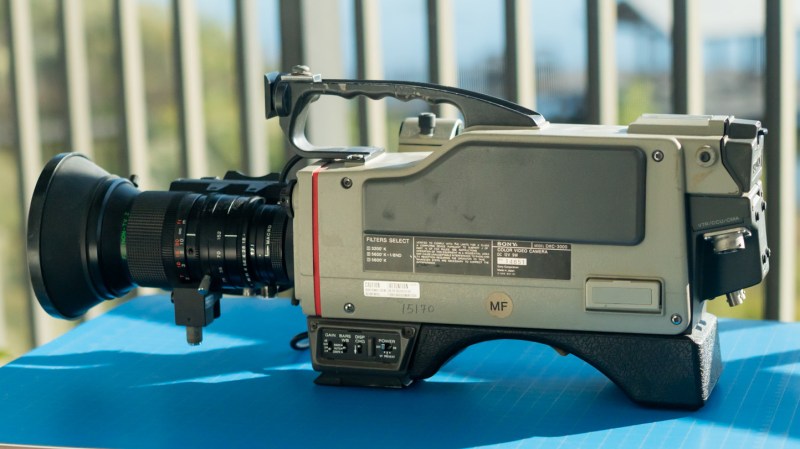
Although it might seem like there was a sudden step change from analog to digital sometime in the late 1900s, it was actually a slow, gradual change from things like record players to iPods or from magnetic tape to hard disk drives. Some of these changes happened slowly within the same piece of hardware, too. Take the Sony DXC-3000A, a broadcast camera from the 1980s. Although it outputs an analog signal, this actually has a discrete pixel CCD sensor capturing video. [Colby] decided to finish the digitization of this camera and converted it to output HDMI instead of the analog signal it was built for.
The analog signals it outputs are those that many of us are familiar with, though: composite video. This was an analog standard that only recently vanished from consumer electronics, and has a bit of a bad reputation that [Colby] thinks is mostly undeserved. But since so many semi-modern things had analog video outputs like these, inspiration was taken from a Wii mod chip that converts these consoles to HDMI. Unfortunately his first trials with one of these had confused colors, but it led him to a related chip which more easily outputted the correct colors. With a new PCB in hand with this chip, a Feather RP2040, and an HDMI port the camera is readily outputting digital video that any modern hardware can receive.
Besides being an interesting build, the project highlights a few other things. First of all, this Sony camera has a complete set of schematics, a manual meant for the end user, and almost complete user serviceability built in by design. In our modern world of planned obsolescence, religious devotion to proprietary software and hardware, and general user-unfriendliness this 1980s design is a breath of fresh air, and perhaps one of the reasons that so many people are converting old analog cameras to digital instead of buying modern equipment.










Possibly a typo…
“sometime in the late 1900s”
Technically correct if by “1900s” you mean “the 20th century” but wouldn’t “in the late 1990s” be less startling?
Cool build, my nitpicking notwithstanding!
Not a typo, just a premeditated act of violence against anyone over the age of 30. 😒
I usually just round it to “late in the last millennium”.
the older M3 camera uses three tubes and can easily be adjusted for 16:9 aspect ratio.
Pretty neat build, though it looks like we still go digital-analog-digital if I understood the article and schematics correctly (?)
The pixel data coming from CCD sensors are already analog, and go through a preamplifier. Unfortunately the analog section is inevitable.
Nice project!
The resulting composite and HDMI pictures are looking very bad compared to the one took with a modern DSLR. The author says that it has not yet re-calibrated the camera, and that calibration is probably off because of aged capacitors. It may be true, but i believe that the poor image quality can be caused by a lack of knowledge of good practices when using a broadcast camera.
A proper white balance must be made on the camera to correspond to the lighting conditions, or at least a default 5600°K “sunlight” temperature should have been set, since it seems it was a sunny day. Here the pictures are looking blueish, so probably the camera was set for a 3200°K studio light setting unsuitable for sun light. Usually broadcast cameras have some switches to either preset white balance to 3200 or 5600°K, or to manually adjust and lock white balance by filming a white sheet of paper under the same lighting conditions than the overall scene.
White level seems to be quite low, or the exposition settings was to low compared to the DSLR picture. On the DSLR picture the light level coming through the blinds and reaching the left wall is fully saturated/clipped, when it seems than on the camera the exposure is set with the same sun light level barely at 1V, maybe less. It could be that a too high neutral filter has been set, and/or lens aperture has been set too closed.
Also a proper black balance/level set since the black level is way too high, so blacks are more or less dark greys, and there’s a lack of contrast. Sometimes there’s also a black balance switch on some cameras, otherwise it is preset by an internal adjustable setting.
I quite sure with proper shooting settings (probably even without a fine camera calibration and/or bad component repair, except if some internal signal is really way off), the overall lighting, contrast and color should be much closer to the DSLR picture, but with a lack of definition due to the SD resolution of this camera.
Those camera can also be controlled by a CCU (Camera Control Unit) with which all luminance/chrominance settings can be dynamically altered.
Also, despite white level is supposed to be no more than 1V in analog, and black no less than 0.3V (0V is sync tip level), in reality analog circuits are able to handle signals overcoming these limits before saturating. So usually you will have higher than 1V levels in high lights part of the picture (for example white clouds in the sky) with visible details in these part of the picture. But in digital domain , for example in 8-bit, 255 will be the absolute maximum level. So you will have to decide at what analog level the maximum 255 digital value will correspond. Theorically it should be 1V, but in this case anything above 1V in the analog signal (which would be visible on a analog TV) will be clipped when converted to digital, and you may loose some fine high light details. You can also choose to lower the overall luminance level by bringing the highest level to 1V, keeping all the luminance details in high lights, but the overall image will be a little darker. So when digitizing an analog picture, you sometimes are loosing some informations compared to the original analog signal.
Also, the Youtube video is still interlaced, when Youtube only support progressive video. It should have been deinterlaced properly before being uploaded to Youtube.
Hi Gerald!
Thank you for the insight. As you noticed, I’m certainly no broadcast video engineer. I did take the setup and “on site” calibration steps outlined by the manual (white balance, black levels, etc.) but you’re correct in noting that I used the 3200K filter (the 5600K image was particularly noisy in the dim, late afternoon when the images were taken).
I didn’t deinterlace the videos because I wanted to avoid as much post-processing as possible for comparison’s sake, but when I actually record useful video I’ll deinterlace it.
Colby
This is how the picture looks like when doing video https://www.youtube.com/watch?v=gzp0f4rzec8
It’s ironic that back then TV cameras contained user servicable parts, while nowadays advanced military aircraft such as the F-35 are (c) Boeing and if one goes wrong on a carrier in the middle of the ocean they’re not allowed to fix it until an authorised engineer is flown out…
There’s a slight difference between large 1980s analog through-hole parts on a 2-layer PCB and the very latest modern stuff where things can be broken by tightening a screw to 2 Nm instead of 1,75 Nm as specified in docs.
Also, if a TV camera fails the worst thing is Oprah won’t get her screen time. If a fighter jet malfunctions it may result in a loss of life or even worse, a bad PR if it was shot down by enemy action.
Indeed, there is a difference. These large 1980s analog through-hole parts on a 2-layer PCB were succesfully used at dangerous places such as Chernobyl site,
whereas that very latest modern stuff not seldomly is such a puny sunshine technology that falls apart by just looking at it,
yet alone stops functioning once temperatures falls below that of frozen water.
No idea what an Oprah is, also. I don’t watch shows about wildlife that often.
As for the F-35.. Never mind. It’s not worth to be talked about, I think.
Video about a robust video camera from the 80s:
https://www.youtube.com/watch?v=mpRR2UUjb8E
“No idea what an Oprah is, also. I don’t watch shows about wildlife that often.”
[as David Attenborough] “Here we see the wild Oprah in its native habitat, the television studio, hunting its prey of attention and ratings…” =))
Interesting project. The Sony DXC range weren’t broadcast cameras, they were professional or as they used to be termed “industrial”. The BVP range were broadcast, but the higher spec DXC cameras had some broadcast rated features like 3 x 2/3 inch tubes or CCD’s like this camera. No doubt some small broadcasters would have used DXC kit though. The output of the CCD’s are analogue and are processed separately before being encoded into a PAL/NTSC composite signal. I can’t remember if the 3000 has the large multi connector at the back which would provide a component output to tap off from. But these separate RGB signals would be good for converting to digital if the Feather RP2040 can process component/RGB analogue inputs. Colours would be better and resolution (only slightly) sharper, but you would then get the best possible pictures from what is at the end of the day, a late 80’s SD 4×3 camera!