
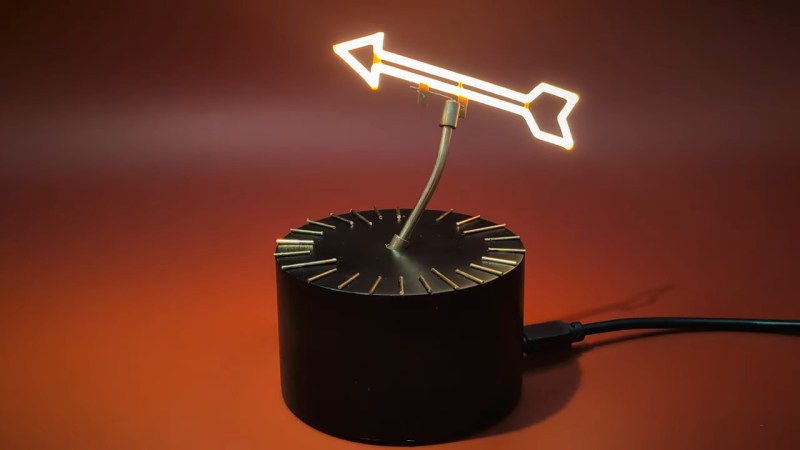
The Dutch word for sundial, zonnewijzer, can be literally translated into “Sun Pointer” according to [illusionmanager] — and he took that literal translation literally, building a reverse sundial so he would always know the precise location of our local star, even when it is occluded by clouds or the rest of the planet.
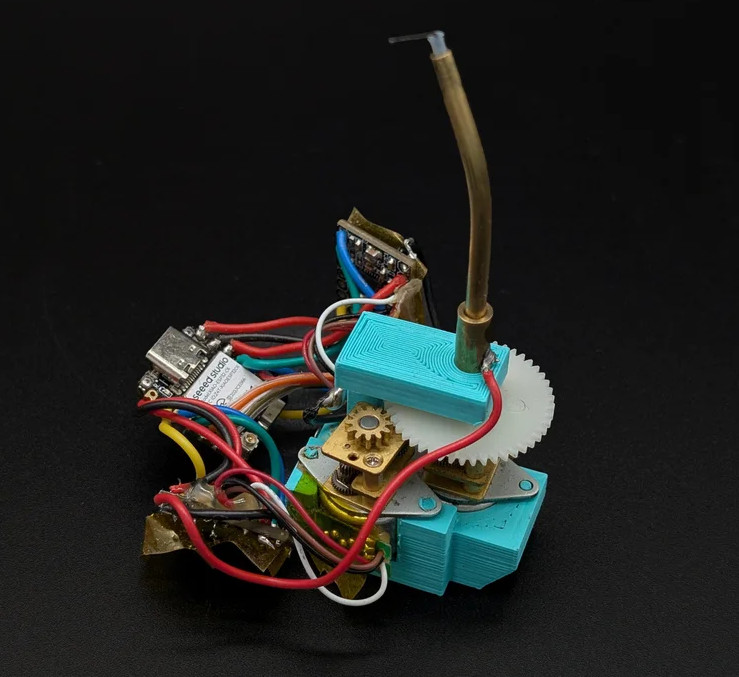 The electronics aren’t hugely complicated: an ESP32 dev board, an RTC board, and a couple of steppers. But the craftsmanship is, as usual for [illusionmanager], impeccable. You might guess that one motor controls the altitude and the other the azimuth of the LED-filament pointer (a neat find from AliExpress), but you’d be wrong.
This is more like an equatorial mount, in that the shaft the arrow spins upon is bent at a 23.5 degree angle. Through that hollow shaft a spring-steel wire connects the arrow to one stepper, to drive it through the day. The second stepper turns the shaft to keep the axis pointed correctly as Earth orbits the sun. See the demo video embedded below for full details.
Either way you can get an arrow that always points at the sun, but this is lot more elegant than an alt-az mount would have been, at the expense of a fiddlier build. Given the existence of the orrery clock we featured from him previously, it’s safe to say that [illusionmanager] is not afraid of a fiddly build. Doing it this way also lets you read the ticks on the base just as you would a real sundial, which takes this from discussion piece to (semi) usable clock.












Really a very nice project, congratulations!
Is there a version available for flat earthers?
I went to a Flat Earth convention in New York City…but it was a scam…..no one from California said..,”Hey I can see my house from here.” 🤣
flat earth or not, it still points exactly to where the sun is. But it uses the formula’s that work perfectly for the non-flat earth as they seem somehow magically work for flat earth as well ;-)
Maybe the next version of this should give elevation too and perhaps also provide a distance, since the earth’s orbit isn’t a perfect circle.
but this version does tell you the elevation of the sun. Perhaps you should watch the video https://www.youtube.com/watch?v=YBoe1sSEhB0 It shows you how the sun moves up and down during the seasons. Distance isn’t very useful, but the software itself does take care of the elliptical orbit (the yearly motor doesn’t rotate the same amount every day because the speed of the earth varies along its orbit)
Awesome build ! The video really shows off the science behind it. Excellent job !
Be sure to check out the educational video https://www.youtube.com/watch?v=YBoe1sSEhB0
I’ve edited the post to embed your video so everyone sees it.
btw Tyler August made an error in his article. The spring-steel wire connected to the arrow takes care of the yearly movement, not the daily rotation. The daily rotation is obviously handled by the main axle that is parallel to the earth axis. The equatorial mount analogy is because of the fact that this main axis is parallel. The 23.4 degree bend takes care of the tilt the earth axis makes with the ecliptic (or the earths orbit)
OK, that sidereal time trick is a bit of genius. I would have brute-forced it and done it all in software, but that way is The One True And Correct Way to do it.
The hardware needs two axis to keep pointing at the sun during the day and during the year. You could have build one motor to go around and one to go up and down, and use software, but my axes have a meaning, which makes it much more interesting and educational. Still it is done in software and may I say, very accurately ;-)