
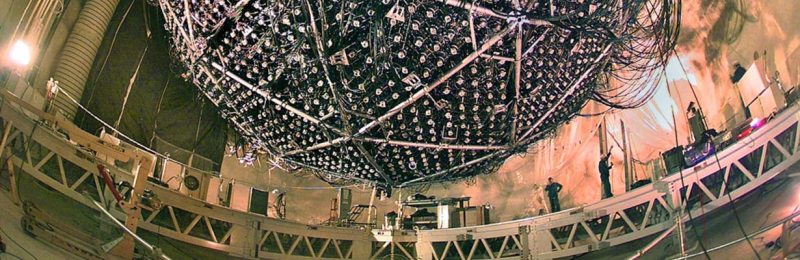
Once upon a time, transmutation of the elements was a really big deal. Alchemists drove their patrons near to bankruptcy chasing the philosopher’s stone to no avail, but at least we got chemistry out of it. Nowadays, anyone with a neutron source can do some spicy transmutation. Or, if you happen to have a twelve meter sphere of liquid scintillator two kilometers underground, you can just wait a few years and let neutrinos do it for you. That’s what apparently happened at SNO+, the experiment formally known as Sudbury Neutrino Observatory, as announced recently.
The scinillator already lights up when struck by neutrinos, much as the heavy water in the original SNO experiment did. It will also light up, with a different energy peak, if a nitrogen-13 atom happens to decay. Except there’s no nitrogen-13 in that tank — it has a half life of about 10 minutes. So whenever a the characteristic scintillation of a neutrino event is followed shortly by a N-13 decay flash, the logical conclusion is that some of the carbon-13 in the liquid scintillator has been transmuted to that particular isotope of nitrogen.
That’s not unexpected; it’s an interaction that’s accounted for in the models. We’ve just never seen it before, because, well. Neutrinos. They’re called “ghost particles” for a reason. Their interaction cross-section is absurdly low, so they are able to pass through matter completely unimpeded most of the time. That’s why the SNO was built 2 KM underground in Sudbury’s Creighton Mine: the neutrinos could reach it, but very few cosmic rays and no surface-level radiation can. “Most of the time” is key here, though: with enough liquid scintillator — SNO+ has 780 tonnes of the stuff — eventually you’re bound to have some collisions.
Capturing this interaction was made even more difficult considering that it requires C-13, not the regular C-12 that the vast majority of the carbon in the scintillator fluid is made of. The abundance of carbon-13 is about 1%, which should hold for the stuff in SNO+ as well since no effort was made to enrich the detector. It’s no wonder that this discovery has taken a few years since SNO+ started in 2022 to gain statistical significance.
The full paper is on ArXiv, if you care to take a gander. We’ve reported on SNO+ before, like when they used pure water to detect reactor neutrinos while they were waiting for the scintillator to be ready. As impressive as it may be, it’s worth noting that SNO is no longer the largest neutrino detector of its kind.












Is that one of the Aperture Science test chambers from Portal 2? :-D
Pure asbestos! Keeps the rats out.
Hah, it looks like it could be! But no, that’s the test chamber, photographed from below at a time when it was drained for maintenence. Normally that space is full of ultra-pure water to shield the detector from the rock. Specifically, the black thing is the isosphere of photomultiplier tubes surrounding the acrylic vessel that holds the liquid scintillator. The metal holding it together was all carefully chosen to be ultra-pure and low-emissions as well: any steel in that thing came from WWI battleships at Scapa Flow to avoid atomic-era contamination.
One of the many reasons Sudbury is beautiful
Underground mines are full of radon. Are they sure they’re not capturing local x-rays confusing them with some “gost p4rticl@z”? XD
Most people in science are actually pretty retarded outside of their narrow scope. They only care about grant money.
Fortunately there were a whole passel of people at SNO whose “narrow scope” was to create a low-radiation environment. Maybe they weren’t all the most well-rounded individuals, they absolutely did create an amazingly low-background environment, which was extensively tested and ground-truthed before any neutrino measurements began. In the 1990s. The ones that resulted in a Nobel prize.
It’s also hardly the first or only low-background lab. Yes, if you are in the wrong rock, radon can be a big problem– but there are ways to seal off from that, and not all rock has equal radon emanations.
John only wants MAGA grant money.
I have background in particle physics. I can easily bet that any physicist that does actual physics — like those at SNO — have done their homework for radon shielding. You probably don’t realize it, but there are quite bright people in the academia.
First sentence, last para, minus ‘in science’, back at ya.
Everybody is ‘tarded about some things, but some people are ‘tarded about all things.
They can be recognized by the fact they are equally confident of their knowledge of all things.
Rarely humble, usually PhD from Autodidact U in ‘All Interesting Things.’
Not to be confused with obnoxious physicists/engineers calling BS because something violates ‘the laws of physics’.
Even if the subject was ‘way outside’ ‘physics’.
And BSer had control of both houses and the presidency.
Could change any GD laws they wanted.
In that case the obnoxious ones were right.
let’s go through the hilariousness:
Why do you think x-rays – which are, y’know, photons – would mimic a neutrino signal?
Why do you think radon decays produce X-rays (they’re alpha emitters)?
but most importantly:
Why in the hell didn’t you just google “SNO radon” and you would’ve immediately been overwhelmed by the bajillion papers talking about the radon assay that they’ve got setup to monitor and measure the radon and other secondary emitters?
Also, your last sentence is flat out hilarious. Don’t talk to theorists. Find people who actually do experiments. The amount of random crap I have to know about is insane. This $#!+ wouldn’t have a prayer of working otherwise.
HaD how was this comment left up
You want your comment deleted? Be best!
Breaking: local commenter complains harshly about publication he reads for free, more at 11
I guess spelling is so important you’ve missed the whole point of this free review! Go buy yourself a subscription somewhere so you can get your spelling right.
ദ്ദി ( ᵔ ᗜ ᵔ )
Creighton not Crieghton
Well, that’s embarrassing.
“I before E except after C, and maybe if there’s an R in-between but sometimes not.”
I can fix the typo, but I can’t fix English orthography.
👍
Obligatory XKCD: https://xkcd.com/2819/
“I before E except after C, or when sounded as A as in neighbor and weigh” is the actual saying. Be best! You fix you.
“like A” is what I actually remember. Be best!
add “weird” and “weir” to that list I think but they are not A sounds…
and what is a KM please?
“why the SNO was built 2 KM underground” I think should have 2km instead so it doesn’t mean two Kelvin million.
thanks
Well spin my nipple nuts and send me Alaska!
‘Universal Tapered Nipple Thread’ (UTNT).
That is clearly, clearly the drive from Event Horizon.
and event horizon is clearly a wh40k prequel.
looks like we figured out what scifi universe we live in.
Beat me to it.
Libera te tutemet ex inferis!
As long as they provide one,ission accomplished. This site has never been hacksaday
While this is great and all, as particle physics experiments get super sophisticated, it sounds to me that they become very difficult to independently replicate and verify. How do we know that this result is truly a detection of transmutation and not just some false positive coupled with wishful thinking?
(I am not doubting the results but just some healthy skepticism on methodology)