
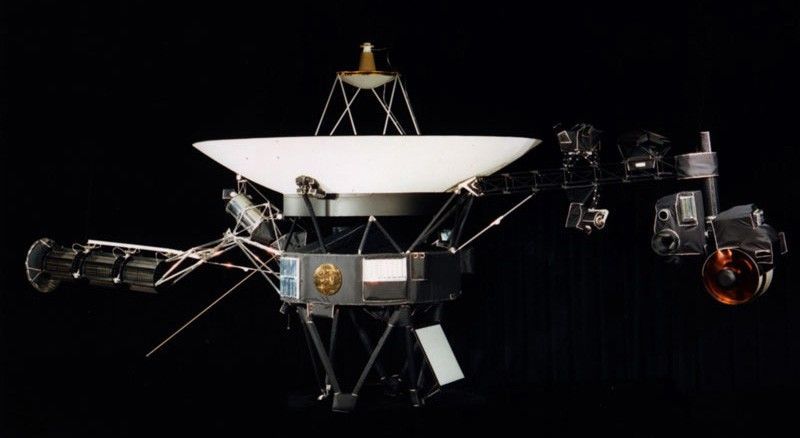
Recently NASA confirmed that the Voyager 1 spacecraft is now one light-day from Earth, taking more than 49 years to reach this point since its launch in 1977. Marring this memorable occasion is the disconcerting discovery that although the spacecraft is still sending a carrier wave back to Earth via the Deep Space Network (DSN), it’s no longer sending science- and engineering data, with the cause still to be determined.
This is reminiscent of the 2023 incident in which Voyager 1 went completely silent aside from the carrier signal, before being coaxed back to life. Following this, a defective flight data system (FDS) RAM chip was remotely diagnosed and bypassed. More recently Voyager 1 went quiet for about two days for an unknown reason, which may be related to this current issue.
With the spacecraft’s radioisotope thermoelectric generators (RTGs) slowly running out of juice, failing RAM chips, and various instances of clogged fuel lines hampering basic orientation controls it’s hard to tell how many more kilometers we’ll get out of Voyager 1 or its sibling, or whether it’ll make it to the 2030s.
Until we invent faster-than-light space travel, both Voyagers will remain the most distant human-made objects from Earth, as well as our furthest glimpse at what lies beyond this solar system should we ever venture outside it. Or as the ancient Roman poet Virgil once wrote: Sic itur ad astra.












“…as well as our furthest glimpse at what lies beyond this solar system should we ever venture outside it.”
Klingons.
Before Klingons, it was Vulcans, thankfully.
The fact that the craft has lasted SO long is awe-inspiring.
I wonder how easy it would be to match that feat today. On the one hand, our ability to send and receive strong radio signals efficiently has improved, and we can put more computing power and more redundancy within given space and mass constraints.
On the other hand, I’m not sure that we still have the technology to make simpler, slower semiconductors with the larger junctions which are much less susceptible to being damaged by radiation. Absent those we’d need much thicker shielding, necessitating a lot more mass. And even at that, some particles will get through and hit junctions.
I’d be interested to hear from someone who has some experience in this field. Do I have a valid point, or are there other over-riding factors that I’m missing?
There is for example RAD750, a PowerPC chip designed for use in space. There are also techniques and materials for hardening electronics against radiation…
Also there is no reason we can’t use 150-350nm process with larger structures, like 1um or more…
Virtually impossible to match the feat today, unless, of course, the Chinese were doing it and we had to beat them, like the current “MOONBASE!” scramble.
Technologically, there are numerous radiation-hardened processors designed specifically for deep-space missions. The BAE Systems RAD750 is on the JWST, for example. No technology gap there.
However, Plutonium 238 is in short supply, and it’s vital for mission that you can’t solar-power. The Department of Energy has been working for about ten years to bring a new process for its production online, and everything I read seems to indicate that they are on-track for production of 1.5 Kg of the oxide “by 2026”, even a report from 2025 (see https://www.osti.gov/servlets/purl/3024060).
Voyager 1 has 15 kilograms of plutonium 238 oxide on board! That’s about 10 years of production at the targeted 2026 rate!
Dont forget that voyager depended on a “once in a 175 years planet alignment”. Even if we can build the craft, we cannot slingshot it the same way
Yes – though that was spcifically for the “Grand Tour” of all the outer planets. We can generally use Jupiter (which contains more mass than all the other planets combined) much more frequently as a big slingshot, though combining it with of course the Sun (or Saturn, since it is farther out and the heliospheric escape velocity is correspondingly lower) is the best (but the need for a big sunshield is a big constrain)…
Bring back tubes.
Nanoscale Vacuum Electronics: Back to the Future? – NASA Science
You mean like an X band traveling wave tube
The art of radiation-tolerant electroncs has improved since the day of
Voyager’s construction.
The main problems are parasitic junctions: unintentional transistors in the IC, and radiation triggering an intentional junction. Because the wafer base in
most ICs is itself a semiconductor, there are unintentional transistors between
the base and the intentional parts of the IC, and radiation can turn them on,
and then they latch on and use current, possibly blowing out bits of the IC.
Only turning off the chip can reset them.
The old solution for this was silicon on a sapphire base, this was horribly
expensive because of the material, the small market for such chips, and the
difficulty of fabrication.
This was replaced with silicon-on-insulator. As it happens, most FLASH-based
devices use a process that is inherently less prone to radiation, so certain
gate-arays and FLASH microprocessors on the consumer market can be repurposed
for space.
There is a more expensive class of part for security of life and property,
which has internal redundancy and can ignore most bit-flips. There is also
ECC memory, which can resolve many bit-flips.
In space devices continually read and write memory as a strategy to “scrub” it,
and remove bit errors before they accumulate enough that ECC can not fix them.
It mostly doesn’t work to use shielding material. Besides making your
satellite heavy, when a high-energy particle hits a shielding material, it
can break up into a shower of more destrutive particles.
For long term habitation of space and surviving solar storms, etc., the
habitable space will probably be surrounded by water. NASA specifies 10 cm
for a centennial storm (worst in a century) and 20 cm for a millenial storm.
They don’t make them like they used to… Not spaceships… Not lawn mowers… Not TVs…. Not anything.
That report is more than ten days old, and there have been crickets since then.
Yes, sure it’s two days for each ping, but it still doesn’t bode well.
I wonder what the criteria are for deciding when to turn off the lights at the office?
On Nov. 23rd, and currently (Nov.26), I note that the real-time status page for NASA’s Deep Space Network showed/shows that the Madrid 70m antenna is receiving telemetry (spacecraft status data) from Voyager 1. So the spacecraft is obvisouly responding to JPL commands, and returning data (at the usual whopping 40bps for telemetry) that should allow them to diagnose the issue and hopefully get it back to returning science data…
We wouldn’t need faster-than-light travel. We’d only need a probe faster than Voyager 1. Voyager 1 has a big head start, about 173 AU. But a head start is just distance, and a faster probe closes that gap eventually. The question is only how long it takes.
A probe leaving the solar system at about 7 AU per year would close the gap at about 3.4 AU per year. It would pass Voyager 1 in roughly 50 years. It’s about what NASA’s “Interstellar Probe” mission concept (a study led by APL) aimed for, using a big launch vehicle plus a close swing past Jupiter or the Sun.
It’s way more absurd than that. The initial speed doesn’t even really matter. It’s all about acceleration. A new probe maintaining 0.0001 g of acceleration would pass Voyager 1 in about 7 years. That amount of acceleration is so small that it is imperceptible to human senses.
If you HAD to launch today using 2020s technology, you would wire a mini fusion reactor to some ion thrusters and do a Jupiter gravity assist. That passes Voyager 1 in about 20 years.
So the statement is wildly off the mark. “Until we invent faster-than-light space travel” becomes the much less impressive “Unless we decide to spend money on it”.
Building that mini fusion reactor might turn out to be a little bit difficult as we don’t even have regular fusion reactors. We have some prototype / research reactor, but nothing that even comes close to continuous power production or even decades in space without any maintenance..
You could do it with a radioisotope thermal device, which is what we use for the present Voyagers and Mars rovers.
Lookup Space Reactor-1 (SR-1), which a scheduled launch date of late-2028. In reality this is only a test reactor for the Lunar Reactor-1 (LR-1), which on paper should be ready for launch December 2030.
Sorry I assumed fission, and not fusion. I do not see a practical fusion reactor happening in our lifetime (for space crafts).
It would be interesting to sketch out that mission. Ulysses famously used a Jupiter gravity assist to enter a high-inclination solar orbit but (afaik) did not actually perform an Oberth maneuver at perihelion.
NASA did the Interstellar Probe study that looked at perihelion boosts, and I think came to the conclusion that it only works if you go quite deep (like twice as deep as Parker Probe), and then thermal shielding becomes a significant mass constraint, even though you’ll be in the hot zone for just a few hours. It was a bit of a wash between using a lengthy drop down to the sun, vs. just getting the boost at Jupiter (which is what all 5 current star-bound probes ended up doing)
In either case (Jupiter-Sun, or just Jupiter) the mass ratio still would be crazy to get to that 34 km/s. Maybe with a Starship and refueling in orbit, and gravity assist, you could get something like one-two tonnes to that speed. For a launch mass of 11,000 tonnes.
For reference, the Voyagers and New Horizons launch vehicles (Titan III and Atlas V) were under 600t, for about a half tonne of lobbed mass.
If the Vulcan/Centaur ever flies again, topping it with a Star48 (like New Horizons used) we could get 100 kg up to that 34 km/s.
Gravity sucks.
OR less tonnes and let a ion engine run for a while, while you’re close enough for solar. Not like it decelerates out there.
Work that one through. You might be surprised. In this case, with this trajectory and velocities, solar-powered ion won’t get you any more net delta-V than a good burn in a gravity well. Nuclear-powered isn’t much better, at least not RTG. And fission isn’t there yet, or too heavy.
Voyager took advantage of a once-in-~175-year planetary alignment. #1 used gravity assist at Jupiiter and Saturn, #2 at Jupiter, Saturn, and Uranus and then a slow-down at Neptune.
… hmm, that means the light version of space travel is not slower than the full version (assuming Voyager 1 isn’t shareware)?
Not necessarily! The spacecraft are not themselves travelling at the speed of light, so we could build faster ones that will eventually catch up.
Glad you said it. I came here to make long pedantic explanations.
If you could shoot guns in space, a single .50 cal bullet would overtake Voyager probes at some point because there’s no air resistance to slow it down.
I’m thinking Tracking might be an Issue..
I’m not sure it would. Voyager 1 left Earth’s SoE at 40km/s relative to the sun. Earth’s own orbital velocity is 27km/s. Since a .50 cal bullet goes at a bit less than 1 km/s (unless you’re thinking of a different gun that my extremely basic research found?) then the maths don’t add up.
…unless there’s some weird slingshot course which would allow it to steal kinetic energy from one of the inner planets, which is entirely possible but I have no idea how to check for that.
Talk is easy but unless you bring a humble old Browning to the ISS and fire it at the space you can’t actually tell what will happen. It might keep churning ammo boxes like it does on Earth or it might lock up after a single shot. It’s all impossible to predict without experimenting. I would love to see some scientist fire a Glock, AK47 and M2 on the orbit and record their bullets with high-speed camera. It would be so much more interesting than the slop we’re being spoonfed daily on Netflix.
You may be interested to know that the Soviet cosmonauts routinely carried 9MM Makarov handguns to space, and then later the weird-ass TP-82 which is a small triple barrel gun that shoots shotgun shells and AK74 rounds. They were, in theory, used to protect themselves from bears after landings in Sibera.
If you want confirmed shots in space, their Salyut 3 space station had an aircraft autocannon that was test-fired in 1975.
That being said, it is very easy to model the movement of objects in vacuum, and normal bullets have proportionally way less propellant than a spacecraft.
If you fire a gun from the ISS, the bullet won’t even leave Earth orbit, let alone solar orbit, and absolutely not get on an interplanetary trajectory. No amount of addled gunthink will make it so.
Yeah… they’re pretty far off.
Another way to think about it is payload-to-propellant ratios. By the time Voyager 1 got to orbit, it was still 1:20 (almost all propellant, little payload). A bullet is like 3:1 (a little propellant, but mostly payload). So Voyager is going to outrun a bullet no matter what.
50 BMG is fast, but not rocket/space travel fast.
“If you could shoot guns in space, a single .50 cal bullet would overtake Voyager probes at some point because there’s no air resistance to slow it down.”
That’s not even close to being true. So wrong. So so wrong. Even the ISS is faster than a rifle bullet. Earth moving around the sun? Faster than a rifle bullet. Moon around Earth? Around rifle bullet speed.
Sure not. Not enough propellant to get even a bullet suborbital.
Kudos to the engineers behind Voyager 1 and Voyager 2. As a hardware engineer myself, I’m genuinely in awe of what they accomplished. The fact that spacecraft designed in the 1970s, with far less computing power than a modern smartwatch, are (was?) still returning data from interstellar space nearly five decades later is nothing short of remarkable.
It took me all of about 20 seconds to figure out that the Voyager one spacecraft is traveling 38,000 mi an hour, roughly! ” A standard .50 BMG bullet typically leaves the muzzle at 2,700 to 3,000 feet per second (about 1,840 to 2,045 mph, or roughly Mach 2.4–2.7). roughly. So anybody thinking you could shoot a bullet whether you shoot it from Earth or in space that it would somehow magically catch up to a vehicle that has been traveling at 38,000 miles an hour for a very long time…. should maybe not be posting here.
This bug with a post getting out-of-alignment is still around i see.
User error will always be with us.
So the simulation we live in only has a radius of one light-day. I guess they never thought we’d go farther than that.
Already covered by xkcd, in case you have not seen it already: https://xkcd.com/3326/
There’s always an xkcd.
*like
To save anyone else a search:
Is a Latin phrase meaning “thus one journeys to the stars” or “such is the way to immortality”
I was 19 years old when both Voyagers launched. I am now 68 and retired. Amazing and awe-inspiring.
Faster than light travel is time travel, aka you are alwais moving throgh space AND time, sonbined to make the c constant,faster than c through space would result in -“speed” through time.
You just need a faster space craft. Doesn’t need to even approach the speed of light. Voyager got an early start but it was never meant to be the fastest.
The parker solar probe is 10x as fast ( but not leaving the solar system by design)
None of these are even 0.1% the speed of light.