
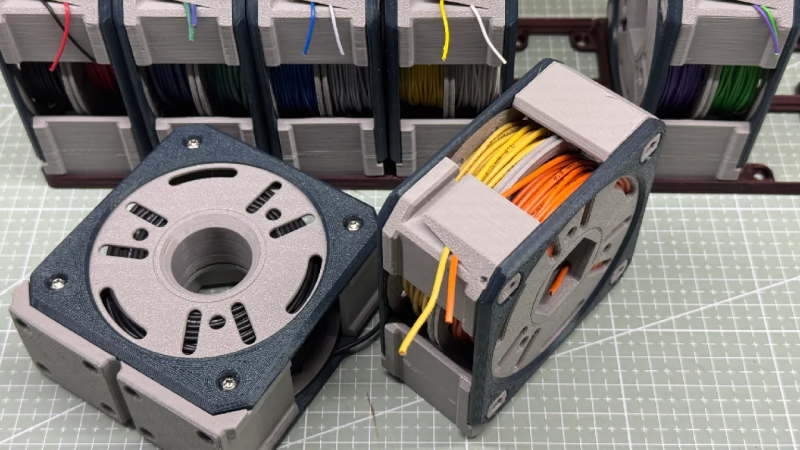
Hardware hackers tend to have loads of hookup wire, and that led [firstgizmo] to design a 3D printable wire and cable spool storage system. As a bonus, it’s Gridfinity-compatible!
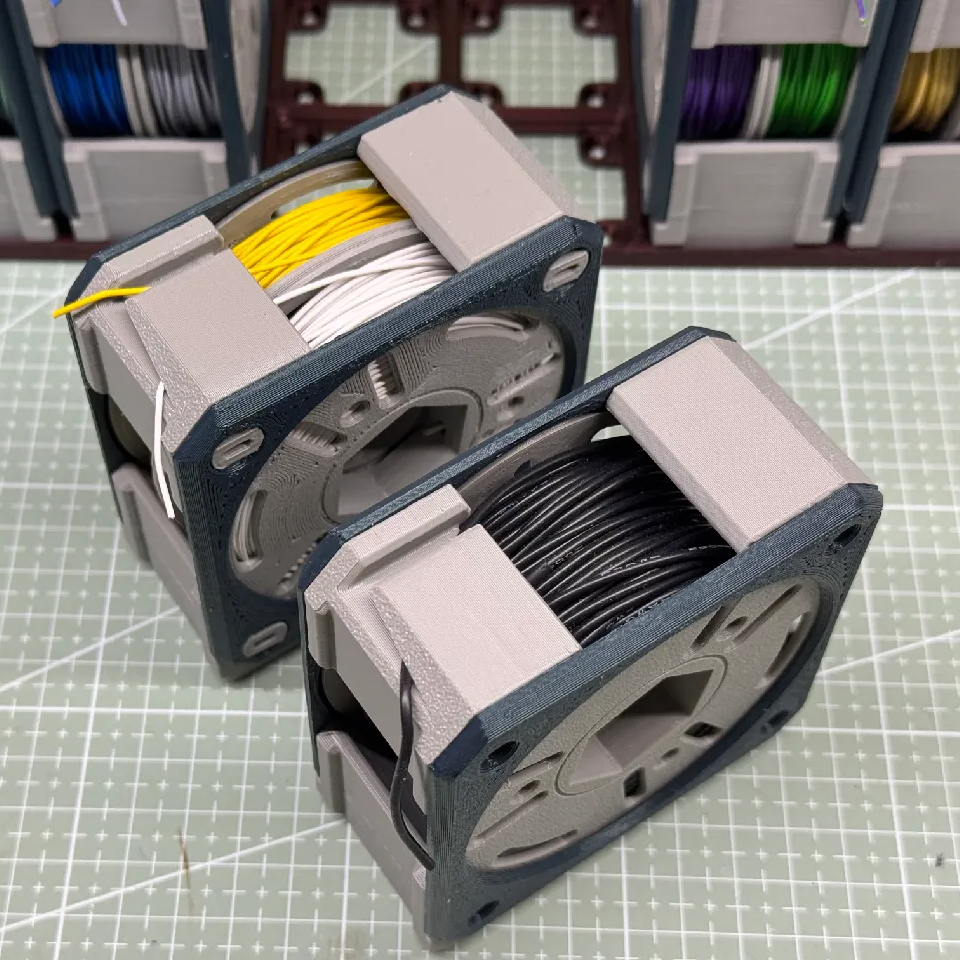
There are a lot of little design touches we love. For example, we like the little notch into which the wire ends are held, which provides a way to secure the loose ends without any moving parts. Also, while at first glance these holders look like something that goes together with a few screws, they actually require no additional hardware and can be assembled entirely with printed parts. But should one wish to do so, [firstgizmo] has an alternate design that goes together with some M3 bolts instead.
Want to adjust something? The STEP files are included, which we always love to see because it makes modifications to the models so much more accessible. One thing that hasn’t changed over the years is that making engineering-type adjustments to STL files is awful, at best.
If there is one gotcha, it is that one must remove wire from their old spools and re-wind onto the new to use this system. However, [firstgizmo] tries to make that as easy as possible by providing two tools to make re-spooling easier: one for hand-cranking, and one for using a hand drill to do the work for you.
It’s a very thoughtful design, and as mentioned, can also be used with the Gridfinity system, which seems to open organizational floodgates in most people’s minds. Most of us are pinched for storage space, and small improvements in space-saving really, really add up.












Must… build…
Me too, this is a great idea. The only change I’d make is to make it so you can snap them into DIN rail.
Of course scope creep says why not integrate with Home Assistant so you can just ask for the wire you want in the length you want and it spins it out, cuts it off and drops it on the floor. That would actually be a really fun design exercise.
Strips too. Tins as well, unless for screw down terminals.
Personally I have a junk wire bin of useful pickings and recycling. Some were un-soldered and ready to go even Teflon coated, never bought anything but speaker and audio wire in lengths. One jacketed cable I see front of me on a Samsung TV has the BBROYGBVGW (bad boys…) rainbow of colors.
It should also support crimping for most common connectors.
Someone here is just jelly for not having a 3D printer 😘
As I said, jelly much 😜
Hater 🦀
Ok, slow your roll a bit :-)
Learn to use a saw or three.
Check – I own a Delta Unisaw
Learn to frame a building.
Check – and insulate, and wire, and windows, and rock, texture, paint, everything
Learn to weld.
Ok, you got me on this one. It’s on my list now that you can (theoretically) do gas free wire welding of aluminum
Learn to use a lathe…Again, metal/wood.
Check – Have 2 lathes 3 actually if you count the tiny CNC one.
Learn to plumb…Again, plastic, copper, threaded…Learn what a ‘water hammer’ is.
Check – moved a complete bathroom and built a custom 2-head shower
Learn to change a clutch!
Check – and 5 engine swaps.
My primary tool is still a 3D printer :-)
Maybe your problem is YOU need to learn something new.
I’ve done everything on your list*, and I own a 3D printer. Note, in several cases a 3D printer was critical to the project, like recreating a NLA plastic clip for a car repair.
I didn’t “double” my car’s power”, generally I find that’s just unnecessary macho bs. But I have improved the performance of several cars (braking, handling and power), and repaired many other cars.
@HaHa “I don’t oppose 3d printers, just using them for the wrong projects, like this one.” It’s always a joy to read your comments. How else would the rest of the comment section know what’s right or wrong!
Well, with such a wealth of 3D printer experience I am surprised you can not see the value here.
First off, I would say this project is a nice exercise in industrial design, and the designer really seems to have pulled it off. Second, I would say there is potential value/applications if you are running a high traffic makerspace, where you want things uniform and easily organized (the more disorganized the makerspace, the less attention users pay to clean up). Additional value for people buying consumables (like wire and cable) in bulk, but you don’t want to leave 1000foot spools of wire lying around. If you are running multiple makerspaces, you can have smaller spools being quickly refilled from 1000ft spools, saves money over buying 50 small spools.
While I like the design, I don’t think it is for everybody. Personally, I would prefer something that enclosed the spools so that dust doesn’t settle on them. In my workshop I’ve been going with a box-with-holes in it for my wire, although I would like to improve on that solution at some point.
Looks nice, and obviously a fair amount of work went into the design. Kudos.
But too bad, it won’t work for me.
Looking around my shop I see at least 25 spools of wire, ranging from 40 AWG to 4 AWG, single conductor to 25, diameter a few mils to almost an inch, and in lengths from a feet feet to a few hundred.
This respooling project would accommodate the wire from about three of those spools.
And, well, the wire is already spooled…
I can see they could make pretty props for a youtube channel though.
Cool idea, I guess. Seems like more work than it’s worth. I just keep my reels on a dowel and 3D printed stand, or leave them in the boxes and pull through holes in said boxes.
I’m not about to spend days printing these, then hours and hours re-spooling all my wire. But, if it works for you, that’s great.
Do both.
Punch dowel holes in the side of the boxes and put them on the dowel with the others.
Oh, it’s you again.
I haven’t seen any posts from you for a while (unless you have been making dumb posts under a different name). Good to see you haven’t changed.
Exactly my thoughts! Comment section is not the same without HaHa. Glad he’s back.
Anyone would delete your comments. They are basically worthless.
Solved this a long time ago. Wire reels have a convenient 0.75″ hole.
With 1/2″ EMT conduit ( OD of ~0.71″) and 1/2 conduit brackets, screw brackets to wall or ceiling, ends dangle and cut what’s needed. Conduit slides nicely in-out of brackets to add or replenish spools.
I am printing them now… these look really cool. Thanks for taking the time to put this together!
I honestly appreciate it!
I just started…
Ok. One is done, with the two narrower spools. It’s just the thing, so I’m making at least three more, which should be enough to get organised. A bit.
Been poking holes in cardboard spools for 35yrs.
These look cool, but, cardboard spool until used then throw away.
I don’t see the point. But do have a lot of wiring sorted.
Do own a 3d printer. 2 of them.
Still don’t see the point.