
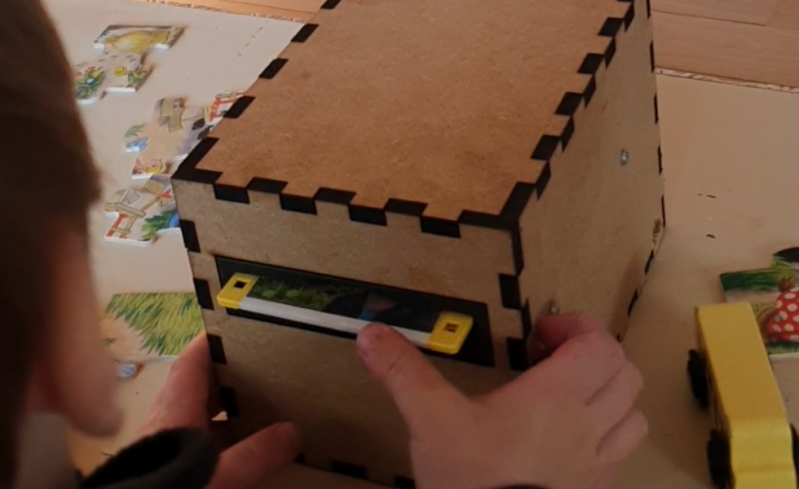
Famously, the save icon on most computer user interfaces references a fairly obsolete piece of technology: the venerable floppy disk. It’s likely that most people below the age of about 30 have never interacted with one of these once-ubiquitous storage devices, so much so that many don’t recognize the object within the save icon itself anymore. [Mads Chr. Olesen]’s kids might be an exception here, though, as he’s built a remote control for them that uses real floppy disks to select the programming on the TV.
This project partially began as a way to keep the children from turning into zombies as a result of the modern auto-play brainrot-based economies common in modern media. He wanted his kids to be able to make meaningful choices and then not get sucked into these types of systems. The floppy disk presents a perfect solution here. They’re tangible media and can actually store data, so he got to work interfacing a real floppy disk drive with a microcontroller. When a disk is inserted the microcontroller wakes up, reads the data, and then sends out a command to stream the relevant media to the Chromecast on the TV. When the disk is removed, the microcontroller stops play.
Like any remote, this one is battery powered as well, but running a microcontroller and floppy disk drive came with a few challenges. This one is powered by 18650 lithium cells to help with current peaks from the drive, and after working out a few kinks it works perfectly for [Mads] children. We’ve seen a few other floppy disk-based remote controls like this one which replaces the data stored on the magnetic disc with an RFID tag instead.












When I first heard about this project, I thought he added an NFC-tag to floppies, and just using the floppy drive “passively” (which could be pretty satisfying by itself). Using it “for real”, motors and all, is of course much more impressive… but yeah, power consumption could be an issue here.
I was thinking he stored the actual video on the floppy by changing the interface to use like an SD card’s pins or something.
Which gave me an idea: A project that maximizes the number of bytes stored in a floppy shell. A RAID array of micro SDs packed into the shell of a floppy disk. Not 1.44MB, but 1.44TB 😎
With 2tb SD cards, you might find yourself closer to 0.144PB
Well, this is close :)
https://hackaday.com/2016/02/28/floppy-drive-hides-sd-card-reader/
I put a video on a floppy disk that played back on my android Smart TV. Here is the video:
https://youtu.be/mrsNhPzmbPg?si=SapRUkaVNRxBjMVL
Reading the title, a part of me hoped for the bit pattern cut into sheet of black plastic [ Not the floppy discs, they are reasonably good IR filters ], spinning the discs Infront of a constant light source to produce the correct control signal. Maybe a project for another day.
Adapt a mechanical TV with IR-LEDs. The timing is going to be a bitch though.
I bought a couple of brands (turned out same as far I externally) of external USB floppy drives. I then formatted them ext2 and used an RPI-5 as the computer. I could read/write files to the floppies. My intent was/is to show the grand kids what we used to use to load data/programs with the proper mechanical sounds. New tech is so ‘boring’ sound wise :) .
Neat creative project above. We didn’t allow our kids to watch TV though, but still above is creative for what it is.
formatted the floppy ‘disks’ to ext2….