
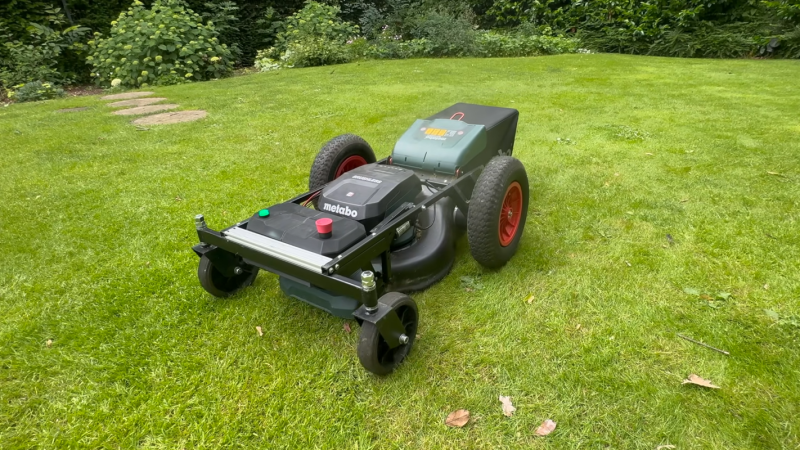
Decades ago, shows like Star Trek, The Jetsons, and Lost in Space promised us a future full of helpful computers and robot assistants. Unfortunately, we haven’t quite gotten our general-purpose helper to do all of our tasks with a simple voice command yet. But if some sweat equity is applied, we can get machines to do specific tasks for us under some situations. [Max Maker] built this remote-controlled lawnmower which at least minimizes the physical labor he needs to do to cut his grass.
The first step in the project was to remove the human interface parts of the push mower and start working on a frame for the various control mechanisms. This includes adding an actuator to raise and lower the mower deck on the fly. Driving the new rear wheels are two wheelchair motors, which allow it to use differential steering, with a set of casters up front for maximum maneuverability. An Arduino Mega sits in a custom enclosure to control everything and receive the RC signals, alongside the mower’s batteries and the motor controllers for the drive wheels.
After some issues with programming, [Max] has an effective remote controlled mower that he can use to mulch leaves or cut grass without getting out of his chair. It would also make an excellent platform if he decides to fully automate it in the future, which is a project that has been done fairly effectively in the past even at much larger scales.












Question for us all to ponder: what does it imply if our objective through technology is to create servants for ourselves?
Maybe most importantly, how does it impact our humanity to treat something as merely a servant, even if that thing is now a machine?
I think we would all agree that treating people as slaves objectifies them and steals their humanity. Hegel argued that this form of relationship does just as much harm to the master as the slave (of course with the master still bearing the responsibility).
Intro paragraph got me thinking here. So often we picture a utopia where we have created the perfect system to serve us everything we could need. I’m increasingly convinced that that would actually be a distopia.
Time to go now my lawn 😂
Our servants will say, “we don’t exist”. And the cycle starts anew.
I think when the time comes the Morlocks will find a way to address that issue with the Eloi so I wouldn’t be too worried.
The idea of making robots to do some tasks we don’t want, is to release time to do things we do want.
For example, this exact project, it’s been crossing my mind doing something like this, but not for grass, for actual forrest cleaning, because i have terrains, that are very steep, where i can’t use a tractor, and i need to clean them, if the robot is faster than a “manual” weed wacker, that’s more time to ride bycicles for example, because no one is going to volunteer to clean my property for me, that’s a guarantee
But in the end, you’ll end up doing it by hand because the robot would take longer to build and end up having to be retrieved and repaired endlessly. Automation is never a “good” solution, it’s usually done out of desperation due to resource shortages.
We invented the steam engine to pump water out of mines so we could dig up more coal. Why did we need more coal? Because we burned all the nearby trees already. Same goes for any “technological breakthrough”. In the end it all boils down to population growth and the consequences thereof.
Fundamentally, it’s cowardice. Civilizations in the past didn’t need robots, they just enslaved their enemies.
Modern civilizations don’t need robots either. They just enslave their own population.
The question is moot. We employ “servants” anyhow – without it we would hardly survive.
The fundamental point of humanity is that we employ energy other than ourselves and what we eat. A simple fire is a servant – it cooks dinner or clears a forest for a farm, or drives animals out of the brush so we can spear them with a wooden stick. What difference does it make if we use the fire through convoluted automatic mechanisms? What difference does it make if the servant is another person? Other than the point of social contract that we use to guard ourselves from becoming someone else’s tool and losing our personal agency?
On the point of treating our tools as mere servants, demanding that we somehow revere them is an artificial ritual that makes no difference to the result. It would be moral self-justification: a subtle lie we tell ourselves to say that we’re allowed to do “bad acts”. It’s a double lie, actually – first we invent the point that we’re committing some sin by doing it, then we invent a way to atone that sin and do it anyway. Remember: before you flick the light switch, you must spin around and clap your hands to pay your respects to electricity.
Note the subtle distinction here: we consider e.g. slavery as universally bad because it’s something that can easily backfire on ourselves. That means it’s not intrinsically wrong but wrong relative to our own self-interest as individuals and as people. Possible, but not a good idea.
People take such notions and treat them as objective absolutes because doing so skips the need to explain why it must be so. It bypasses the argument and debate that we might otherwise run into, having to justify the point again and again. When new people come around, we just tell them “don’t do it.”. This has the side effect of spilling the notion onto other things where the subject that defined the point gets switched for something else and the original reason no longer applies. Such as animal rights, where the question is no longer directly about us, so our self-interest doesn’t automatically extend to cover the self-interest of the animal.
Once you see the point, it suddenly becomes clear why one human society can easily enslave another. It’s not “evil”, because there was no rule against it to begin with. It merely appears so from the point of view of the enslaved. An argument can be made again from the point of view of the whole humanity, particularly if we risk to be on the losing side ourselves, but we don’t necessarily have to take that stance – which is why we need the moral absolutist to force the point, with a gun if it comes to that. See the irony?
This is the point that Hegel was alluding. The master-slave relationship is a corrupting one, because it risks losing direction. Hegel was a big fan of predetermined human destiny – driven by the divine Absolute Spirit. But, the point about corruption here is itself a corruption because it insists that such absolutes exist, and if this one does, so may others. Whole systems of moral absolutes will follow, defined by people according to their own self-interests, against the interests of others. The good lie turns into a bad lie, like a mathematical proof taken from false premises that results in absurdities when applied further. If the divine path does not exist, your moral absolutes become tools of oppression.
The real answer lies in recognizing the truth and taking responsibility of your moral choices.
Or just make things up as you go along. Life’s a lot more fun that way!
I mean, that’s what we do anyways. We pick and choose our absolutes by how they serve us. The only difference is that we stop thinking afterwards.
What a huge long way of saying that forcing someone to labor without fair compensation is wrong. Everyone, even four year olds know this. All of the intellectual gymnastics do nothing but obfuscate.
It’s not wrong, but it has consequences, which is why we say it’s wrong. That’s the point. Not everybody has to think that way – not really. Not everybody does.
Being wrong, and saying it’s wrong are two different things. Doing that, we skip an important part of thinking, and once we take the habit we tend to make other leaps of logic and make up other “wrongs” that are actually nothing but “I don’t like it, therefore you can’t do it.” Then we force the point with a gun.
Besides, the point of slavery is the forcing, not the compensation. If they paid you fair and square, wouldn’t you still be a slave?
Although, that would solve many problems. First, you wouldn’t have to look for a job because one is already provided. Secondly you couldn’t get fired no matter how incompetent you are because they chose you, so it’s their problem to train you and put you in a job that you can perform. On top of it they would pay you a good living: a nice house, enough rest, good food, some exercise and fun… everything to keep you comfortable so you can keep working. It would be a bliss.
Maybe there are some upsides to this whole slavery thing, like, version 2.0 instead of the old getting whipped until you die of exhaustion style. I could agree to that, but say, doesn’t it sound a lot like what the communists were trying to do?
We’ve been using tools since before we were human. A machine is a tool.
This reminds me of the WEEDINATOR project. It’s an open-source agricultural robot that uses similar remote and autonomous controls.
https://www.youtube.com/watch?v=USgmJXplbWo
Lawn mowing is one of the things I will not push to automated operation. I enjoy it as a chance to get outside.
Just wait till the drought and heat waves hit. Then people will wish for a lawnmower that “goes outside” while we stay cool and comfortable.
If you are being hit by drought and heatwaves your lawn will be a parched, brown wasteland. No need to mow!
The day of maximum overdrive is nigh… touching grass is the only way to save ourselves.
That wind tunnel deck consumes more power than a flatter blade mulching mower would. Multi-pass vs. cut-and-lift one shot cut. Wheels over hang blade path and in front, can’t mow close to edges or to the top of the curb.
At least with lower weight the zero turn wheels will leave less damage than the heavy lawn tanks do leaving much damage in repeated tight turns in the same place. Will full robot mowers be able to avoid getting into their own ruts unless random?