
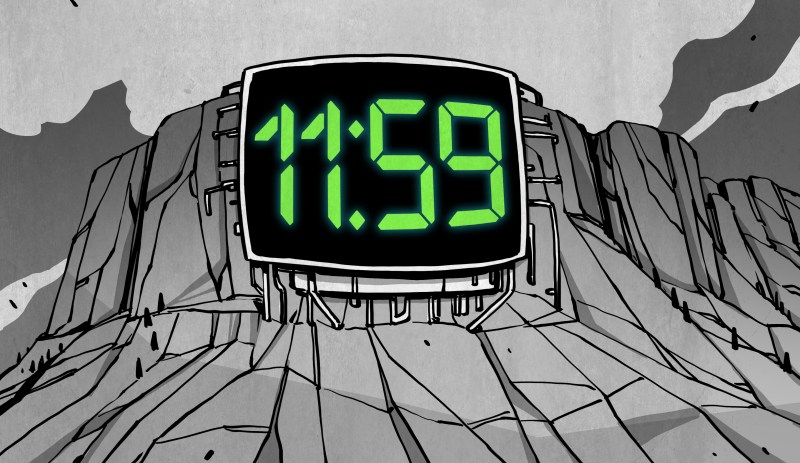
You wake up in the middle of the night. Is it time to get up? Well, you can look at the nightstand clock. Unless your partner is in the way. Whoops. Even then, without your glasses, the time is just a fuzzball of light. You could ask Alexa, but that’s sure to wake your partner, too. The answer is a projection clock. In its modern form, it shoots a digital time display on a wall or ceiling with digits so large that you don’t need your glasses. If you can see the ceiling, you can tell what time it is.
New Tech
A modern invention, of course. No, not really. According to [Roger Russel], a UK patent in 1909 used an analog clock face and lightbulbs to project the clock face and hands on the ceiling. Unfortunately, [Roger’s] website is no more, but the Wayback Machine is on the job. You can see a device of the same type at the British Museum.
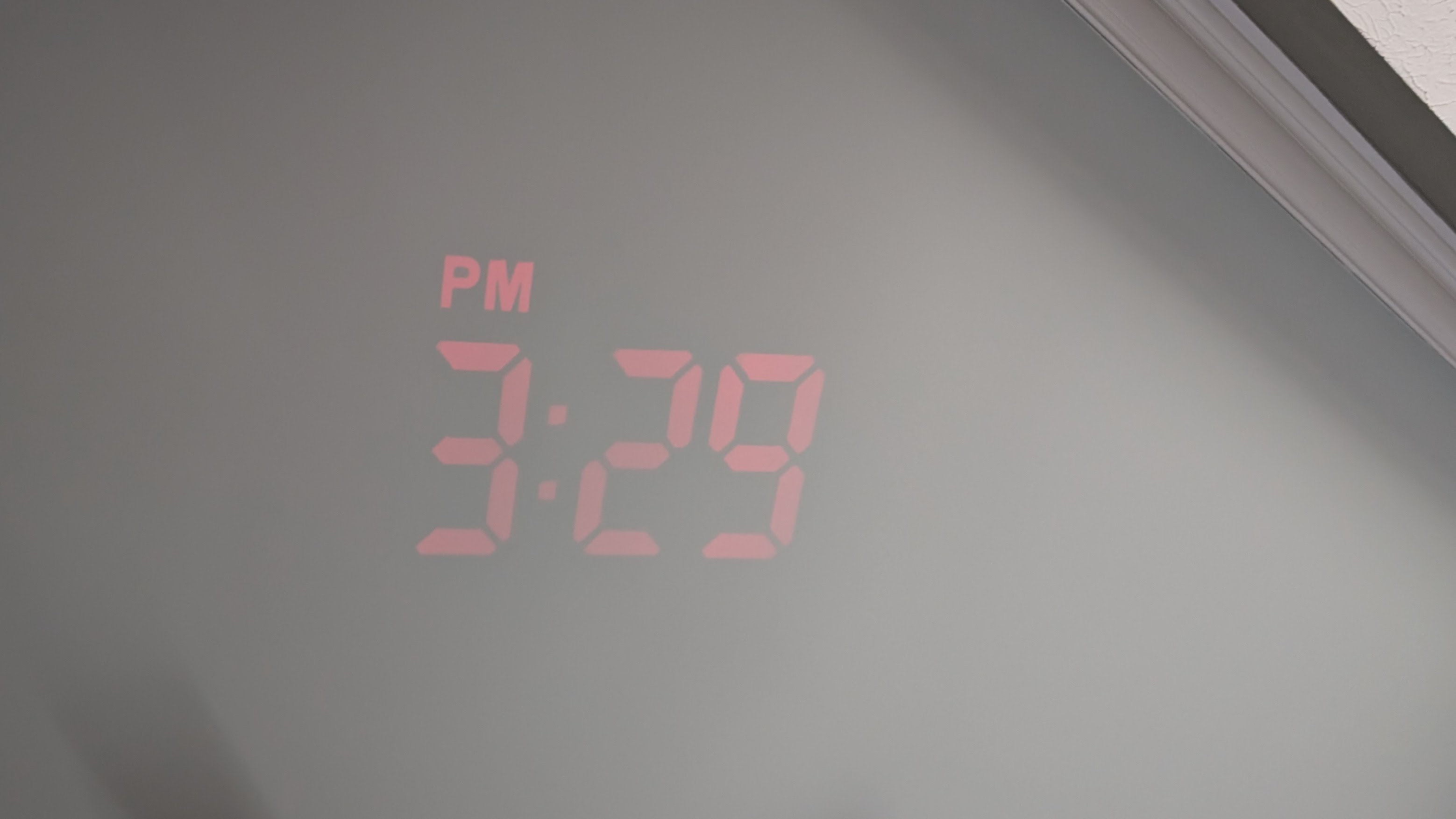
In 1938, [Leendert Prins] filed for a patent on a similar projection clock. Sometimes known as “ceiling clocks” or “night clocks,” these devices often have a regular clock visible as well as a way to project the time. In the old days, this was often an image of a translucent analog clock lit up by light bulbs. In the modern era, it is almost always either LEDs or an LCD with a halogen backlight. Of course, there are many variations. A clock might use numbers on a rotating drum with a lamp behind it, for example.
Development
It isn’t hard to imagine someone putting a pocket watch in a magic lantern as a prototype. In general, some bright light source has to pass through a condenser lens. The light then travels through the LCD or translucent clock face. Finally, a projector lens expands the image.
We couldn’t find much about the actual history of old projection clocks outside of [Roger’s] defunct website. But if you can project an image and build a clock, all you need is the idea to combine them.
Teardowns
Want to get one and tear it open to see how it works? You don’t have to since [Soudnmisen] and [svetnovinek.cz] already did that for you, as you can see in the videos below.
Of course, what you project doesn’t have to be just the time. We’ve seen clocks that can project the weather, for example. But, usually, all you need in the middle of the night is the time.
DIY
Clocks are always a fun project, and a projection clock is certainly in the realm of a homebrew project. You could use a lot of methods to form the clock face, or, like [OSO POLAR MOVIES] did in the video below, just shine a light on your analog clock. Sure, that’s cheating, but it is certainly a hack.
If you prefer, try an LCD. Or a VFD. If you want to go analog and can’t put together a translucent clock face, try making a clock face from a mirror. You can remove the marks and numbers so they don’t reflect, and then use normal clock hands, which will block light just fine. You’ll just have to reverse the clock movement to run backwards, but that’s easy, too.
How about you? What strange method would you use to draw the time on the ceiling? A laser and a galvo come to mind. A tiny CRT? Then again, you could just mount a giant display on your ceiling. That’s how they did it at a Kentucky library. Let us know your plans in the comments, and when you have it done, send us a tip.












If you whisper at Alexa she’ll reply in a whisper.
sssssshhhhh :-p
Funny that you’ve asked.
Just finished tweaking/stabilizing rp2040 micropython project with a small round LCD showing analog hands, date/time/sunrise/sunset feeding off a standalone RTC. Just before wrapping it all up realized the round shape is perfect for projecting, so next iteration will be figuring out the offsets to mirror/upside-down the thing. Local goodwill should provide me with a suitable projector clock lens at my level of affordability, I may even end up recycling the innards, power block, etc.
Presently, code cleanup is underway, but once through, the last leg will be adding a second round LCD with the mirrored/upside-down version half-lit for the night projection : – ]
The majority of corrected vision is near sighted and it’s on the rise. How can I see bigger numbers farther away, still out of focus? Two inch (10cm) high digits in my clock at 10 feet and it’s 4 blurry red shapes. Seven segment displays are not the most readable thing in the world.
Pie clock with filled in shape will give you general idea of the time :)
I think the only solution is to have a clock with a that loudly announces the time every 10 seconds (to avoid having to wait) throughout the night. That way, you can sleep better because it doesn’t cast any light into the room.
“THE TIME IS ONE AM, FIFTEEN MINUTES AND TWENTY SECONDS” [listener breathes a sigh of relief and continues sleeping]
Obvious solution: get a bigger clock or move it closer.
With my -6D naked eyeballs my 2″ (5 cm) clock is readable 50 cm away.
Or get a TIX, like Destin, and counting coloured blobs is sufficient to tell the time: https://www.getdigital.com/pages/offlineprodukt/tix-uhr Though the process of interpreting the display might recruit enough brain cells to completely wake you up.
Is it possible to project a corrected focus clock image directly to the eye?
Yes, provided the projected image is a virtual one (not scattered off a wall or ceiling). In other words, the image will be coming directly from the image-forming apparatus (lens or mirror), not from a screen. That image could be made to appear to be floating in space in front of you.
This is a project of mine that has been on the backburner for a decade now ; I have an old Philips projection clock (AJ3650) but with a small 5×16 pixel matrix instead of the ubiquitous seven segment displays. I’d like to upcycle the projector to be the basis of a small video game console playing low resolution games like tetris. As this alarm clock is still running fine I’m on the hunt for another one or a source of such matrix based projector displays which seems to be unobtainium.
“pocket watch in a magic lantern”? That seems like the easy way? I suppose you’re right, “it isn’t hard to imagine”; neither is overunity- the imagination is a wonderful thing…
A backwards running clock with hands on a mirror face. Place it so the sun reflects a clock image on the wall. Drilling a hole in a mirror was the hardest part. Did this in the 1970s
I miss my Roku app screen saver also showing local weather incl wind direction speed and gusts