
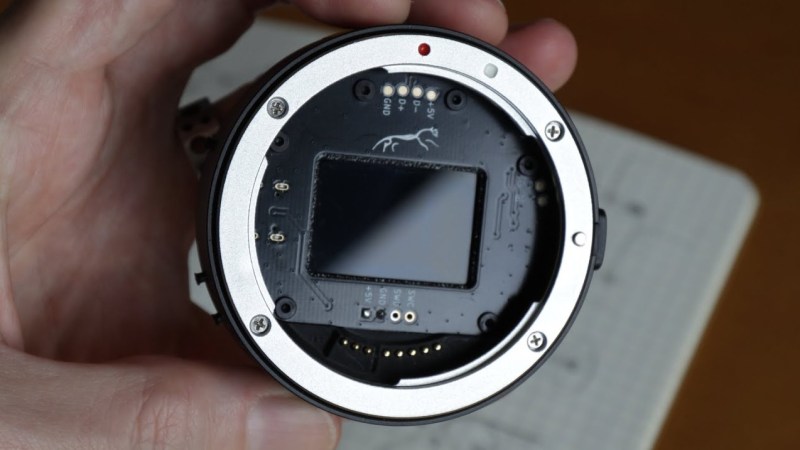
For a long while, digital single-lens reflex (DSLR) cameras were the king of the castle for professional and amateur photography. They brought large sensors, interchangeable lenses, and professional-level viewfinders to the digital world at approachable prices, and then cemented their lead when they started being used to create video as well. They’re experiencing a bit of a decline now, though, as mirrorless cameras start to dominate, and with that comes some unique opportunities. To attach a lens meant for a DSLR to a mirrorless camera, an adapter housing must be used, and [Ancient] found a way to squeeze a computer and a programmable aperture into this tiny space.
The programmable aperture is based on an LCD screen from an old cell phone. LCD screens are generally transparent until their pixels are switched, and in most uses as displays a backer is put in place so someone can make out what is on the screen. [Ancient] is removing this backer, though, allowing the LCD to be completely transparent when switched off. The screen is placed inside this lens adapter housing in the middle of a PCB where a small computer is also placed. The computer controls the LCD via a set of buttons on the outside of the housing, allowing the photographer to use this screen as a programmable aperture.
The LCD-as-aperture has a number of interesting uses that would be impossible with a standard iris aperture. Not only can it function as a standard iris aperture, but it can do things like cycle through different areas of the image in sequence, open up arbitrary parts or close off others, and a number of other unique options. It’s worth checking out the video below, as [Ancient] demonstrates many of these effects towards the end. We’ve seen some of these effects before, although those were in lenses that were mechanically controlled instead.
Thanks to [kemfic] for the tip!












Ancient ought to mimic the weird, non-circular patterns in animal eyes to demonstrate how they see the world.
Cats, for instance, have irises that close in a vertical slit. This increases depth-of-field selectively in the horizontal axis, so it sharpens vertical lines, thus emphasizing horizontal motion
Sheep and goats have these weird barbell-shaped irises. That probably serves some evolutionary purpose, but I can’t imagine what specifically it does to their vision.
Custom Bokeh / eclipse shadow generator.
The execution on this is excellent. It’s an older idea, at least in some scientific circles. One of the issues with these if I recall is the dark regions don’t block enough light for a lot applications. For photos at normal conditions it’s probably great.
Adafruit sells little lcd light shutters, but I do wish there was a nonhacked version of screens like this. Yes I said nonhacked sorry. I hate dealing with LCDs and removing backlighting.
Super cool project though
While true light valve operation won’t be possible with this screen, it’s not out of the question, and depending on the lighting conditions may be unnecessary. Still, putting an exotic piece of optical kit within reach for even hobby use like this is pretty incredible. The old systems this approximates weren’t exactly able to be used as field cameras either, so there are true advancements even in this implementation.
Looks like this may be susceptible to infrared leakage unless they took specific steps to deal with it, UV should be blocked though.
That poor-man’s light valve will, but the modern-ish sensor will itself have a pretty good IR-cut filter on it. There might be a thin slice around 750 nm that’s an issue.
I think the further an aperture is from the nodal point of the lens the more likely it is to cause vignetting and this is as far as they get. So I think this would be limited to creative vignettes/masking and a built-in neutral-density filter.
Yeah, definitely not the correct location for the aperture…
Absolutely. This is much too close to the sensor. You could put it in front of the lens and get much the same effect.
I looked it up shape is because of predators, grazing in large open spaces is extremely dangerous. So the shape and eyeball and orientation can give them between 270 to 320 degrees of view. They can almost see what is behind them. And a flock or heard grazing never align to avoid having dangerous blind spots.
Odd that was a reply to SteveS
@Truth – HaD’s threading seems to be a little broken now…
I was thinking the same thing. Potentially very selective collimating features could be modelled and implemented as well.
Amazing work, a very professional level of competence on display there too! Perhaps not how it is now, but a future version could also perform contrast masking where one can achieve a HDR like effect by giving some areas of the image more or less exposure than others. Normally this mask would be closer to the imaging plane but with some math an aperture type contrast masking effect may be possible, after all it is just about constructing the desired light field on the sensor. You would be essentially treating the aperture as a Coded Aperture, this would essentially create a spatial light modulator (SLM) system.
If that hardware will run a Gameboy emulator, you could play Bokeh-mon.
OK. That one’s good.
XD
You win an internet
Badass!
THIS IS COOL!
I always wanted to do something else, embed a large sensor AND processing unit in place of the film. I suspect run-of-the-mill DIY microcontrollers (modern-day equivalent of Arduino) now have more than enough processing power to do something like 24Mp (Mega-pixels) no problem.
The beauty of old-school DSLRs is in the wide aperture. Pin-holed cameras, with however advanced post-processing/compensation are truly no match for a good old Hasselblad level of photo taking.
something else, embed a large sensor AND processing unit in place of the film.
So, like Sony’s large-sensor, small-camera offerings, like the RX0 II or the ILCE-QX1 (or QX10 or QX100)
That – perfect. Now if could score one for under $100 without the lens.
I suspect it is easier than that, just I haven’t searched wide enough. Sensor and maybe the bus that I can attach to something like ESP32-P4 or RP2350.
Look for astronomical/astrphotography cameras: typically bare-bones, no filter, nuthin’ but a USB port. They start around $100 for an OK entry level one, with good ones still under $1k. The really high pixel count and large-acreage ones have correspondingly astronomical price tags though. My Apogee Alta with its 20 mm sensor had an original list price (not what I paid!) more than a decent car.
Thank you for the good pointers, looks like the ones I could potentially use are the Sony ones handling 8.3Mp, selling for around $300 depending on the vendor. The astronomy kind that come with the coupler and barebone USB/firewire datafeed port.
The 24Mp would have to wait in the fantazy land until the prices drop down to my level of the food chain.
Looks like I am not just behind, but quite behind with the latest : -[
Light L16 claims to deliver 52Mp with multi-apperture solution. From the amazon description: “…The lenses are grouped into three focal lengths: five 35mm lenses, five 70mm lenses and six 150mm lenses. ..” neat, if the aperture is small, add more of them to make it larger.
Still, I have nice Cannon DSLR that could use an upgrade. Mostly nostalgic value, and I suspect finding an old Hasselblad for the upgrade would accomplish more.
As punishment for piranha type behavior, paparazzi camera lenses were secretly switched out with these things–grody traffic death footage now replaced with wholesome cartoons.
With an Lcd there s a polarizing effect. Not really bad but unexpected
All LCDs use two polarizers — that’s a fundamental part of how they work. So expected. My concern would be that they’d linear polarizers, and many modern cameras need circular polarizers for their metering and autofocus to work correctly.
Impressive implementation and good demonstration of the effects.
But an LCD will drop at least 50% of the light when “clear” and mess with polarization. The blockage when switched to dark is also not perfect. I would expect an out of focus highlight from the scene to blur unexpectedly.
Still – nice tool If you know what you are doing, but unlikely to be found in commercial cameras anytime soon.