

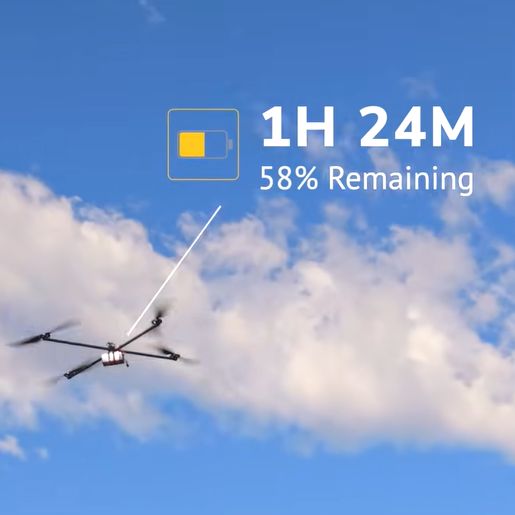
Although not a typical focus of people who fly quadcopter drones for a hobby or living, endurance flying has a certain appeal to it for the challenge it offers. Thus, as part of his efforts to collect all the world records pertaining to quadcopter drones, [Luke Maximo Bell] has been working on a design that would allow him to beat the record set by SiFly Aviation at 3 hours and 11 minutes.
By using knowledge gained from his PV solar-powered quadcopter, [Luke] set about to take it all a few steps further. The goal was to get as much performance out of a single Watt, which requires careful balancing of weight, power output and many other parameters.
Crucial is that power usage goes up drastically when you increase the RPM of the propellers, ergo massive 40″ propellers were picked to minimize the required RPM to achieve sufficient lift, necessitating a very large, but lightweight frame.
The battery packs are another major factor since they make up so much of the weight. By picking high-density Tattu batteries and stripping these down even more this was optimized for as well, before even the wire gauge of the power wires running to the motors were investigated to not waste a single Watt or gram.
All of this seems to have paid off, as a first serious test flight resulted in a 3 hour, 31 minutes result, making it quite feasible that [Luke] will succeed with his upcoming attempt at the world’s longest flying electric multirotor record. Another ace up his sleeve here is that of forward movement as well as wind provides effectively free lift, massively reducing power usage and possibly putting the 4 hour endurance score within easy reach.












I wonder if toroidal props would improve efficiency at the RPMs he’s using?
So far every single video I have ever seen of someone attempting to use toroidal props for anything they have failed to show a greater efficiency than traditional props. This includes PC case fans and model boat propellers. I’m beginning the think the paper that proposed these can’t be reproduced in the real world. That or they have some strange conditions under which they’re optimal that don’t line up with anybody’s usage.
The problem with torroidal props is correct implementation. Multi rotors are terrible for it because you want to be able to quick speed up and slow down the rotation of the motors for your control loops. Torroidal propellers have inherently more mass for a given size and at the edge of the prop disc, which makes the multirotor motor response laggy and unstable.
Torroidal props are great at constant load, constant rpm, like a boat propeller. Or a fixed rpm on a thrust test stand.
The same can be said with cold fusion and anti-gravity. You’re just not doing it right.
Is there any real-world replication of results not coming from people who sell these things?
There are multiple independent reviews of Sharrrow’s toroidal props for boats:
https://boattest.com/article/boattest-review-sharrow-propeller
I see one. Where’s the multiple?
Interestingly, the rationale for toroidal props (which have seen success on boats but not yet for any rotary wing aircraft, likely because properly designed ones are heavy) is to reduce tip vortices.
He’s already observed that forward flight instead of a hover tends to reduce these behaviors: https://en.wikipedia.org/wiki/Vortex_ring_state
I wonder if this multi-rotor category allows for different configurations? A helicopter with a single rotor and a tail rotor is also a multi-rotor. It can have a much lower disk loading, so the efficiency should go up even more.
Or the experiments of Nick Rehm: a giant slow turning rotor will have a much lower disk (wing?) loading, thus getting a higher efficiency, you just needs some fancy tricks to keep track of orientation so it remains controllable.
When using wings:
The longest distance flight by a hobbyist RC plane is 3,030 km (1,883 miles).
This record was set by The Spirit of Butts’ Farm (TAM-5), a radio-controlled model aircraft flown by Maynard Hill, Barrett Foster, and David Brown.
The flight crossed the Atlantic Ocean nonstop from Cape Spear, Newfoundland, Canada, to Mannin Beach, Ireland, launched on August 9, 2003, and landing on August 11 after 38 hours, 52 minutes, and 19 seconds.
It used a 10 cc four-stroke piston engine fueled by Coleman lantern fuel with lubricant additive, carried in a balsa wood and plastic film airframe weighing under 5 kg fully fueled.
The Fédération Aéronautique Internationale (FAI) recognized it as a world record for straight-line distance in the relevant RC model category.
Context
This remains the benchmark for hobbyist long-distance RC flights, outpacing others like a 1995 straight-line record of 738 km or amateur electric flights around 547 km. No verified longer hobbyist RC distances appear in current records.
Does this have to be point-to-point, or could I just fly around Atlanta for a week?
Thanks for the info. There’s a photo on the wikipedia page, and a couple more at https://www.pilotspost.com/PsPpyarn1573
I’d like to see some more info about the support for the record attempt. Presumably they would have needed a fast, stable boat in which to chase the aeroplane across the Atlantic. Boats that can do 77km/h all the way across the North Atlantic are pretty serious hardware too.
Replying to myself here. No chase boat was used. Amazingly, it did most of the journey autonomously! They chucked the plane into the sky over the Newfoundland coast, then their friends waited a day and a half for it to appear in Ireland. Sounds like telemetry was spotty! There’s a better write up at https://fly.historicwings.com/2012/08/the-spirit-of-butts-farm/
Amazing work :-)