
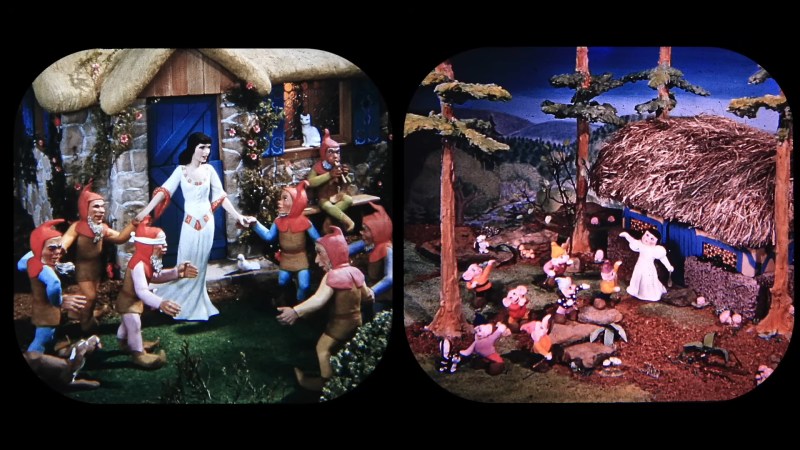
An image of a miniature diorama of Snow White and the Seven Dwarves. On the left is a more detailed 1/6 scale model with a tall, dark haired Snow White and dwarves with red caps and tan tunics. The image on the right is of a much smaller and less detailed set of miniatures. The figures's proportions are a little more uncanny and feel like a low budget Disney rip-off.

How Did They Make View-Master Slides?

The basics of producing a stereophotograph of real life places were well-established by the time the View-Master arrived, but producing images of imaginary scenes was a bit more involved. [View Master Travels and Peter Dibble] took a look at how the fairy tale and media tie-in reels may have been made.

Starting with simple dioramas, View-Master eventually developed an entire team to work on fairy tales. One of the most influential members was sculptor [Florence Thomas]. She was instrumental in updating many of the original fairy tale reels from small scale miniatures to 1/6 scale dioramas for the scenes. Unfortunately, the department was eventually cut and all the original miniatures thrown away.

Before VCRs, View-Master was the primary way people could interact with their favorite TV shows and movies when they weren’t being broadcast. TV shows could be photographed while in production in Hollywood with a stereo camera giving great visual detail. Some cartoon and movie reels were less engaging, having been made from promotional images, giving more of a paper cutout appearance rather than “real” 3D. In either case, many of these visual techniques have been lost with little documentation on how they were achieved.

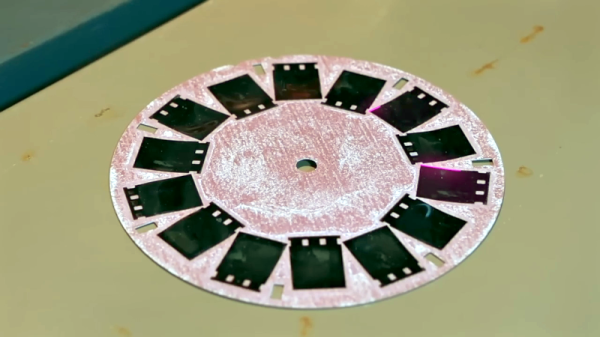
We previously covered [View Master Travels and Peter Dibble]’s History of the View-Master and how you can digitize the disks for posterity.

Continue reading “How Did They Make View-Master Slides?”

The History Of The View-Master

We are going to bet that as a kid, you had a View-Master. This toy has been around for decades and is, more or less, a handheld stereoscope. We never thought much about the device’s invention until we saw a recent video from [View Master Travels and Peter Dibble]. It turns out that the principle of the whole thing was created by the well-known [Charles Wheatstone]. However, it was piano repairman [William Gruber] who invented what we think of as the View-Master.

[Gruber] didn’t just work on normal pianos, but complex player pianos and, in particular, the pianos used to record player piano rolls. He was also, as you might expect, a stereo photography enthusiast. Many of the ideas used in automating pianos would show up in the View-Master and the machines that made the reels, too. In the 1930s, stereoscopes were not particularly popular and were cumbersome to use. Color film was also a new technology.

Continue reading “The History Of The View-Master”








