Ask Hackaday: Do You Have A Dead Man’s Switch?

During the Cold War, the specter of a nuclear “dead man’s switch” was central to the concept of Mutually Assured Destruction (MAD). In the event that one side was annihilated by the other, an automated system would be triggered to deliver a revenge strike that would ultimately destroy the attacker. It was the ultimate defense, as your enemy will never attack if they know doing so will inevitably lead to their own destruction.

The same idea has occasionally been employed by whistleblowers and journalists as well. Should the individual fail to check in regularly, a series of predetermined events will be set into motion. Again, the idea is defensive in nature. If somebody is in possession of information so damning that they could be abducted or even killed to keep it quiet, making arrangements to have that information be released to the public in the event anything should happen to them is a great way to stay safe.

A nuclear dead man’s switch is a key plot point in Dr. Strangelove.

But what about for the average person? In the past, there was no need for most people to think about something as elaborate as a dead man’s switch. But we live in interesting times, to say the least. In an information society such as ours, whistleblowers have never been more common, and the Internet has significantly blurred the definition of what it means to be a journalist.

For those living under a repressive regime or in a war zone, simply posting to social media can provide the outside world with an unfiltered look at what’s actually happening on the ground. A teenager with a cell phone has the potential to reach a wider audience than the legacy media — a powerful, but dangerous, proposition.

Even if you’re not in the middle of political upheaval, there are still reasons you might want to have previously secret information made available in the event of your death or incapacitation. Perhaps you’d like to send your loved ones a final personal message, or make sure the passwords for all your accounts get in the hands of whoever will be handling your estate.

Of course, one could argue that could be accomplished with little more than a notebook hidden in your sock drawer. But this is Hackaday, and over-engineering is the name of the game. So do you have a dead man’s switch? How is it implemented? Or is the whole idea just a bit too out there for you?

Continue reading “Ask Hackaday: Do You Have A Dead Man’s Switch?”
NextSilicon’s Maverick-2: The Future Of High-Performance Computing?

A few months back, Sandia National Laboratories announced they had acquired a new supercomputer. It wasn’t the biggest, but it still offered in their eyes something unique. This particular supercomputer contains NextSilicon’s much-hyped Maverick-2 ‘dataflow accelerator’ chips. Targeting the high-performance computing (HPC) market, these chips are claimed to hold a 10x advantage over the best GPU designs.

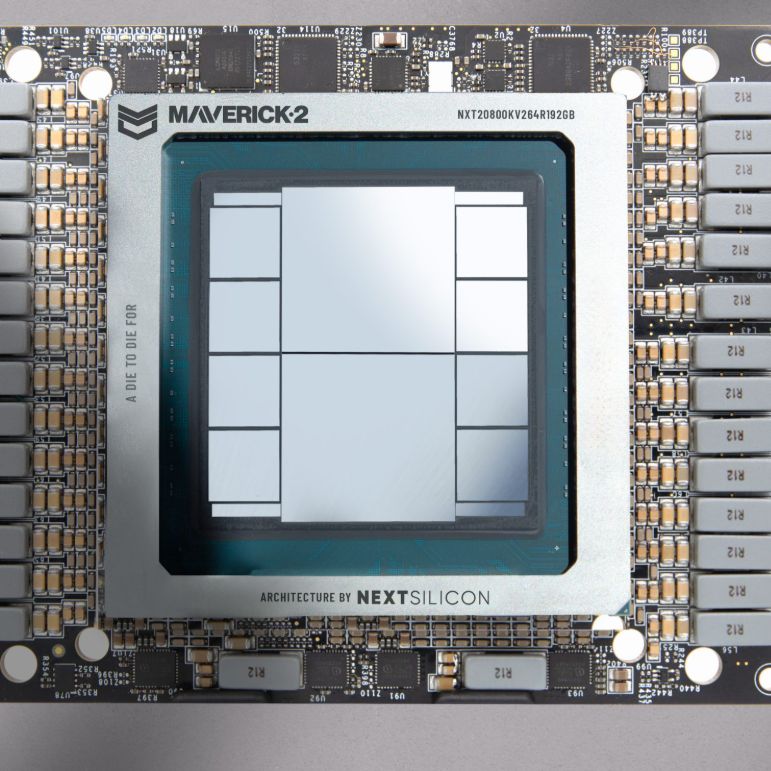
NextSilicon Maverick-2 OAM-2 module. (Credit: NextSilicon)

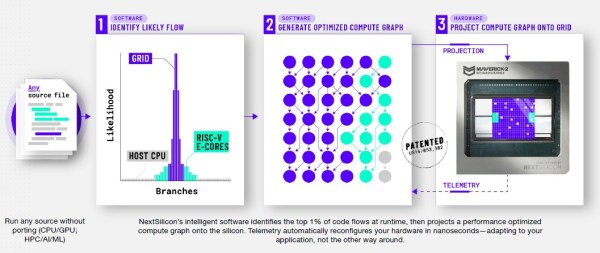
The strategy here appears to be somewhat of a mixture between VLIW, FPGAs and Sony’s Cell architecture, with a dedicated compiler that determines the best mapping of a particular calculation across the compute elements inside the chip. Naturally, the exact details about the internals are a closely held secret by NextSilicon and its partners (like Sandia), so we basically have only the public claims and PR material to go by.

Last year The Register covered this architecture along with a more in-depth look. What we can surmise from this is that it should perform pretty well for just about all applications, except for single-threaded performance. Of course, as a dedicated processor it cannot do CPU things, which is where NextSilicon’s less spectacular RISC-V-based CPU comes into the picture.

What’s apparent from glancing at the product renders on the NextSilicon site is that these Maverick-2 chips have absolutely massive dies, so they’re absolutely not cheap to manufacture. Whether they’ll make more of a splash than Intel’s Itanium or NVIDIA’s brute force remains to be seen.

Cheap Writing Deck Eschews Distractions

A modern computer can be a great productivity tool. It can also be a great source of distractions. To solve that issue, [Quackieduckie] built the e-typer—a device for writing without distraction.

[Quackieduckie] refers to the device as a “low-cost e-ink typewriter” which lays out the basic mode of operation. It consists of a 4.2 inch e-ink screen, combined with an Orange Pi Zero 2W running the Armbian operating system. It’s set up to boot straight into a document editor so there’s no messing around with other software that could get in the way of productivity. The components are all wrapped up in a tidy 3D printed housing, which includes a foldable stand so you can prop the screen up wherever you happen to be working. [Quackieduckie] built the device to work with any USB-C keyboard, probably figuring that those eager to maximize productivity will already have the typing device of their dreams on hand. Code for the project is available on GitHub for those eager to replicate the build.

We’ve featured similar builds in the past, often referred to as “writing decks.” They’re becoming increasingly popular as people look for distraction-free, ad-free tech experiences. A great example is this clamshell design with an integrated keyboard. If you’re building your own productivity aids in your home lab, don’t hesitate to notify the tipsline!