
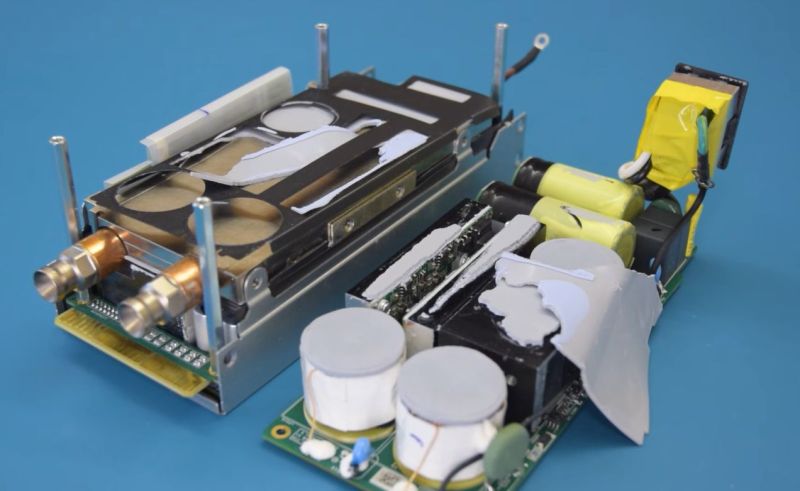
Recently [ElecrArc240] got his paws on an Intel-branded 3 kW power supply that apparently had been designed as a reference PSU for servers. At 3 kW in such a compact package air cooling would be rather challenging, so it has a big water block sandwiched between the two beefy PCBs. In the full teardown and analysis video of the PSU we can see the many design decisions made to optimize efficiency and minimize losses to hit its 80 Plus Platinum rating.
For the power input you’d obviously need to provide it with 240 VAC at sufficient amps, which get converted into 12 VDC at a maximum of 250 A. This also highlights why 48 VDC is becoming more common in server applications, as the same amount of power would take only 62.5 A at that higher voltage.
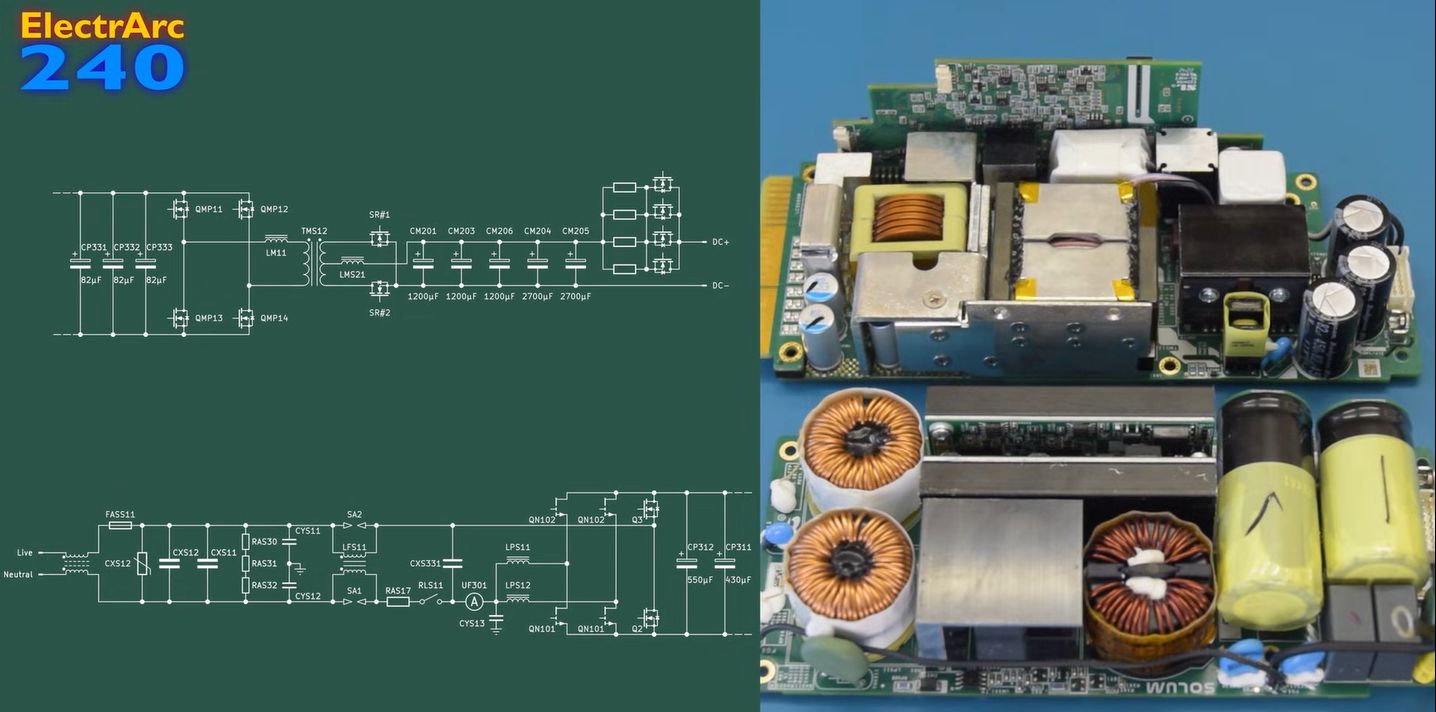
The reverse-engineered schematic shows it using an interleaved totem-pole PFC design with 600 V-rated TI LMG3422 600V GaN FETs in the power stages. After the PFC section we find a phase-shifted full bridge rectifier with OnSemi’s SiC UF3C065030K4S Power N-Channel JFETs.
There were a few oddities in the design, such as the Kelvin source of the SiC JFET being tied into the source, which renders that feature useless. Sadly the performance of the PSU was not characterized before it was torn apart which might have provided some clues here.












Power N-Channel JFETs
What dark magic is this?
looks at handy linked data sheet
Ah, Maya omitted the critical word cascode!
It’s a Silicon Carbide Cascode JFET
Neat part.
For normally-off opration, they’re cascoded, and practically packaged with a low-voltage Si MOSFET attached on top of the SiC jFET. The jFET terminology gets to stick around, but it’s the LV MOSFET gate presented on the control side.
Infographics here: https://www.powersystemsdesign.com/articles/breaking-the-mold-sic-fets-as-circuit-breakers/138/18425 – Advantage of SiC jFETs over MOSFETs is the higher current per unit area.
United SiC was promoting them big time. TIL they were gobbled up by Quorvo.
48V DC is also the preferred power supply for Telecommunication Exchanges.
Technically, -48VDC for telecom.
I wish laptops & power tools decided to use industry standard 24v rather than the 20n-ish they settled on.
Which industry? :-/
I last used 24 V when I worked on public transit bus electronics, 44 years ago.
The industries that use 28 V are more interesting.
All, you both talking about the same thing, but from different view, you from the source, Bob from the use.
Holy S, so much engineering put into it.
Water and high voltages would be an interesting combination otherwise.