
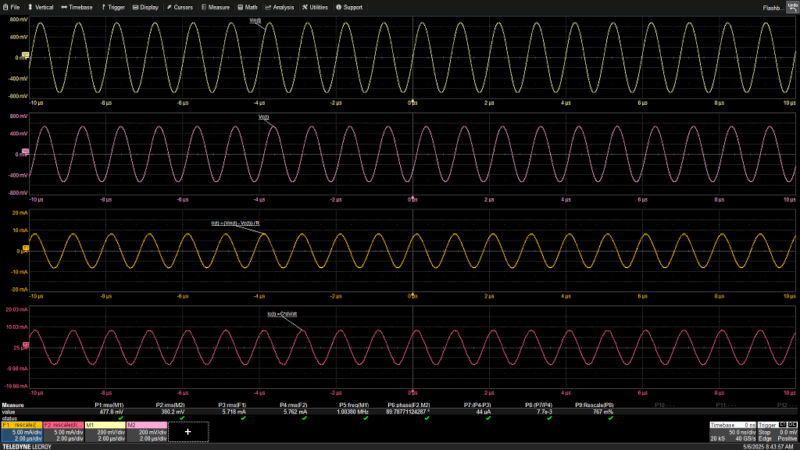
Even entry-level oscilloscopes today have simple math functions such as adding or subtracting two channels. But as [Arthur Pini] notes, more advanced scopes can now even do integration and differentiation. He writes about using these tools to make measurements on capacitors and inductors. The post in EDN is worth a read, even if your scope doesn’t offer this sort of math yet.
It makes sense that capacitors and inductors would benefit from this feature. After all, the current through a capacitor, for example, is proportional to the rate of change in the voltage across it. That’s a derivative. Since the scope can measure voltages, it can also differentiate to find the current.
The same idea applies to inductors, where the current through an inductor is related to the integral of the voltage across it. It is a simple matter to measure the voltages and perform an integration to determine the current.
All of this, of course, relates to differential equations and calculus. While calculus has a reputation for being hard, it actually makes sense if you want to work with quantities that change over time. Once you realize that a sine wave is just a fixed spot on a rotating wheel, everything comes together nicely. You could, of course, grab discrete samples from any scope and use numerical methods to get the same results. But it is much easier if your scope can do it for you.












“But as [Arthur Pini] notes, more advanced scopes can now even do integration and differentiation.”
Most half-decent scopes have had these functions for years/decades—just saying. Pretty trivial given it’s just adding & subtracting samples…
I’ve found differentiation to be iffy, given its sensitivity to noise. If you can precede it with a scope’s LP filter (and THAT’s a much rarer function), I expect it would be helpful.
And still, if you want an oscilloscope with “power analysis”, you have to pay quite a lot extra. More then I’m willing to spend. I’m not sure what it does exactly, but I guess it can keep track of things like power consumption of a gadget, or (dis)charge of a battery with addition of a shunt resistor.
Analysis of harmonics in AC systems is also a part of that, but all digital scopes I know also aldready do FFT, so that is not much special either.
Functions like this do make it more useful to have a 12 bit resolution on your scope.
My early 1990s HP1653B a digital scope and does not do FFT. I don’t know when FFT became common on digital scopes.
My 1990 LeCroy 9400 does FFTs.
Durned thing has a 68000 in it.
Mine has a 68000 as well. It might be fun to add FFT functionality to it some time. (I have done a lot of reverse engineering of it. For instance, I added screenshot-to-disc functionality, and am playing Infocom’s Nord and Bert game on it with my daughter.)
If you can limit the input to the frequency of interest, a resistor and capacitor can be an integrator or a differentiator. The op-amp versions can have very broad bandwidth with very simple circuitry and by broad I mean from zero to a MHz, and at audio frequencies very cheap op-amps will work. High input impedance op-amps as you go lower with FET types and some others good down to 0.1Hz or lower.
Isn’t all this stuff that’s easy to do as long as it’s analog ?
I vaguely remember watching someone shooting Polaroids of a scope because doing the math would be too hard
Back in the very old days of NMR spectroscopy, we’d use scissors to cut out the shape of a peak on the chart recorder paper, and weigh the piece on a scale to integrate under the curve.
Yep, same for a lot of instrument signals from voltammetry to gas chromatography. Weigh the density of the paper first then cut cut cut.
Most nmrs now have hardware that fills a mobile server rack and a computer for analysis. I have seen some where the signal was displayed on an oscilloscope but it was an old research project.
Sometimes I think we lost something from these days. Sometimes I’m glad we aren’t forced into them.
From the article…
“…calculus has a reputation for being hard…”
Calculus is, most definitely, not ‘hard’.
Calculus has a reputation for being ‘hard’, engendered and promoted only by those who have a vested interest in making it appear to be hard. {I’ll leave it to you to to decide which pedagogy—either academic, or internet page-clicks—takes precedence in any one particular instance}
One of academia’s dirtiest ‘secrets’ is that most academic calculus ‘experts’ learned from, and still, to this day, rely on Sylvanus P. Thompson’s “Calculus Made Easy”, first printed in 1910 and never out of print since. And, get this…these same experts have steadfastly refused to allow the book to be used as a calculus text in their courses and departments for ⁓135 years.
Oh, and uh…one more dirty little secret for your consideration:
you’re not EVER going to learn calculus by looking at a ‘scope trace; and most certainly not EVER by watching a video.
You’re going to have to bite the bullet, and learn how to READ!
If you claim to be (or want to be) a mathematician, physicist, or engineer, that’s how it’s done.
There ain’t no free lunch.
Someone had to tell you…
“The man who will not read has no advantage over the man who can not read.”—Mark Twain
It’s pretty basic math.
Tell the innumerate 90% of the population that will never be prepared that it’s easy.
Calc isn’t hard if you got trig and algebra.
It’s impossible if you didn’t.
Just like algebra is impossible to those that can’t add fractions.
“It’s pretty basic math.”
This is the only part of your post which is absolutely accurate; none of the rest is.
Do not buy into the trope—nor ask me or anyone else to— that ‘calculus is hard’, when simple remediation is the solution (so TEACH a person how to add fractions, for crying out loud…); else you are taking the position that calculus isn’t hard, it’s just that most people are too dumb to understand it.
That’s not a position I’d be proud to take.
(sometimes it’s REALLY HARD to teach something. It’s at those times that the bad teachers retreat to the refuge of “…you’re just too dumb to understand it…”)
“If the professors of English will complain to me that the students who come to the universities, after all those years of study, still cannot spell ‘friend,’ I say to them that something’s the matter with the way you spell friend.”
Richard P. Feynman
Dumb or lazy, yes.
Most people are too dumb or lazy to ever complete calculus.
Not even baby calc (aka calc for business majors).
But truth be told, baby calc grads also couldn’t complete calculus.
In that case, it’s demonstrably true.
Because the innumerates gave up years earlier and tried to get by on ‘memorize and regurgitate’, like medical students, but without the memorization skills.
For many, their only hope would be to go back to where they lost the thread (3rd grade?) and repeat those years of study.
Ego won’t allow that, ergo ‘math is useless’.
If calculus is so easy to you im am kind of jealous.
I agree that calc(ulations) are sometimes easy but could you prove the fundamental theorem of calculus if it is so easy?
Also being able to add fractions does not make it easier to work with infinite vector spaces for example in algebra.
Adding fractions is not sufficient, but necessary.
When doing algebra, you mostly skip least and just multiply the denominators when adding formulas. Simplify later.
If adding fractions stumps you, this is magic.
Everybody either sticks with math until it gets hard or is a quitter.
My 5 on the AP calc test was decades ago, as with the later ‘A’s.
Hamiltonians bend my brain, as did K domain (like Laplace domain but with finite size deltas).
K is digital control system math. I passed by ‘memorize and regurgitate’ and never used it. Today all that tuning is done with neural nets.
The math minor was automatic for one of my Engineering degrees.
Everybody got one, for the trouble of filling out a form.
…never heard of the ‘K-domain’, but have done an awful lot of work with the z-transform (the discrete ’embodiment’ of the LaPlace transform, which allows one to build a digital filter with any imaginable transfer function).
Are you certain you didn’t mean to say “z-transform“? See—
https://en.wikipedia.org/wiki/Z-transform
And…everyone gets a minor degree in Math by simply filling out a form ‽ ‽
Perhaps there are some in-built reasons why calculus is hard sometimes…
I once saw a video of professor Starbird joking that the reason calculus was hard, had to do with the origin of the word Calculus itself. It comes from Latin and means “small pebble or stone” which the Romans used in counting boards. Stones are hard. :)