Railguns: Making Metal Go Fast Using The Lorentz Force

In science fiction, the use of gunpowder-based weapons is generally portrayed as something from a savage past, with technology having long since moved on to more civilized types of destructive weaponry, involving lasers, microwaves, and electromagnetism. Instead of messy detonating powder, energy-weapons are used to near-instantly deposit significant amounts of energy into the target, and railguns enable the delivery of projectiles at many times the speed of sound using nothing but the raw power of electricity and some creative physics.

Of course, the reason that we don’t see sci-fi weapons deployed everywhere has arguably less to do with today’s levels of savagery in geopolitics and more with the fact that physical reality is a very harsh mistress, who strongly frowns upon such flights of fancy.

Similarly, the Lorentz force that underlies railguns is extremely simple and effective, but scaled up to weapons-grade dimensions results in highly destructive forces that demolish the metal rails and other components of the railgun after only a few firings. Will we ever be able to fix these problems, or are railguns and similar sci-fi weapons forever beyond our grasp?

Continue reading “Railguns: Making Metal Go Fast Using The Lorentz Force”

The Challenges Of Simulating A Human Brain On A Supercomputer

It’s quite the understatement to say that at this point in time we don’t quite understand how even the tiniest brain works exactly. Much of this is due to the sheer complexity and scale of these little biological marvels: with the human brain packing billions of neurons and their associated supportive scaffolding into a few kilograms of gooey pink-white mass, the sheer connectivity density is more than we can reasonably hope to measure in-situ. Ergo attempts to recreate digital simulations of small sections of such brains, a process that’s making gradual progress.

Most recently we have been doing mapping of neurons and their connections in the brain of the humble fruitflyD. melanogaster. Despite their brains being minuscule, with only about 140,000 neurons and 50 million connections, we’re not quite at the level where we can have a simulated fruitfly brain spark to life. This should probably give us some hints as to the sheer complexity of mapping the human brain, never mind simulating even a small part like a cubic millimeter of the temporal cortex with about 57,000 cells and 150 million synapses.

Even once you have all the connectome data of such a bit of brain, it’s not like you can just toss it onto a supercomputer and expect a meaningful simulation. All supercomputers today are massively parallel, meaning thousands of networked computers that require the computing task to be split up and all communication between nodes restricted as much as possible to not starve nodes.

Continue reading “The Challenges Of Simulating A Human Brain On A Supercomputer”

Modded Lightbox Makes For Attractive LED Matrix Display

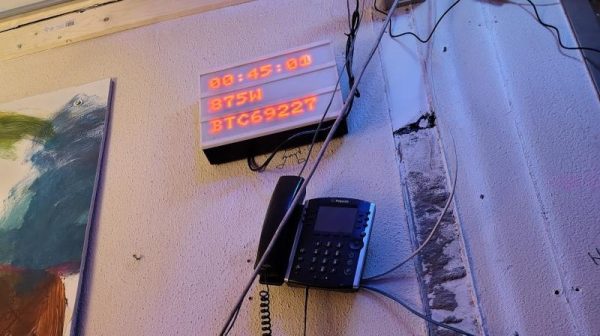
If you’ve been to a wedding or a downtown coffee shop in the last 10 years, you’ve probably seen those little lightboxes that are so popular these days. They consist of letters placed on a plastic frame in front of a dim white light, and they became twee about five minutes after your hipster friend first got one. However, they can also make a neat basis for an LED display, as [Folkert van Heusden] demonstrates. 

The build is straightforward enough, using daisy chains of 32×8 LED matrix modules, two each for the three rows of the lightbox. This provides for a 24 character textual display, or a total display resolution of 64 x 24 pixels. An ESP8266 is used to command the matrixes, which are run by MAX7219 display controllers. Thanks to the microcontroller’s onboard wireless hardware, the display can be addressed in a number of ways, such as using the LedFX DDP protocol or [Folkert’s] Pixel Yeeter python library. Files are on GitHub for the curious.

Quite a few of these exist out in the wild — [Folkert] has built a variety of modded lightboxes over the years with varying internals. The benefit of the lightbox is that it effectively acts as a handy housing for LED matrixes and supporting electronics, while also providing a neat diffuser effect. The lightboxes are also readily wall mountable and generally look more like an intentional piece of signage than most things we might homebrew in the lab.

We’ve featured similar-looking builds before, like this public transit display that was hacked for custom use. If you’re building your own public information boards or other nifty LED displays, don’t hesitate to notify the tipsline!