New Artemis Plan Returns To Apollo Playbook

In their recent announcement, NASA has made official what pretty much anyone following the Artemis lunar program could have told you years ago — humans won’t be landing on the Moon in 2028.

It was always an ambitious timeline, especially given the scope of the mission. It wouldn’t be enough to revisit the Moon in a spidery lander that could only hold two crew members and a few hundred kilograms of gear like in the 60s. This time, NASA wants to return to the lunar surface with hardware capable of setting up a sustained human presence. That means a new breed of lander that dwarfs anything the agency, or humanity for that matter, has ever tried to place on another celestial body.

Unsurprisingly, developing such vehicles and making sure they’re safe for crewed missions takes time and requires extensive testing. The simple fact is that the landers, being built by SpaceX and Blue Origin, won’t be ready in time to support the original Artemis III landing in 2028. Additionally, development of the new lunar extravehicular activity (EVA) suits by Axiom Space has fallen behind schedule. So even if one of the landers would have been ready to fly in 2028, the crew wouldn’t have the suits they need to actually leave the vehicle and work on the surface.

But while the Artemis spacecraft and EVA suits might be state of the art, NASA’s revised timeline for the program is taking a clear step back in time, hewing closer to the phased approach used during Apollo. This not only provides their various commercial partners with more time to work on their respective contributions, but critically, provides an opportunity to test them in space before committing to a crewed landing.

Continue reading “New Artemis Plan Returns To Apollo Playbook”
Creating An Ultra-Stable Lunar Clock With A Cryogenic Silicon Cavity Laser

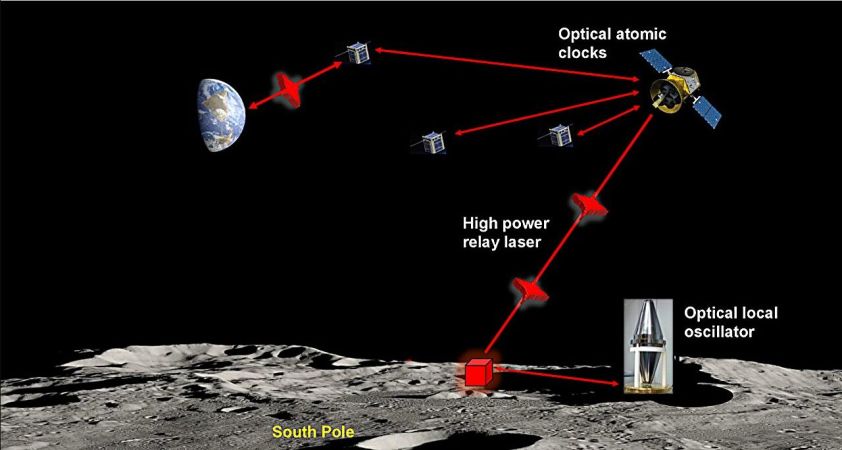
Phase-coherent lasers are crucial for many precision tasks, including timekeeping. Here on Earth the most stable optical oscillators are used in e.g. atomic clocks and many ultra-precise scientific measurements, such as gravitational wave detection. Since these optical oscillators use cryogenic silicon cavities, it’s completely logical to take this principle and build a cryogenic silicon cavity laser on the Moon.

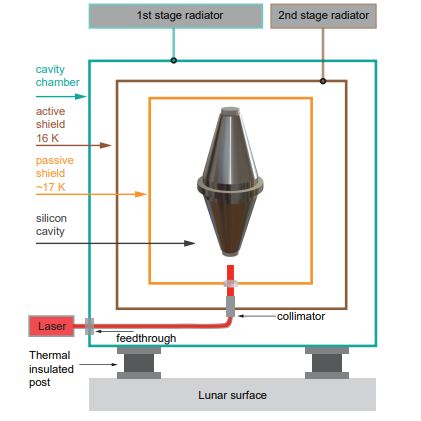
In the pre-print article by [Jun Ye] et al., the researchers go through the design parameters and construction details of such a device in one of the permanently shadowed regions (PSRs) of the Moon, as well as the applications for it. This would include the establishment of a very precise lunar clock, optical interferometry and various other scientific and telecommunication applications.

Although these PSRs are briefly called ‘cold’ in the paper’s abstract, this is fortunately quickly corrected, as the right term is ‘well-insulated’. These PSRs on the lunar surface never get to warm up due to the lack of an atmosphere to radiate thermal energy, and the Sun’s warm rays never pierce their darkness either. Thus, with some radiators to shed what little thermal energy the system generates and the typical three layers of thermal shielding it should stay very much cryogenic.

Add to this the natural vacuum on the lunar surface, with PSRs even escaping the solar wind’s particulates, and maintaining a cryogenic, ultra-high vacuum inside the silicon cavity should be a snap, with less noise than on Earth. Whether we’ll see this deployed to the Moon any time soon remains to be seen, but with various manned missions and even Moon colony plans in the charts, this could be just one of the many technologies to be deployed on the lunar surface over the next few decades.

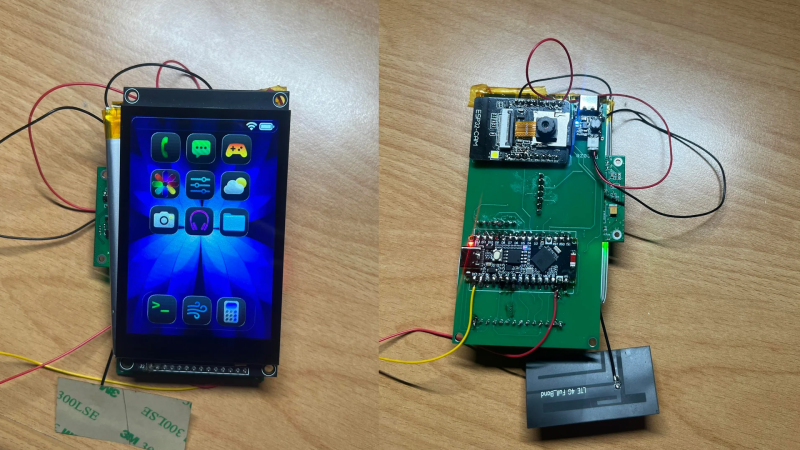
Front and back of the prototype phone

Neither Android Nor IOS: DIY Smartphone Runs On ESP32!

You may or may not be reading this on a smartphone, but odds are that even if you aren’t, you own one. Well, possess one, anyway — it’s debatable if the locked-down, one-way relationships we have with our addiction slabs counts as ownership. [LuckyBor], aka [Breezy], on the other hand — fully owns his 4G smartphone, because he made it himself.

OK, sure, it’s only rocking a 4G modem, not 5G. But with an ESP32-S3 for a brain, that’s probably going to provide plenty of bandwidth. It does what you expect from a phone: thanks to its A7682E simcom modem, it can call and text. The OV2640 Arducam module allows it to take pictures, and yes, it surfs the web. It even has features certain flagship phones lack, like a 3.5 mm audio jack, and with its 3.5″ touchscreen, the ability to fit in your pocket. Well, once it gets a case, anyway.

Continue reading “Neither Android Nor IOS: DIY Smartphone Runs On ESP32!”