
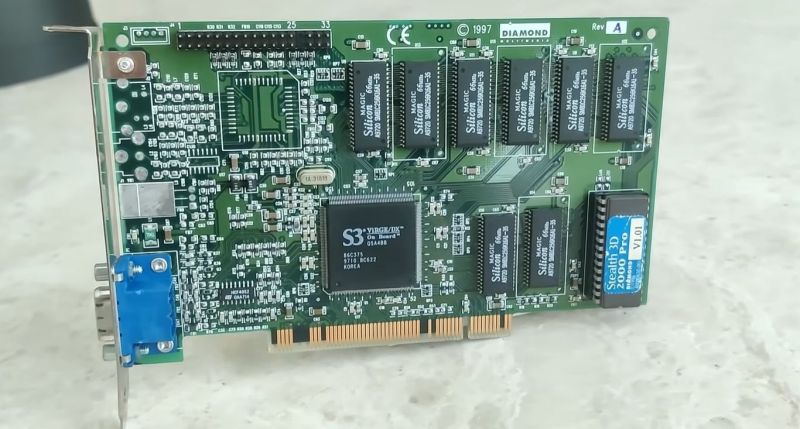
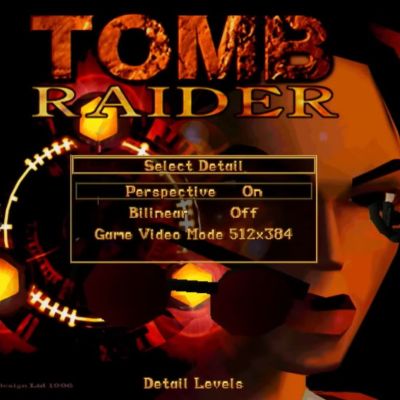
Back in 1996 the 3D gaming market on PC was beginning to heat up, with hot new titles like Tomb Raider coming out that year and requiring much more graphics power than what was needed for old titles like Doom and Duke Nukem 3D to experience good graphics. Thus you had to pick some kind of 3D accelerator card to buy. Here a common joke was that of the available options, the S3 Virge GPU was so bad that it was actually worse than running in software rendering, but was this true? Cue [Bits und Bolts]’s investigation to finally put this myth to rest.
On software rendering mode a zippy Pentium 166 would struggle to render at 640×480 resolution, so if you wanted more than 320×240, or really knock down graphical fidelity, you had to get that 3D accelerator card. After combining a P166 with an S3 Virge/DX – a minor update to the original Virge – the Tomb Raider game was first compared while running in 512×384 resolution, which the game offers you with an S3 card installed along with bilinear filtering.
After hitting a capped 30 FPS on that first test, 640×480 was tried and hit a solid 15 FPS with bilinear filtering enabled, but the conclusion is basically that the special 512×384 resolution mode is pretty good. Perhaps the main causes of the myth was the wide variability in quality of the various GPUs using the S3 Virge chip, as well as trying to run at anything other than this special resolution which appears to target the card’s strengths.












I had one of these, and I think I had the Pentium 166 too. It was better than software rendering but the rendering was a little weird, like the textures were too compressed. The 3dfx voodoo passthru/overlay card was way better – like not even comparable.
I had an S3 virge (actually I still have it somewhere). Decent 2 supportedb it. A fast Pentium could render faster than it could but the image quality wasn’t as good as the Virge.
Same here. I remember that the original 325 model needs no compatibility patch to make DOS based ViRGE games run, also.
It also has 2D VGA core that’s related to the excellent S3 Trio64V+ or something (VGA core; not the 2D or 3D acceleration, they’re different).
So it’s perhaps nice to keep it for that. On Windows, the DX and VX versions are perhaps better than 325, though.
The S3 Trio3D for AGP 1 port was an VIRGE spin-off, I vaguely remember.
No idea if it supported S3D, S3 Metal or none..
i love how fast the 3dfx dos version of d2 was. no windows overhead + acceleration was awesome. freedos gpu drivers when?
I don’t know much about the S3 ViRGE, but I think that it had low performance for a couple of reasons.
a) the memory timings for the 325 model were set too conservative (could be tweaked/fixed by an utility)
b) it had to many features; and the game devs using them all same time to produce a pretty looking game had a price
c) the internal engine was incompatible with Direct3D and common 3D rendering methods; the native S3D API succesfully provided much better results
That’s close to the old Macintosh resolution! ;)
The card was still sold as an accelerator in the Pentium 2 era. It mostly reached about half the fps of the software renderer then and added visual artifacts. It has well earned its decelerating reputation.
The S3 ViRGE 325 was also installed to high-end graphics boards used for CAD/CAM.
The Elsa GLoria L, for example, had a 3DLabs GLiNT Delta chip and an S3 ViRGE 325.
Here, the ViRGE acted as a VGA chip to have graphics during boot and when running DOS applications.
In other versions of the GLoria an S3 Trio64V2/DX was installed, I think.
A pin-compatible predecessor to the ViRGE 325, I believe.
Interestingly, the GLiNT chip had featured 3D acceleration (OpenGL?) on Windows NT 4, while the ViRGE didn’t.
On Windows 9x, it was other way round.
Here, the S3 ViRGE had 3D acceleration (S3D, Direct3D 3 or 5?) while the GLint hadn’t.
Probably due to missing drivers or missing OpenGL/Direct3D hardware support.
Windows NT 4 did use software-rendering for DirectX only (DX6 compatibility via hack),
but could hardware accelerate OpenGL just fine.
Windows 9x by contrast, had ViRGE drivers and ran OpenGL 1.x in software most of time.
https://vgamuseum.ru/gpu/3dlabs/elsa-gloria-l-88-compaq-3dlabs-glint-500tx/
https://theretroweb.com/expansioncards/s/elsa-gloria-xl
The Glint (the GL in glint is because it was designed for opengl), i remeber reading it was an early example of optimizing for benchmarks… people would benchmark with the opengl teapot, and the glint actually had hardware to specifically accelerate the teapot. So it was fast for the time but appeared to be VERY fast when one benchmarked gl teapots.
As part of the small team that developed the GLINT (and Permedia) chips, I can say with absolute certainty that this is not true. The hardware was a generic OpenGL accelerator. The drivers were optimsed to some of important benchmarks, however.
About a decade ago I threw a whole box of these cards away. They’re worth good money now. Kicking myself.
Yep, did the same with Voodoo Cards and an Amiga 1060 Sidecar in mint condition and some other things i regret, but i guess if i had kept the stuff it would have been worthless. >_<
I also had an S3 Virge, soldered-on the motherboard of a Compaq Presario pc, I believe Pentium 2 200mhz? Hardware was developing quickly at the time, but I recall this card was super common in multimedia PCs of that very mid-90s era. I do remember there was a racing game and a few other demos with absolutely mind-blowing graphics, but any mainstream game off-the-shelf never seemed to benefit. You could go to slightly higher resolutions, but the “acceleration” never improved FPS which was the main issue with 3d games of the time. It always felt like these early cards were more about pretty screenshots in magazines and box art, but were never playable at full detail in reality. What a trip, haven’t thought about the famous “decelerator” in ages and appreciate this article.
I had a STB Nitro 3d with a Virge chip. It was used to play Duke 3d on a P90 overdrive. It played and looked better than when in software mode. My friends and I played deathmatch Duke 3d in a studio over a lan. Good times and my PC always looked and played better than the rest. Trip mines and pipe bombs ruled the night. Such a fun game to kill your buddies in.
Duke3D only had software renderer, no hardware acceleration support whatsoever.
History repeating itself, for 5-ish years many top integrated GPUs seem to be faster than the venerated 1050ti, 1060 3GB. Now we are surpassing the 1060 6GB and pushing past the 1080 with integrated graphics.
No it isn’t software rendering, but if you have it on your CPU it is ‘free’ in the sense that you don’t need to purchase (or power) an add-in/add-on GPU.
I would call my first ‘real’ GPU a Voodoo 3 2000, second was an nVidia TNT2, then a geForce 2 GTS, then a very disappointing FX5200.
More modern example is AMD RX 9060 4gb I guess it would still win compared to latest iGPU but what a joke of an accelerator that is.
I have a soft spot for buying used thin clients with Ryzen 5 2200ge/2400ge/3400ge CPUs. You can snag complete systems for under $100 on eBay. Their iGPU is a Vega 11 which is comparable to a GeForce 1030. Just ensure you use 2 sticks of RAM (which doubles the iGPU bandwidth). And note they are not officially supported on Windows 11.