
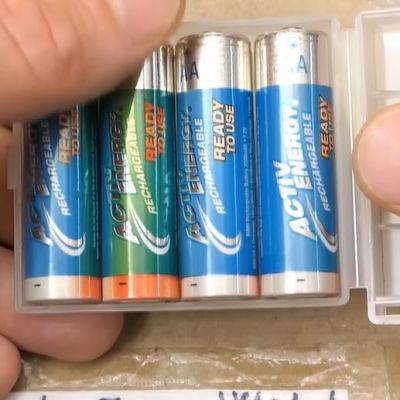
After finding a pack of NiMH rechargeable cells that had never been used since buying them in 2014, [DiodeGoneWild] decided to test whether they could be tossed or not. After previously testing different brand cells that had gone high internal resistance after only about five years, he wasn’t expecting much. Amazingly, the batteries not only recovered, but seems to be not that much worse off for wear.
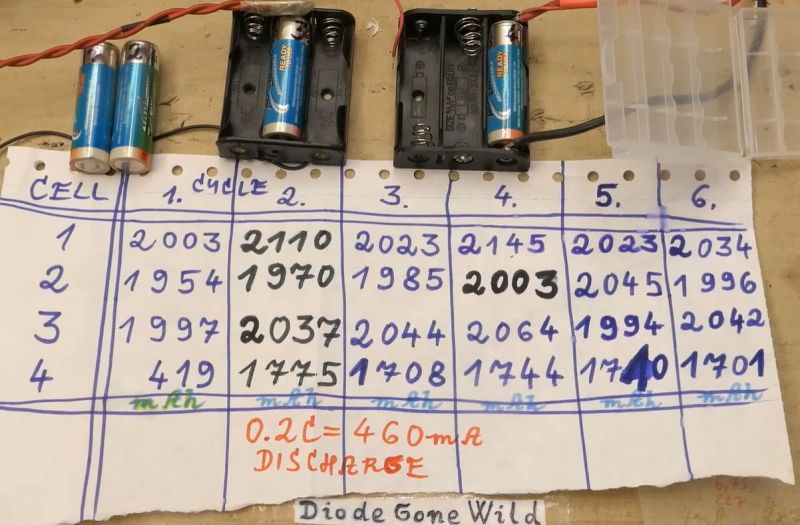
Three of the four precharged cells still held some voltage and happily charged back up to their rated 2,000 mAh capacity basically with the first cycle. One of them read 0V initially, but was revived using the typical manual charging approach involving a bench power supply. After a few charge-discharge cycles only the deep discharged cell showed some noticeable degradation with slightly reduced capacity, but all of them read healthy internal resistance values.
What this mostly shows is that not all NiMH cells are made the same, with the Tronic ones that previously failed after a few years doing much worse than these Activ Energy cells which are apparently sold primarily at Aldi stores. Overall NiMH is a pretty robust battery chemistry, so it’s always worth it to try reviving a cell before tossing it.












I believe it! I’ve had decent luck with the IKEA branded NiMh(in the US) Anything from Amazon was dead in no time. I have a few NiCds that I swear are close to 25 years old and they still have some grunt in them. Granted, they were barely used, but stories like the post here are damning proof that at least some thing can be made to last after all, if they want to.
Ikea Ladda cells are relabeled Panasonic Eneloops. They’re fantastic cells and can maintain a charge in storage for years.
IKEA LADDA cells are excellent. They look and work exactly like my Eneloop and Eneloop Pro cells at half the cost.
A few months I have found a old unused JVC VCR in the original box from 1985 and the remote control AA batteries were like new. 1.56v. No leak. I still have them.
I second that, had a similar experience with high quality LR6 batteries.
A pair of them was from good old West-Germany, from before re-union.
They still had their nominal voltage! :)
The NiCd batteries in Voyager are continuing to function 49 years after they were manufactured.
There are no nicad batteries or solar panels on Voyager. It’s powered by Radioisotope Thermoelectric Generators.
Can any one tell me why there aren’t NiMH batteries in a larger formats, like a car battery? As far as I know, they don’t have the swelling, burning, explodey issues of LiPO and they’re good as long as you don’t charge them too quickly. In my opinion they should be perfect for solar applications. All I’ve seen is NiCad in the solar lanterns and I’ve never heard of them in off-grid setups. Why?
Early Nissan leaf did. Much worse Wh/kg, less cycles before loss of capacity, worse power delivery, worse efficiency and suffers from memory effects. LiFePO4 is a better choice.
There’s basically no such thing as memory effect for NiMH cells, that’s a NiCD thing, and only under specific repeated charge/discharge cycles.
NiMH don’t suffer from the same crystalline growth problem that NiCD do under repeated equal partial discharge cycles.
What people mistake for memory effect in NiMH cells is usually just normal aging, or at worst ‘voltage depression’ that is corrected by a proper discharge/charge cycle.
Yep, recharge cycles is the more important measure there than time without charge.
Lots of early hybrid cars used large NiMH cells. For stationary storage where you don’t care about weight, they were never better than lead-acid.
Look up what happened to the “NiMH EV95 battery” and their use in the Toyota Rav4 EV. Sad story and why I watch the rebuilding of the newly found EV1.
Gen 1 – 3 priuses are nimh..
I’m driving with almost 20 year old cells.
I suspect LiFePO4 does a good job filling that niche
Did a project @ work that require high (30A) current pulses. LiFePO4 cells were the only viable candidate, then we found we were competing w/Tesla for cells! The cells we were able to get (A123, IIRC) worked great.
I used to design battery backed-up automotive kit in the 90’s and used mainly NiCd and NiMH. In those days the manufacturers were chasing capacity numbers and started using foam to increase the surface area of the electrodes. It boosted the low current capacity but destroyed their current response and longevity. The best NiCds and NiMH cells are the ones with “lower” capacity.
NiMH batteries dont tolerate cold weather very well. They dont give necessary cranking current at -30C (lead battery performance also drops in extrem cold, but unlike NiMH, it does not get damaged when charged cold)
https://www.himaxbattery.com/2025/11/21/the-hidden-cost-you-cant-afford-to-ignore-how-low-temperatures-shorten-nimh-battery-life-and-drive-up-the-total-cost-of-ownership/
They’re not NIMH (or even alkaline), but I have a pair of lead-acid C cells still holding 1.29v and 1.17v. The expiration date is stamped on the bottom: 4/63. “Guarantee: If this battery damages your photo flash equipment, send both to Bright Star Industries, Clifton, N. J. We will repair or replace free of charge.” Bright Star, of course, disappeared decades ago.
Back in the 1990s, the manufacturers of the NiMH cells in the batteries of the two-way radios the company I worked for sold recommended a maximum discharge rate of 0.2C/hour. For a 600.mAh cell, that would be a maximum discharge rate of 120 mA.
Needless to say, the transmitters of the radios drew more than that. The small (600mAh) batteries died in droves. The larger batteries did fine with the load, but nobody wanted them. The radios were small, so everyone wanted the small battery to go with them.
NiMH cells go high impedance if you overload them. I tested several batteriesto destruction to prove the problem to the radio manufacturer. All that got us was small batteries with higher capacity cells (same volume, higher capacity) that died even faster under load.
All that to say that I wouldn’t expect a NiMH cell to go high impedance from sitting around doing nothing.
Shorted cells, sure. Dendrites grow through the insulation layers. Low capacity, sure. Chemicals age.
nothing special about using old nimh, imo. i optimistically bought a handful about 20 years ago, only used a couple of them before learning that they’re basically useless…then they sat on the shelf until a demand that could be satisfied by ‘basically useless’ came along (an x-box controller), and now they’re in use uh i think literally 20 years later.
they have truly awful properties in most ways compared to lithium but if you don’t mind low capacity, high internal resistance, and high self-discharge rate, they really can hit the spot…especially if you’re particularly wedded to the AA form factor :)
I use NiMH cells for my wireless mouse. They work very well and seem to last forever.
Talking about rechargeable batteries, interesting small Lead Acid Batteries found in cheap Bell + Howell LED Bar. Also the charging circuit is interesting too.
Bell+Howell LED Lightbar Review & Teardown”
https://youtu.be/0xJ15Tj9d-k?si=3wxX5cYemBCOcyhN
Lithium are definitely the go to for high power and/or frequent use devices but LSD (low self-discharge) NiMH really get me going and make me want to put them everywhere I can.
They are specifically designed to retain a charge for years (I think most quote 70% at 10 years), and they don’t seem to degrade just from age much just from use. They are the perfect batteries for low power or rarely used devices and just sitting around ready to be used. Plus they don’t like to explode like Alkaline cells like to do.
I feel like they have a solid niche and if they were any better (density, current, voltage, cycles), they’d likely have taken over more than they have.
Thinking about it, I’m surprised they don’t show up in UPS battery packs. I’d guess that it’s the current that limits them there otherwise LSD NiMH would be perfect to sit in a UPS for decades.
I have 2 sets of 4 Eneloops that are about 20 years old by now, still work fine.
look at / listen to the video..
i’m trying to work out how he quite clearing says, and the captions agree, that these were bought in 2015.
Why then does the text in the post here say it was in 2014?
Not huge significance i’d agree, but still want to say “Come on! Lift your game”
I bought a bunch of the same “Activ Energy” cells from Aldi in about 2015. I’d say about 50% of them are still OK. I think what killed so many of mine was the Aldi charger. It lookked nice and was supposed to be “smart” but the cells always got much hotter than II was happy with at the end of their charge. Eventually I stopped using that charger and got a cheap no-brand USB charger from eBay. It seems fine!