
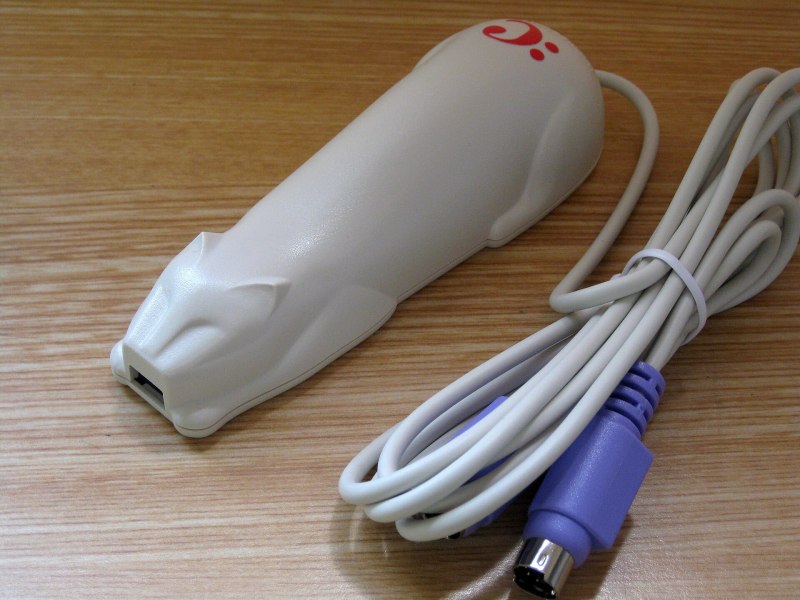
Digital Convergence Corporation is hardly a household name, and there’s a good reason for that. However, it raised about $185 million in investments around the year 2000 from companies such as Coca-Cola, Radio Shack, GE, E. W. Scripps, and the media giant Belo Corporation. So what did all these companies want, and why didn’t it catch on? If you are old enough, you might remember the :CueCat, but you probably thought it was Radio Shack’s disaster. They were simply investors.
The Big Idea
The :CueCat was a barcode scanner that, usually, plugged into a PC’s keyboard port (in those days, that was normally a PS/2 port). A special cable, often called a wedge, was like a Y-cable, allowing you to use your keyboard and the scanner on the same port. The scanner looked like a cat, of course.
However, the :CueCat was not just a generic barcode scanner. It was made to only scan “cues” which were to appear in catalogs, newspapers, and other publications. The idea was that you’d see something in an ad or a catalog, rush to your computer to scan the barcode, and be transported to the retailer’s website to learn more and complete the purchase.
The software could also listen using your sound card for special audio codes that would play on radio or TV commercials and then automatically pop up the associated webpage. So, a piece of software that was reading your keyboard, listening to your room audio at all times, and could inject keystrokes into your computer. What could go wrong?
Of Interest
You might think this was some tiny startup that died with a whimper, but Radio Shack, Forbes, Wired, and several major newspapers were onboard. The :CueCat cost about $6.50 to produce, but most people never bought one. Radio Shack, Forbes, and Wired were giving them away.
The problem is, even free was too high a price for most people. To use the device, you had to register and complete a long survey full of invasive questions. Then the software showed you an ad bar. Digital Convergence had your demographic info, your surfing habits, and knew what you were scanning.
Even then, the scanner solved a non-problem. If you saw something in a Radio Shack catalog, for example, it was probably not so hard to go to their website and search for it by title or stock number. Especially if you were sitting in front of your computer. If you weren’t… well, then, the :CueCat didn’t help you in that case, anyway.
The Next Big Thing?
It is easy to look back on this and think, “What a bad idea?” But Digital Convergence and its investors were in a full-blown media blitz. The video below shows a contemporary demo of the technology.
If you still aren’t sold, look at how happy the woman in the Radio Shack commercial is that she didn’t have to manually search the web for her next phone purchase.
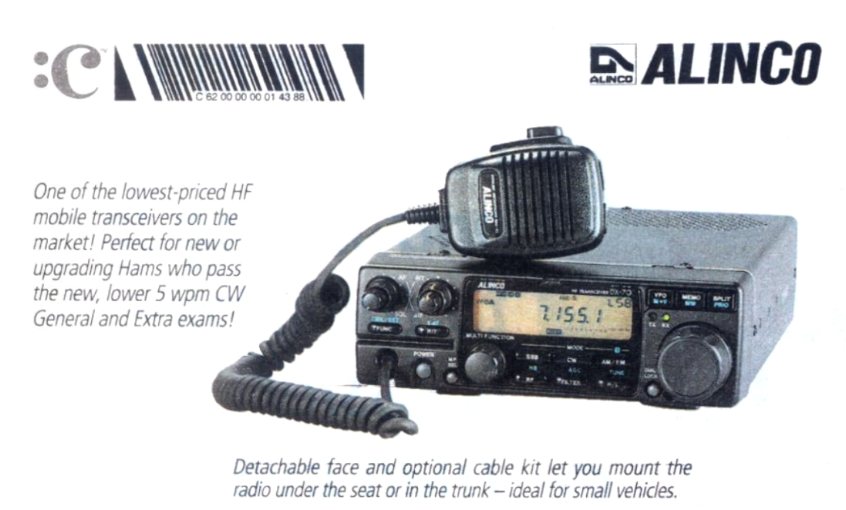
Problem solved, right? Want to buy that new ham radio? Scan the code, and you don’t have to type “Alinco” into a search box! Even the table of contents in the 2002 RadioShack catalog was festooned with barcodes.
The RadioShack catalog might have been an exception, though. A 2001 issue of Forbes magazine showed sparing use of the barcodes and no obvious ones linking to big advertisers. You would think the advertisers would have been a prime target, even if you had to make deals to get them onboard.
Hackers
Naturally, hacks immediately appeared. Drives from [Pierre-Philippe Coupard] and [Michael Rothwell] allowed you to use the :CueCat without the invasive software or registration. You could even scan normal barcodes like UPC codes. Radio Shack and others wound up simply giving away $6.50 barcode scanners.
While people were already prickly about the amount of information gathered and the tracking, hackers found a report file on a public server that revealed personal info about 140,000 users — a huge number for the year 2000.
With hackers attacking both the hardware and the company’s website, Digital Convergence had to act. They changed their license, claiming that you didn’t own the scanner and forbidding reverse engineering. There were no real lawsuits, but there were threats and, as you might imagine, that just made things worse.
The Decline
By 2001, there were a very few USB-native :CueCats distributed. But the bad publicity and the lack of usefulness took its toll. By mid-year, most of the 225 employees at Digital Convergence had been let go. Later in the year, the investors decided to stop using the tech entirely.
By 2005, you could buy the now-surplus devices for $0.30 each, as long as you agreed to take 500,000 or more of them. You can still find them on the used market if you look. Open source software is still around that can make them do useful things, but honestly, unless you’re hacking it into a custom hardware setup, your phone is a better barcode scanner.
Hardware
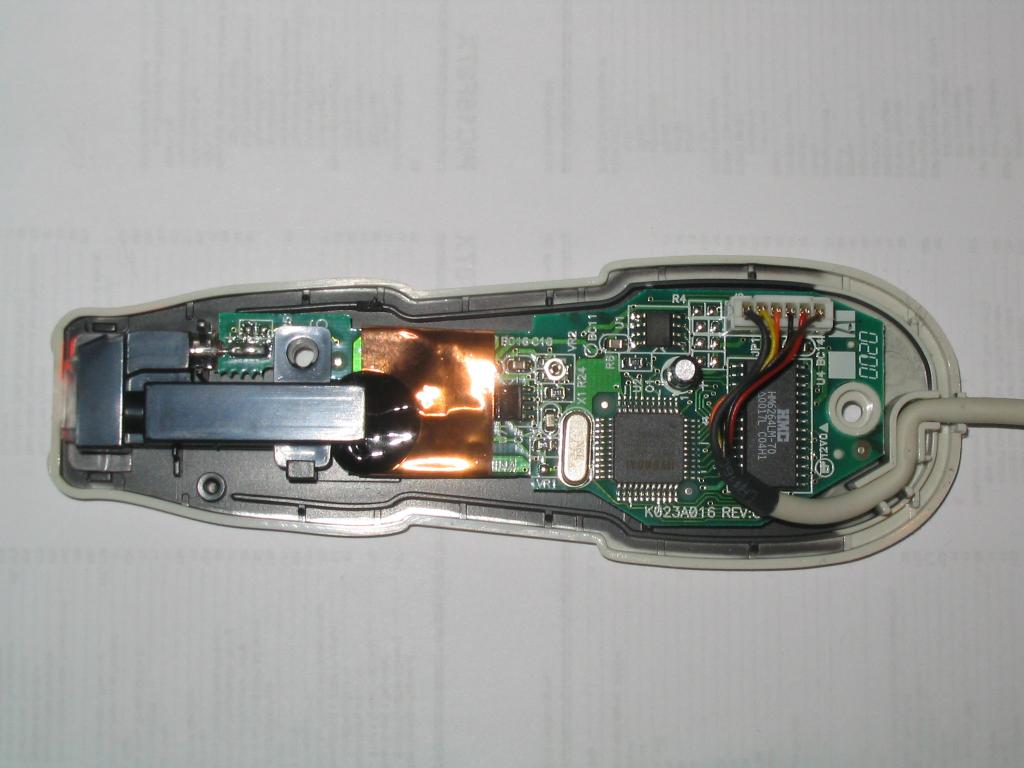
You can still find some of the contemporary teardowns of the :CueCat online. There were, apparently, several revisions of the hardware, but at least one version had a cheap CPU, a serial EEPROM, an 8 KB static RAM, and a handful of small parts. For a free device, the insides looked pretty good.
Aftermath
Of course, now we have QR codes. But these are somewhat more private, work with the ubiquitous cell phone, and even then haven’t caught on in the way Digital Convergence had planned.
Was it a good idea? That’s debatable. But giant privacy grabs usually go poorly. Granted, in 2000, that might not have been as obvious as it is today. But it still doesn’t keep companies from finding it out all over again.
Featured image: The :CueCat. Photo by [Jerry Whiting]












“J. Hutton Pulitzer (formerly J. Jovan Philyaw), the inventor of the failed 1990s barcode scanner known as the CueCat, appeared on The Curse of Oak Island as a guest treasure hunter. Often self-styling as “Commander,” Pulitzer brought his own artifact detection technologies to the show, aiming to solve the mystery.”
I got the cue cat..it was at radio shack
It let you scan the bar codes off of products..like the qr code do NOW
I am sure I have a couple of these in my barn loft storage. My wife worked with Jovan prior to the :CueCat time. He was hired to host an infomercial with Media Arts and ended up as a producer. We went out to dinner once with the “Human Calculator” and I asked him to calculate the tip.
IIRC, ol’ J made an appearance during the kerfuffle over Nevada’s(?) Presideential ballots. His input was, as you might expect, laughably naive and plainly useless.
dont speak ill of the hole, it took many a peoples money and time.
“So, a piece of software that was reading your keyboard, listening to your room audio at all times, …” so (HaD readers excepted) basically every single cellphone everywhere.
The only reason this failed was people cared more about privacy then. Now they give it away.
And I disagree- QR codes literally blindly ask you to go to a totally unknown website. Often to buy stuff! I’d rather buy a real Rolex down on Canal Street.
This thing was just ahead of its time.
Automatic navigation via QR definitely requires more faith in humanity than I have.
The barcode scanner app I use doesn’t default to automatic navigation to whatever was scanned. I’m not even sure if it has that option.
When you scan a QR code with your camera app, you can see the URL it gives. If you don’t recognize it, you don’t have to proceed.
Don’t tell me you’re just blindly clicking through the link?
“(HaD readers excepted)”
I’m here, so your opinion of the readership here is way loftier than it ought to be.
And Google made a significant difference in us “giving up our privacy” in terms of handing out “free” online programs in exchange for that privacy.
As with anything, everything has a price. In the case of google, the exchange of our privacy for a free and well-programmed online data storage, email, excel, and word document programs(and numerous others even!), all that were up to that point, pay-walled by other companies? It’s hard not to feel like the two are equally compensated.
I still have one of these somewhere. I can’t remember how or where I got it. But knowing me as I do, I can say for certain that I did not buy it and did not register it.
I had 2 back in the day, one free from Radio Shack, and later USB version off eBay for a few dollars. I used the declawed cat (modded with lifted pin) to scan my DVD inventory that was in a couple hundred at the time
And I used it to capture barcodes from my paperbacks until real barcode readers became cheap. (“Somos el barcode, somos el mar…”)
Exactly the same here. But now that I know that it can scan UPC codes, maybe I’ll dig it up.
I had a friend that used the cuecat to manage his vast Orchid collection. Taking watering needs and history, and other such plant things, with each plant to having it’s own bar code.
You can now pick up wireless point and shoot barcode readers on the surplus market. The :CueCat is even more useless nowadays.
I had a couple, think I recycled them.
Yea no shit sherlock
Thank you for your waste-stream reduction service.
To be fair, the big surprise that probably escaped most investors back then was that the general public would become very good at keyboard typing.
Most people were atrocious at typing in 2000, and this made it painful to do anything online. But all the internet users learned to type and then it was a non-issue.
Not really no, giant companies have always been out of touch with reality and Radio Shack somehow simultaneously held the beliefs that paid minimum wage clerks could type “940-0827” into the cash register but assumed “mere customers” could never be trained to do so advanced of a task, so we’ll implement a ridiculously overcomplicated bar code reader because people who can’t figure out how to type 7 digits are clearly expert PC sysadmins.
The Radio Shack catalog example from the article above is on page 90 of the 2002 catalog, the catalog number really was 940-0827 and its a lot simpler to type that into a web browser than to install a cue cat and get it working.
The DX-70 was a good radio that I considered buying back in the day, although I ended up buying a Yeasu 817, both long since discontinued I’m sure. I’m not sure if anyone post 1990 or so would buy a HF ham radio transmitter from Radio Shack, despite the store name, which surely contributed to their downfall. Toward the end, Radio Shack was truly a store without a purpose, but their prices were staggeringly higher than any alternative.
I got one of their 2M synthesized transceivers cheap at a hamfest, and used it as a packet radio node. It worked fine, with a few wrinkles as expected fromm a Radio Shack product
I still have my HTX-202. I was licensed in 1994 thanks to no-code tech. Currently I hold General. I need to put up a j-pole I think. I have a beofeng rm-5rm or something like that, I haven’t picked up a signal with it since I’ve owned it.
I’ve been using keyboards continually since about 1983 and I still do not touch-type. But I can reliably type quickly just using three or four fingers and not even having to look. The error rate can be high, though, so not having to type long strings of numbers is always a convenience.
Its the QR code reader for the desktop. The desktop requirement somehow made it even less successful than QR codes.
The other problem they had, was they ONLY wanted to partner with billion dollar companies at an absolute minimum. I worked at a “hundreds of millions of dollar” company at the time and had a pretty novel idea for corporate IT network management and it barely made it past daydream stage when they were crystal clear we were far too small to even bother having them talk to us as a mere fraction of a billion dollar company; this was a product solely for billionaire to consumer advertisement, everyone else needs to go away they forbid the use of this product for anything else. Rather sad. A decade later, Brady sells network cable label makers that print QR codes. If you know what a BMP61 is and you know what IPAM means in a corporate IT context, well, now you know what I was thinking a quarter century ago. Its a good idea, its just Brady has better management than the cue cat crowd had back in the day.
It’s a repeated lesson in business that it doesn’t matter how good the hardware is, if the company is a flaming dumpster fire to deal with.
In fairness, another repeated lesson in business is that you have to know your company’s purpose and core strengths, and CueCat was envisioned as an advertising company. Pivoting into corporate asset management might’ve worked for them, might’ve not — more likely not, IMHO — but I’d contend they were right not to even consider taking on BOTH. They’re completely different business models.
CueCat gambled on the advertising angle and lost, but that doesn’t mean they were wrong to turn down a pitch that would’ve required them to extend themselves in a completely tangential direction. If they had, the most likely outcome would’ve been that they just ended up disappointing (and failing in) TWO industries. (And the post-mortem would’ve been nothing but the advertising side blaming the asset management side for splitting the company’s focus, and the asset-management side blaming the advertising side for dragging them down and not pulling its weight.)
I used mine i got for free at radio shack to make a excel sheet of all my music movies and games (once the cat was out of the bag that is … it sat around doing nothing for the first while)
I used it to catalogue our book collection so I wouldn’t buy duplicates when visiting a used book store. I never really used the catalogue and eventually stopped updating it.
“We can’t even get a form letter sent to us,” lamented Mark Topham, author of BeCode. “That’s like saying we’re not good enough to receive junk mail. What does that say about their level of respect for BeOS?”
http://www.bedope.com/stories/0122.html
That’s Be for you! only 5 people gave a shit!
I was one of those people. I dualbooted win98 and BeOS on my Gateway 2000 AMD K6II-400 machine. It was amazing. Under BeOS I could open six or seven instances of the music player and have all of them playing different mp3s simultaneously (clearly and well), under Win98 I could have Winamp going, but not much else.
…now, there really wasn’t much more software than that available, so the fascination lasted about a week.
Listening to the cacophony of six music tracks at once for a week is more than I would have taken.
Some folks can do that; I guess it would take the ability for parallel mental processes, which I believe some people have and some don’t,(I don’t, lest anyone think I’m here to brag, lol).
I was good friends with the manager of the local RS back in the day and he gave me the “CueCatalog” package just before they were released to the public, curious what I could do with it. By the time I got internet service at home and could get into it, the work had already been done. Using that info, I converted a bunch of them to regular barcode scanners and sold them to local businesses for $20 a pop, far cheaper than those Symbol et al barcode scanners were selling for.
I happened to see one of the cats I modded at the local thrift store some years later and I occasionally wonder how long each one stayed in use, why they were retired (growth, not closure, I hope), and when the last one was retired and why.
The weak point on the cat was where the cable entered the case. They weren’t designed for heavy use.
I have several of these somewhere, both PS/2 and USB, all ‘neutered.’ I don’t remember how I did it, but it didn’t take more than 10 minutes. I used them back then to catalog my books. A friend had the idea to distribute software in printed form to be read by barcode scanners like the cuecat. Scan a line of barcodes with checksum, the computer beeps to confirm a good read, scan the next line. Then CDs became popular and that idea died. I still see cuecats from time-to-time at hamfests and swapmeets, usually marked ‘free.’
The Cauzin SoftStrip system all over again. To be fair, Denso Wave did the world a big favor with the QR code by making all of these ideas both workable and accessible.
The first think that came to mind. How long did that last? 3 months? A couple issues of Interface Age or Byte? I don’t recall which magazine was trying to make it happen.
At the time, someone in the press referred to the CueCat’s form factor as “evocative of a marital aid”.
https://www.zdnet.com/article/cuecat-and-corporate-cluelessness/
When I saw the thumbnail image for the article, with my phone about 2 feet from my face, I thought it was a tampon. That’s the only reason I ended up here. Would you be able to resist a tampon article on hackaday? I didn’t want to let my mind get too creative and traumatize myself with some weird thought lol.
Scary.
I probably have a couple in one of my junk boxes. I got mine from Radio Shack for free.
Damn I remember this! I was in my early teens and I think I got it for free at radio shack. Funny thing is I looked for it a few years back because it randomly popped up in my head and I wanted to ‘hack’ it. I forgot it was called the cue cat, but I never found it. I think we tossed it with my OG 233mhz gateway 2000, or my zip drive.
I made my dad take me to get it but I never used it for its intended purpose. It was free and I loved gadgets. Even useless ones..lol
Good times..
There was much ado about their post-facto license change, too. In an interesting wrinkle, they mailed out a huge number of these to people who never asked for them. For example, mine came on the cover of an issue of Wired. The FTC and US Post Office are very clear: if someone mails you something unsolicited, it’s a gift. It’s yours to keep, and you have zero obligations to or contractual agreements with the sender, other than the usual copyright and patent law stuff.
What this meant was that Convergence had no legal right to demand that anyone comply with their license. The hacker community largely laughed at their requests, and rightfully so.
I used to look at the failure of the CueCat as a beautiful moment of comeuppance for the advertising industry executives so high on their own farts that they really thought there were millions of consumer zombies out there aimlessly wandering the world with fistfuls of cash, desperate for their favorite megacorporation to offer a more compelling way to engage with their brand.
Now that millions of people actually install spyware on their phones to order from freakin’ McDonalds, I realize they were just ahead of their time.
Amazing isn’t it? I marvel at those that come in to McDs tapping their phones looking for ‘deals’ (assuming) on the McD app, when a clerk is right there ready to take their order…. And they seem not to care that all those apps (McD’s or other vendors) are spyware…
The really amazing one is car insurance apps with access to the phones location.
And most websites have pixel trackers, your cell phone can give up your location even when it’s turned off, doorbell cams and security cams can give your whereabouts and allow you to be followed digitally without having a single piece of tech on you, and you’re worried about McDonald’s collecting info about the food you want to order?
Anonymized/sanitized demographic info is useful. So useful that our government still sends people door to door for the census. But now with AI camera tech, they can get that demographic info from every customer at the counter, but even better, they can get race, family size, estimate income and education, class, estimate the cost of your outfit and where you shop, gather personality metrics such as whether you appear introverted or extroverted, monitor customer mood changes and determine how long it takes for a well-mannered person in a good mood to get angry due to how long theyve been waiting for their food, your dietary health (are you overweight and look like your daily exercise primarily comes from putting food in your mouth, or do you spend hours at the gym just to fvck it up with a big Mac), and more, and you gave consent just by walking into the store. And it can be used to identify you when law enforcement needs it to.
All that info is used by corporate think tanks and ai analysis to decide what to keep on the menu, how to market their food, and predict whether building another restaurant across town would be a profitable venture.
Some metrics are good to let be collected, especially for smaller companies that don’t know who their target demographic is yet and can’t afford failed marketing.
It’s information asymmetry. It’s not a good thing – well of course it’s good from their point of view – but not for the consumers in general.
When the corporations know more about you than you can ever know about the corporations, you’re going to get manipulated and exploited. Same goes for the government: their habit is to think about how to tax you more efficiently without you protesting, so they can spend the money to buy more votes.
Despite, or perhaps due to, a lifelong career in both the hard- and soft- ware aspects of IT, and electronics in general, I have become somewhat of a technical Luddite(repetitive term?) and I simply drive up to the marquee and tell the voice what I want, or I occasionally walk in and head straight for the register and wait for a human. I pay cash any anyway(at 79 I only took out a debit card last year). The result? A Double Quarter Pounder with Cheese without all the button-pushing (or touching, or whatever).
I had a few of these free from radio shack, if you have a time machine you could go to my computer around the year 2000 and see a cuecat and a barcode next to my desk, if you scanned the barcode it would unlock the computer (inserting the password). Only thing I could think to do with it at the time. Also, it would read normal barcodes, not just cuecat codes like the article says.
From what I recall, it was still unclear to companies how one would be found on the internet. There is a window where Google was not the dominant form to find places. The concept of “search” was still in the making. Traditional media was understood and there where many attempts to link from there to the net. In that context having a device that gets you from a magazine page to a webpage was probably a good idea, since at that time there must have been a lot of people that still despised keyboards.
PS: From the wiki, only at 2002-2006, did Google (verb) make it into English Dictionaries.
AltaVista was a pretty good search engine in… gonna say… 1996 or so.
Certainly good enough to find the landing page on any consumer-facing website.
Yep, MetaCrawler/Yahoo were nice, Google had something nearly magical for a bit, until it was forced to become adversarial with marketing bots targeting the results.
And we are full circle to people talking into their devices and then (maybe) correcting the result.
Only now it’s worse because your results are generative AI with a confident tone.
Not really. They advertised their websites on the TV, Radio, and magazines.
There was no lawsuit because they didn’t have a leg to stand on. Tons of these were emailed unsolicited to people, and the law is that when you do that you’re giving the recipient a gift. The threatened basis for the lawsuit was “you can’t damage or property”, but the ones they sent out unprompted no longer belonged to them.
What a pearl clutching non joyride that was. Honestly as someone who actually lived thru this the concept was not that bad at the time since a lot of older people were just getting onto the information superhighway back then. Sure, it was gimmicky and got in your mud but no worse than any of the other crap bloatware that was already on your Packard Bell with integrated modem soundcard at the time lol. I would honestly be surprised if the whole thing even netted 4% of the projected data collected so yeah pretty tame. Anyway it was better than a Pets.com coin purse smdh that is a hilarious story that probably collected more user data thru its cookies and mailing lists and salaried shot girls than this thing ever did.
When the first hacks were announced, I picked up one and used it to scan barcodes of shipping labels for my side hustle of buying up network gear and sun hardware from dot-gones and selling it on ebay.
Free hardware that can be repurposed for something useful is great. Free locked down garbage destined to become ewaste– not so much.
CueCat.com lives on!
“But these are somewhat more private” How ? NO!
Same thing.
No, you don’t have to register with a central entity to create or scan QR codes. The scanner doesn’t send a unique ID tied to your machine along with it (or, at least, it doesn’t have to). So while it isn’t totally private and your phone or other device may have other privacy considerations, but anyone can create a QR code and you going to it is no different than you going to the URL in question. Now, that may have its own set of problems, but if I tell you to type in hackaweek.com and you go there, I can still do the same things. OR if I give you a short URL, etc.
Like little things like license agreements and threats of legal action ever stopped a good hacker. In fact it usually spurs us on.
“Of course, now we have QR codes. But these are somewhat more private, work with the ubiquitous cell phone, and even then haven’t caught on in the way Digital Convergence had planned.”
Uh… If you enabled background location tracking in your phone (or more realistic: neglected to disable it), now Google can theoretically even know your location within seconds after you scan a QR code and navigate to a website. They won’t know who you are, but they’ll know where you are. And to be honest, if you’ve got your WiFi switched on, they will also more or less know where you are, even if you switched off background location tracking.
Phones are not somewhat more private. Unless you built your own phone, with your own OS, and use an anonymous prepaid sim.
Here’s the thing. What you are talking about is your phone, not a feature of the QR code itself. And you can scan a QR code without those privacy concerns. The :CueCat was intrinsically identifying you and tracking you with very little possibility of recourse. Now if your phone is tracking you, that’s not the fault of QR codes.
You don’t need a phone to scan a QR code. You can pick up a used 2D barcode scanner dirt cheap these days that will work with anything that supports a USB keyboard. There are also open source programs that can read a QR code with a PC and a webcam.
Basically, :cue cat was too early. The technology was not stealthy enough, and it also came as a revolution that everybody noticed.
Current mobile phones are stealthy, and have been eating away at your privacy one small nibble at a time, so small that you didn’t notice.
But the people who are being rounded up by ICE right now, they DO notice. And remember that what the government does to those people can easily be done to you as well, the only thing necessary is: motivation.
My Dad had a VCR with a barcode reader “pen” and the Radio Times would have barcodes printed by each programme listing.
I don’t think it was slurping our secrets though.
Likewise this did not seem to catch on!
I’m guessing this was a US only thing as I’ve never heard of them and I’m definitely old enough and been on the internet long enough. A quick check on eBay shows only listing shipping from the US would seem to corroborate.
Remembering these being in the All Electronics catalogs for a few years. (Hack it for parts?)
This was at the height of the dot-com idiocy. Funding dumb tech ideas was the style at the time.
I got one for free from Radio Shack, of course, and immediately disassembled it, of course. None of use had any desire or intention of using it as directed.
We look back and laugh at how dumb the idea was, especially because we all KNEW AT THE TIME how dumb the idea was from the moment it was announced. It created new problems and inconveniences for users without solving any problems itself.
Or rather, it solved a bunch of CEOs’ problems, not users’ problems, and they were oblivious to the fact that we don’t share their priorities. It’s ironic that things haven’t changed since then.
Unless I missed it you didn’t cover the hack where you could add a bodge wire and it would spit out plaintext barcodes. No special ‘Drives’ (sic) required. I assume that was a typo for ‘drivers’.
I had one, possibly two if my grandfather gave me his when he got bored of it. ‘Radio Mart’ in my local town distributed them. They were stores with a Radio Shack sign on the front, but were legally distinct privately owned stores. Very confusing because they didn’t share most promotions with the regular franchises.
If I haven’t thrown mine away it probably is still sporting the bodge wire. Of course I also have a USB laser barcode reader from a point of sale terminal courtesy of a second hand store. Haven’t done anything with that either.
Loads of them on eBay. Have one myself while, regretfully, having long ago disposed of all of my many ISA and PCI cards and motherboards from system builds. Same for my long line of non-IBM PC computers disposed of while still in mint condition. I should have been a hoarder.
I inherited one from my Father-in-law. Pay the postage and I’ll send it to you 😆