
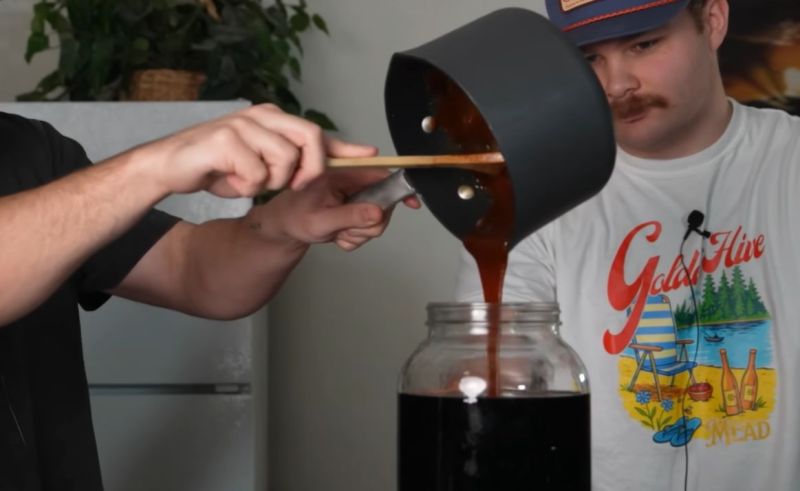
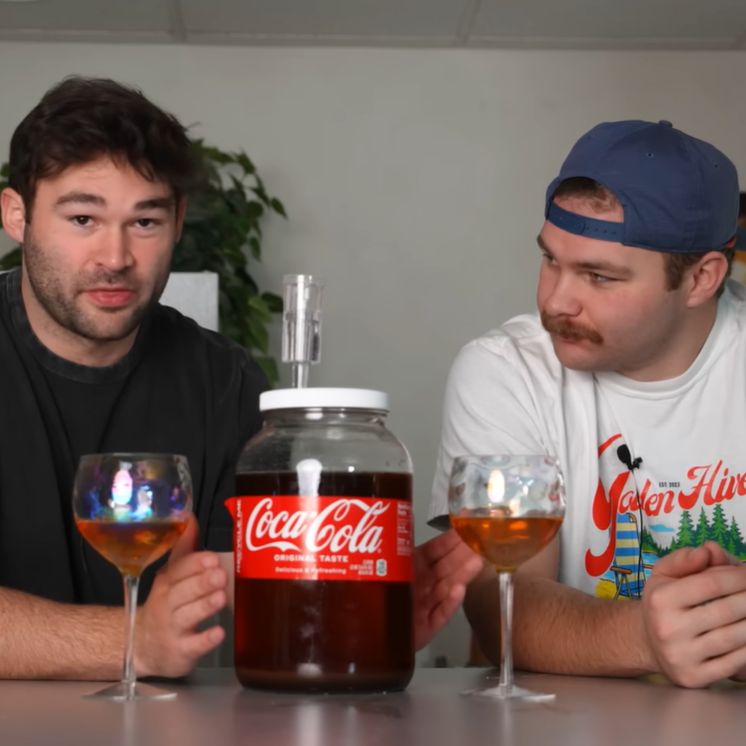
You can certainly just chug down that bottle of soda you purchased, but if you accept the premise that the preparation of food and drink is just a subset of chemistry, and that chemistry is fun, then it naturally follows that using soda as the basis for brewing up some mead makes perfect sense. Thus the [Golden Hive Mead] blokes over on YouTube decided to create some Coca Cola flavored mead.
Mead is essentially just water mixed with honey that is left to ferment after adding yeast, resulting in what is also called ‘honey wine’, with an ethanol content of usually between 3.5% and 20%. Since soda is mostly water and comes with its own supply of sugar for yeast to feast on, this isn’t such a crazy choice in that respect. Just make sure to remove the carbonation, as the CO2 makes the soda too acidic for the yeast to be happy.
Instead of straight honey, caramelized honey was used for extra flavor after which the brew was left to ferment for a while. For extra flavor notes aged oak, vanilla and cinnamon were added as well, to ensure that the fermentation didn’t erase those core notes of the coke. The result was apparently rather flavorful, with about a 10.5% ethanol content, receiving the full approval of both tame test tasters.










colour me intrigued
Most people can’t get it above 8-10% ABV because the conditions aren’t ideal for the yeast and the fermentation stops half-way through. Even if you remove the CO2, soda is way too acidic because of all the phosphoric and citric acid added to it. The PH is around 2.6 – 2.7 while the yeast would like it around 4.
You could remedy that by adding a bunch of sodium bicarbonate, but that has a side effect of making it taste metallic or mineral because of the sodium, so it comes out like wine mixed with flat club soda. You could then remedy that by adding the carbonation back, which makes it come out like a breezer/alcopop.
One tricky question in brewing is how do you get the drink to turn out sweet rather than dry, especially if you want to carbonate and bottle it. If the yeast is perfectly happy, it will keep consuming all the sugar until the alcohol kills it or it runs out. If it’s bottled up with leftover sugars, the CO2 keeps rising until the bottles explode.
Of course you could just add way too much sugar, so the yeast will kill itself with alcohol before it consumes all the sugar, but then you’re left with a drink that’s up to 15-20% ABV with off-flavors produced by stressed and dying yeast , and it takes forever to get there – or you get a stuck fermentation around 10% and end up with a drink that’s way too sweet.
If you want something moderate like 5-6% ABV that brews quickly, tastes clean and still has some sweetness to it, that’s harder to pull off without adding non-consumable sugars like lactose or dextrin, or artificial sweeteners like aspartame. What gives you non-fermentable sugars is roasting, which is what the caramelized honey is doing.
Filter out solids, clarify, sweeten to taste, pasteurize (killing any residual yeast), carbonate, bottle, cap.
If you didnt catch it, the answer to your overcomplication of ceasing fermentation is simply heat. Once you reach 55-60° C yeast dies. Easy peesy.
Substitute Potassium Bicarbonate it has a similar alkalinity to sodium bicarbonate but lacks the salty/soapy, metallic taste, making it ideal for taste-sensitive recipes.