
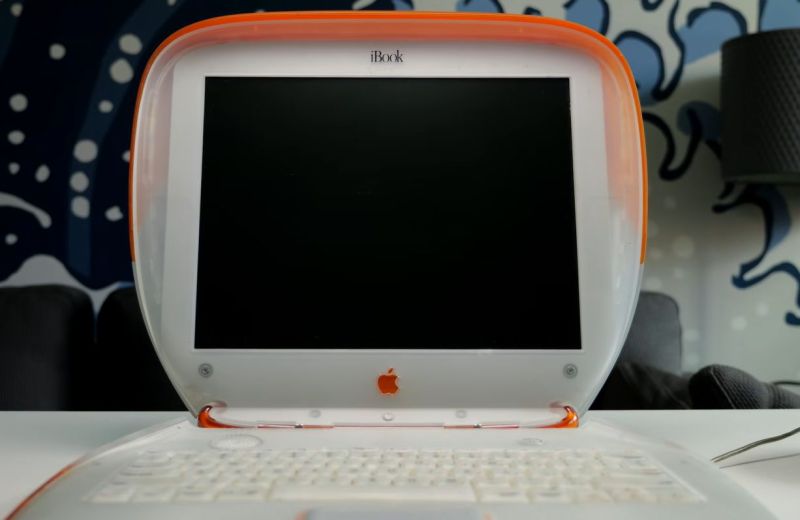
 Before the Apple MacBook there was the Apple iBook, fruity 1999 colors included. These PowerPC-based laptops targeted low-cost PC-compatible laptops much like the iMac did, albeit it the latter with more success. That said, these laptops are said to be a nightmare to repair, so when [This Does Not Compute] got his hands on a shiny first generation, 300 MHz PowerPC powered, tangerine-colored one, he somewhat dreaded trying to fix it.
Aside from some relatively minor cosmetic issues such as typical cracks in the plastic and a missing optical drive door it seemed in good condition. The first issue came on boot, when MacOS 9.0 would throw up an error message about an issue with cache memory. After booting into the OS this cache memory did indeed show up as missing. Next issue was the optical drive doing absolutely nothing and restarting leading to the system locking up and not starting until plugging in the power adapter.
Fortunately the optical drive started working after addressing a software issue, but the power and cache issues were concerning. Cue a long troubleshooting and repair session that involved purchasing a ‘parts unit’ from Japan to merge both into a single iBook with hopefully a working system at the end.
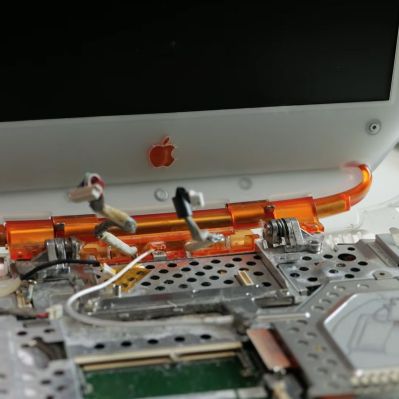
Along the way the reason why people dislike maintaining these systems, as to do something like getting to the hard drive requires removing the entire display. The cause for the first iBook’s problems also seemed to be due to a liquid spill of some type, as on boot there was no chime either, indicating a wider board-level issue. Unfortunately this was left further undiagnosed and the Japanese mainboard used instead. It’d be interesting to see the deeper cause, but most likely the mainboard will be used for components.












Geez we’re so old
But look what GUIs they could build with only 32 MB of RAM. On a ATA HDD.
I mean, why does opening a 1.5 KB text file in a supposedly lightweight editor like Mousepad need 99.9 MB of RAM?
If it were Microsoft the answer would be copilot… does apple finally get there with their AI?
*Siri cries in the corner…
Electron, was my first guess, but on reflection that probably needs more.
No, Mousepad isn’t built on a webrender. But with the state of Gtk nowadays, who knows!
Indeed! It was comparable to Windows 98 here, I think.
And more RAM was better, of course. Say 64, 96 or 128 MB.
32 MB for home use way okay, but in desktop publishing or picture editing of the time Mac OS could make good use of a few hundred MBs of physical RAM.
1,5 GB or 2 GB was about the upper limit for classic Mac OS (on some Macs it saw 1GB at max).
By contrast, Windows 98 already had issues with 256 to 512 MB of physical RAM, became more unstable (there are patches and workarounds, VCACHE etc).
1 GB was about the upper limit at which it started to malfunction.
I think you tried to mean Windows XP with 256 to 512Mb.
My Win98 PC desktop never saw more than 128Mb and it ran perfectly until replacement.
Hi, I’m a VM and emulator fan so I’ve often had installed some extra RAM! 😅
As for Windows 98, it’s true that 128 MB was period-correct.
It was installed in a Pentium III PC bought in ~2000.
Most users had less memory at the time, though.
16 MB was lower limit and 98 was using swap file often, I think.
The poor 486 users must have struggled here! 🥲
By 2006, however, loyal 98SE users or XP/98 dual-boot fans might have faced PCs equipped with 256 or 512 MB of RAM. 🙂
getting to the hd on the original imac was also no fun. Pff. what could possibly go wrong with a hd??
I recently did a repair on a iBook a1005 (one of the last that can run OS9 natively) and it was a total nightmare. Replacing the dead hard drive requires a complete disassembly of the device, including around 100 screws (some of which I had to drill out). And even with a clear warning from ifixit about speakers delicately soldered to the motherboard, I managed to destroy them.
Considering the failure rate of spinning disk drives, it was an unforgivably poor design. It made me rethink the lore that Apple built its brand on “better” hardware.
I understand that. I think there’s some difference between home user models and office models, though.
The older beige Power Macs often had used more mature SCSI drives,
while the home user models used more common consumer level hardware.
The early PowerMac G3 B/W had a “faulty” IDE controller that worked fine with the factory-installed HDD, but not all of the other HDDs.
The other IDE/ATAPI controller used for CD-ROM could be used as a workaround.
Using an SCSI controller card (Mac firmware) and an SCSI HDD like in previous Power Macs was also a solution, maybe the best one.
You say that, but the HD in my SE/30 is fine
And still not full
How is an iMac competition for a laptop?
Hm, the original G3 iMacs had a handle and could be transported.
The concept basically was same as with the original all-in-one Macs of the 80s.
I think there were even bags for transportation being sold.
That being said, I haven’t seen an iMac G3 on a LAN Party yet! 🤷♂️
Though Mac ports of popular games had existed in the 90s and first half of the 2000s.
Not sure is they could join net games with their PC versions, however.
I had one of these (G3 iMac) at work and the handle was only good for moving from one office to one a couple doors down. The CRT made it heavy, and the power cord made it not-a-laptop. Putting it in a bag wouldn’t make it lighter.