

One of the most common ways of comparing the processing power of some microcontroller or older smartphone in a fantastical way was to say that they had more processing power than the Apollo Guidance Computer. While this sounds impressive on the surface, the AGC was the first integrated circuit computer ever built and is predictably under-powered by almost all modern standards. A more apt comparison would be to compare a smartphone to a supercomputer from some bygone era, and someone has recently done just that.
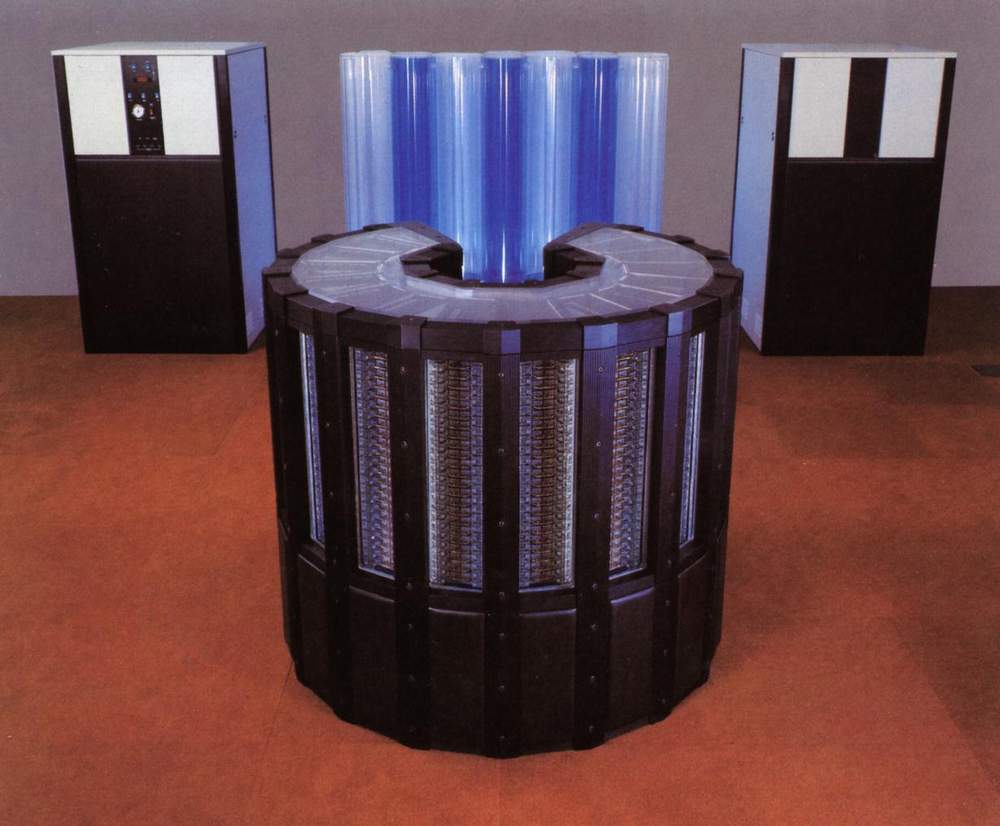
The linked article looks at a modern iPhone 17 compared to the Cray 2 supercomputer. When the Cray 2 was first built in the mid 80s, it was the fastest computer in the world at 1.9 GFLOPS using four vector processors. A modern iPhone is estimated to have slightly more than that, so in some ways the iPhone comes out on top.
However, the Cray 2 was built with vector processors, a specialized type of processor meant to perform rapid calculations on specific types of data sets. So the Cray 2 may have been faster at these types of tasks than the more general-purpose A19 processor, and the A19 may have the edge in other tasks.
The other major difference the article doesn’t discuss is what software runs on these computers. The Cray 2 supercomputer ran a modified version of UNIX System V, which at the time was owned by AT&T (and which ran on plenty of other computers as well). Although proprietary in some sense, it was much more open than Apple’s iOS operating system, allowing users to run whatever software they wanted to run on the supercomputers that they bought and paid for, and to modify many parts of the operating system itself. In that sense, the Cray will always maintain the edge over Apple and their walled garden.












I thought the linked article was a bit light – it would be interesting to read a more detailed comparison. In that article, there’s a link to Adobe, that compares the Cray 2 to an iPhone 12 that I thought was better, but still a bit light: https://blog.adobe.com/en/publish/2022/11/08/fast-forward-comparing-1980s-supercomputer-to-modern-smartphone
“[The iPhone 17] is estimated to process at about 2,073 gigaflops, or 2 trillion FLOPS (2,073,600,000,000 to be exact). That’s over 1,091 times more powerful than the ’80s supercomputer. ”
There has been a mishap with all the zeros there
Ah. Wow, that’s a big difference. Funny how easy it is to mix up numbers by such a huge factor.
2 trillion is 2•10^12 or 2•10^18. You’re log-averaging it out at 2•10^15…
So Cray2 can use vector processors, but the GPU in iPhone is ignored, even though it can do around 2000 GFLOPS?
They also ignore the fact that arm has had vector extensions for a while. Sounds like GPP vs Vector, which is never a fair fight.
And before the commenter about “fanboy” comes along, I’m not. I do have an iphone, but I’m not a fan. The 3? yeah, it was ahead of everyone else. the 17? Not better than anything, mostly ecosystem locked.
Vector processing has been on desktops since MMX. It proved useful, so they got their own registers and a much expanded instruction set, then extensions, then multiple execution units. ARM had to be able to keep up, and there are optional extensions, which I’m sure both apple silicon as well as qualcomm siicon implement.
So no this article isn’t a “fair” comparison, but the fact that the GPP edges out the vector processor of the supercomputer? That speaks volumes as to how far we’ve come.
And the neural processing units in modern iPhones, which I assume is vector-based?
Also you can compile and run your own software for the iPhone as long as you have a Mac to run XCode. And if your budget was the same as to buy a cray, you’d probably get Apple to write your app for you!
Consumer GPUs in general don’t do much in f64 so it’ll be mu h slower than the 2000gflops but still much better than the Cray.
I think vector extensions are the way to go here with NEON.
iOS runs on BSD internally, so another Unix variant.
Is not “slightly more than that”, is 1000x more. You just mistaken the units.
I was confused as well, modern tech is in TFlops/s, unless “GFLOPS” is something else not related to Gflops/s.
I’m not that much interested on smartphone VS Cray but more on how does a flagship phone compares to a 7 years old laptop ?
And I’m interested in the difference between my wife’s breast height now and 7 years ago, but like your interest, it has NOTHING to do with the article / topic
We look forward to your research paper about your wife’s breasts.
Fully illustrated, of course.
I am more interested in the relative strength of an RP2350 (the Raspberry Pico II microcontroller that costs maybe $2) and various vintage Macintoshes. The answer is that the RP2350 has about ten times the floating point performance of a Mac IIfx. Where is my jetpack?
Your doppelgangers jetpack is currently sitting on a rack outside moon base one, on the dark side of the moon in a parallel universe. Unfortunately you were born in the wrong universe and live on the wrong celestial body.
My modern touchstone is the BK7231.
I want to know how much faster a $5 lightbulb in 2026 is than any given historical computer.
It’s quite easy to show that commodity CPUs without vector processors in the mid to late 1990s could match the vector processing maths performance of a Cray-1.
http://www.roylongbottom.org.uk
A Cray-1 could hit 98M Whetstones/second and a Cray 2, 425.
A Raspberry PI 1 could hit 271 and a Raspberry PI 2, 525; a Raspberry PI 400 can hit 3407 using its vector processor. But these are computers from 2012 onwards. However, a PowerMac 7500 with a 200MHz 604e could just reach 99M Whetstones/ seconds. Even a 250MHz PowerPC 603e could get over 100M Whetstones.
http://web-hou.iapc.net/~MMC/Whetstone/Whetstone.html
And this makes sense. 1.9GFlops isn’t that impressive for a modern CPU and as people rightly point out, for these kinds of tasks, we ought to use GPUs. Grief, even the PowerMac G4 was once considered powerful enough to match some supercomputers!
https://youtu.be/OoxvLq0dFvw
Quite an odd comparison.
Well I suppose I understand it but the comparison is what’s faster at vector processing the Cray-2 or misusing an iPhone 17.
Because of course id you’re doing a large vector workload on an Iphone17 you’ll leverage the GPU and ARM vector extensions.
It is ‘odd’ comparison to me too, since a cell phone is for calling/text and an occasional picture in my world. Doesn’t need a barn burner of a cpu or fancy display…. Yet still way faster than computers in the 80s! My ‘computing/multi-media’ is done on a workstation, and on the road on a proper laptop with a keyboard. :)
Maybe if they make a foldable for more screen real estate, I do a ton on my Samsung, how much RAM does an iPhone sport these days?
Right make it a ‘laptop’ :) running Linux.
crude comparison is that you have in the pocket content of one room 40 years ago. miniaturization factor in tens of thousands. per year cca 30%.
RTFA.
1091 rooms, not one.
iPhone has the edge in brainrot video loading, concurrent number of HD ads playing over the words you want to read, and AI integration.
Fun fact with the Cray, they used one to render the CGI scenes in the movie Tron. For which they literally had to invent computer rendering and virtual cameras from scratch, and carry the scene data between computers on physical paper.
Apple inc. should be competing with Raspberry Pi, which is the spiritual successor to the Apple personal computer. If they would open the hardware, even using a sandbox mode where you can write your own apps, and a dongle that allowed GPIO on any Apple device it would be pretty cool.
Apple based SBC … Linux based of course to open up for your own applications. None of the ‘swipe swipe’ stuff of cell phones…. Just an SBC. Might be a thing. Problem though, Apple isn’t know for open hardware/software….
I really can’t find references to Tron using a Cray for the CGI. They certainly used a Foonly F1, which was a 4.5MIPs PDP-10 clone.
https://en.wikipedia.org/wiki/Foonly#The_Foonly_F1
The majority (ie, the remainder) of the Tron animation was performed by an Interdata 8/32, which was a minicomputer 16/32-bit relative of an IBM 360, but tuned for realtime operations.
https://en.wikipedia.org/wiki/Interdata_7/32_and_8/32
The 8/32 could achieve 0.571 Whetstone MIPS, about 200x slower than a Cray-1.
Ex-Cray (well, SGI/Cray) person here.
It’s actually a mildly disappointing analysis, because the thing everyone missed about the Cray was that the CPU was largely secondary to the memory and I/O system. The memory subsystem of the Cray PVM class systems (I, II, X/MP, Y/MP etc.) was a work of art. Everything in the Cray was designed to keep memory streaming through the vector registers, and the Cray 2’s main memory was essentially composed of:
“Cray-2 system common memory consists of 128 storage banks of two million
words each. Each word consists of 64 data bits and eight error correction bits.
This memory is shared by the foreground processor, background processors and
peripheral equipment controllers .. It contains program code for the background
processors as well as data for problem solution. System tables are located here
for the foreground processor but foreground program code is not. Data buffers
for the disk files are located directly in the background job data fields in
this memory.”
“Each two million word memory bank occupies one Cray-2 circuit module. There is
an independent data path from each bank to each of four memory access ports.
A background processor and a foreground communication channel are associated
with each memory port.” Total memory bandwidth is 64 gigabits per second. Total
memory capacity is 11 gigabits. Each background processor can read or write a
word of data per clock period in a vector mode.”
“The integrated circuits used in the common memory contain 256 thousand bits of
data. The bank of memory consists of a 8 by 8 by 9 array of these circuits
in a three dimensional package. The memory bank module then contains 516 of
these memory circuits and 192 logic circuits to support the memory access paths.
Memory access time at the circuit level is 100 nanoseconds. Memory cycle time
is 160 nanoseconds.”
(Excerpt from https://cray.modularcircuits.com/cray_docs/hw/cray-2/SR-2000-0-CRAY-2_Description-December_1982.pdf)
The Cray 2 actually used CMOS SRAMs (Fujitsu MB81C81A-45CVs) and had ECL to CMOS converters. It optimized memory size for performance, but even so, this was a beast of a memory subsystem using components which other vendors would have used for primary cache. Oh, and like all Cray PVM systems: no virtual memory, no paging, no memory translation. They didn’t want to take a few gate delays.
The MFLOPs rating will take some of this into consideration, but it’s a pretty poor performance metric. I would be surprised if there weren’t some applications which might still perform better on the 1982 Cray-2 than on a modern ARM-based smartphone processor. Or at least come close. They would be corner cases, but they were the kinds of corner cases people purchased Crays for in the 1980s.
A better comparison, by the way, would be comparing a modern GPU to the Cray.
I have a comment earlier on this page which claims that mid-to-late 1990s CPUs could match the floating-point performance of a Cray-1 based on Whetstones. However, I didn’t take into account the Cray-1 memory architecture, which would have been far more capable than the commodity DRAM used on those machines.