
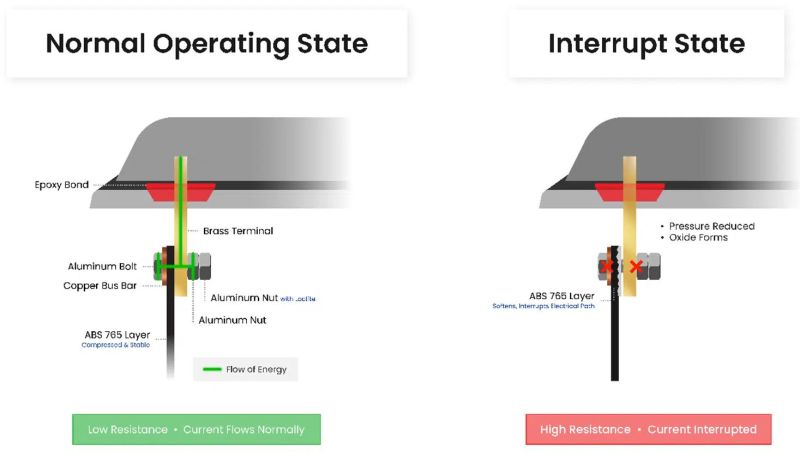
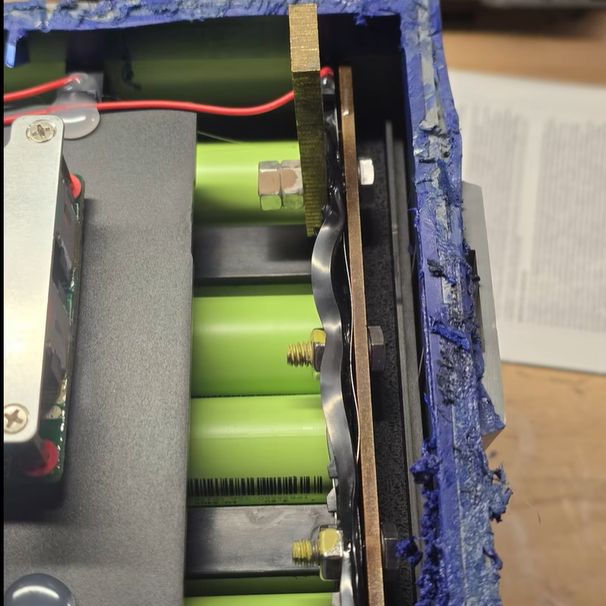
After users of Battle Born LFP batteries encountered issues such as a heavily discolored positive terminal and other signs of overheating, multiple autopsies showed that the cause appeared to be the insertion of a thermoplastic between the bus bar and the terminal. Over time thermal creep loosened the connections, causing poor contact and melting plastic enclosures. According to Battle Born, this is actually part of an ingenious thermal safety design, and in a recently published article they explain how it works.
The basic theory appears to be that if there’s a thermal event, the ABS thermoplastic will soften and reduce the pressure on the bolted-together copper bus bar and brass terminal. This then allows for an aluminium-oxide layer to form on the aluminium connecting bolt courtesy of the dissimilar copper/aluminium interface. Aluminium-oxide is non-conductive and thus interrupts the flow of current.
Of course, there are countless issues with that theory, least of all the many reports of in-field failures. We recently covered [Will Prowse] studying the death of one of these 100 Ah LFP batteries from brand-new to failure under controlled circumstances. This clearly shows the thermal creep loosening up the connection and causing poor contact between the bus bar, the bolt and the terminal, with poor contact and thermal issues resulting.
Naturally, [Will Prowse] had to address this most recent statement by Battle Born, with the latter taking care to indirectly attack and dismiss his findings. Here Battle Born’s argument seems to hinge on the removal of the lid damaging this aluminium-oxide layer and preventing the ‘thermal safety’ from working, yet not addressed are the many batteries that failed in the field and showed loose connections due to thermal creep from the ABS layer.
It’s also never addressed why these LFP batteries cannot simply be equipped with a traditional thermal fuse rather than this convoluted contraption, among many other questions that remain. Correspondingly [Will] is rather incredulous at this response, as should anyone be who has been following this saga.











I suspect the company owner is probably moving assets to hidden places as fast as he can while stalling until this becomes a legal case.
I wouldn’t be surprised…
I wonder if he (Denis Phares, CEO of the parent company Dragonfly Energy) has much left to move. He collected $8M in shares when he exercised warrants two years ago. That’s worth $300k now.
The company stock has fallen by a factor of 1000 from its peak. It’s circling the drain.
As someone who has never heard of Battle Born or Will Prowse, help me figure out who I trust less: companies potentially covering up design flaws, or youtube content creators potentially stirring up controversy to get clicks?
Normally a pretty fair question, but knowing a little about this (and a little about the fairly well established science and standards within the industry), it seems that Will is probably right and Battle Borne tried something different/ non-standard (pretty clearly because it was potentially a little cheaper), that doesn’t seem to have worked out as planned.
Will has built a pretty big following on the basis of his expertise and candidness. He isn’t known for general clickbait type content and as far as I can tell has been diligent about clearly exposing when he might have a particular bias or potential conflict of interest (think old school journalistic disclosure). If this were a departure to gain clicks it would potentially undo literally years of established credibility (but anything is possible, of course).
On the other side, they have every incentive (financial, reputational, and potentially legal) to defend their prior design decisions, even if they have since come to realize they were a mistake.
Don’t get me wrong, I support and encourage pushing the envelope of the industry standards or just trying something different – if I didn’t I probably wouldn’t read this site (ever), but I am also acutely aware that doing so doesn’t always result in a success. Even less frequently is it an improvement vs the prior standard, let alone a viable product that should be released.
Will constantly states misnomers about batteries. Or just plain false statements. Hard to say that Will is right or wrong however, this passed all required testing, so the fuse must work.
Its not a fuse, and the battery’s fail at rated load after only a few cycles. It is a design flaw. Battleborn is cooked
Calling this a fuse is so much of a stretch.
Fuses associated with integration into batteries are either the classic bimetallic/PTC self-resetting kind, or the kind that trips what’s essentially a last resort hard-disconnect which requires replacing said component of the battery when triggered.
Ol’ school easily hot-swapped laptop batteries have apart from the traditional fuse, often a fuse made with special temperature alloy that’ll essentially melt away from its contacts when the BMS triggers it, and EV batteries have a pyrofuse that literally blows a contact connection apart, which is controlled by the airbag controller.
This? This is halfassing halfassing, essentially quarter-assing.
Although in typical YouTuber fashion, Will does come off as someone obnoxious chasing a clickbait trend, which isn’t helping the efforts of people who’re being adults about the design fuckups in afromented batteries.
constantly? give some examples please, otherwise…
the UL listings they passed have to do with use combined in a product together, and reducing risk of fire when the battery is taken out of that product, stored and or transported. The other listings has this disclaimer:
“This standard is not, by itself, generally suitable for the evaluation of the safety of end-products, as it lacks specific requirements regarding charging, the effect of normal loads, abnormal conditions that should be considered, and the physical and electromagnetic stresses encountered in the anticipated environment of the end-product”
So tell me about how safe the “fuse” that isn’t a fuse and is a safety design that leaves you with dead batteries, when theres a solution to that problem that wont kill the battery forever is again….Those listing are so incredibly specific and doesn’t really cover the issues that are being found.
Noone can help you with that. Look at both sides and use your critical thinking skills to come up with your own opinion.
On the face of it: relying on an layer of ABS plastic to hold significant tension or compression on a joint goes against sane engineering practice because plastic will inevitably creep regardless of overheating or lack of.
That means the excuse given by the company is just a smokescreen. The contact will eventually fail regardless, which makes it a a bald face lie.
To make the point, for the ABS plastic layer to act as a “thermal fuse” relies on the idea that it becomes softer and creeps faster as the temperature rises. Unfortunately this is not an on/off effect. Plastic creep happens anyways and you lose tension on the joint gradually at normal operating temperature. It’s just a matter of time and thermal cycles when the joint becomes loose enough that it starts to fail.
The idea that this was an “intentional engineering choice” is just bullshit. If it was an intentional choice, it indicates that the company doesn’t know what the hell they’re doing.
So this “thermal fuse” fails UNsafe – it’s like aluminum house wiring in the 1970s: as the battery’s structure cold-flows, the contact resistance increases, increasing the temperature, increasing the flow. It’s a positive-feedback fire-assurance loop.
Exactly what I came here to say. We went through years of house fires to learn that the aluminum oxide layer formed isn’t very thick, isnt a perfect insulator, and is actually a large power resistor, making enough heat to cause fires.
On top of that, recent additions to the NEC include torque specs, because loose connections have also been found to mimic large power resistors, create a lot of heat, and start fires. At higher voltages, they can also create ignition sources in the form of small arcs.
So this company has taken two concepts that were eliminated, because of fire hazard, and called them a safety mechanism. Utterly insane.
I’m glad they actually took into account mechanical creep, but then failed to offer the temp that is needed for their graph. NEC is quite generous at 60 degree C ratings. These guys eem to imply you need a 20 degree C, and thus a single ot cable! No one would ever do such a thing. It wastes a ton of money, and makes useless weight. If they require it, I realize its not a house wiring, and I have no idea if RVs fall under NEC, but they should have giant warning lables on the needed size of the cable, as well as operating conditions (an engine bay will be more than 20 degrees C for example, accelerating the creep).
I don’t entirely blame the CEO. He is ultimately responsible leagally speaking for sure. But unless he’s the idiot who came up with this, its a case of misplaced trust. It may not even be the CTO, but some underling. Regardless, they really need to admit this was a massive mistake, apologize that no one in the leadership chain caught it, and accept liability. Yes, it probably means the company goes bankrupt. But their reputation is declining fast anyhow, the’ll be bankrupt in no time anyhow. At least accepting responsibility, lets them bow out with grace, and not cause them to be blacklisted forever, because right now, I wouldn’t trust a company with anyone from this company on their leadership team in any way!
If they really meant this to act like a fuse there would be some more positive disconnection method in there to force the connection open cleanly and deciseively, not just the random slow creep of gooey plastic and a poor / intermittent contact.
Their “explanation” replaces “this is a terribly engineered connection” with “this is a terribly engineered fuse”, which isn’t really any better.
Reading your comment provides plenty about your attitude towards both parties. My “click” is that you are seaking for attention (clicks) by “staging a battle”(“who I trust less”).
As a senior engineer who has designed electrical connectors for the last 15 years, and seen multiple battleborn failures, I can tell you for certain that you should listen to Will Prowse. He has done extensive testing on these batteries to prove what any decent engineer would tell you is a design flaw.
You shouldn’t listen to Prowse unless you already know something about this stuff because he will test a battery on his (completely un-calibrated) equipment, get a capacity of, say, 98% of what’s on the label, and screech about how the battery is “under capacity” and act like the manufacturer is trying to rip people off. Even if his equipment is accurate and calibrated, the capacity tests are often at a specific temperature, which he never replicates.
I strongly suspect he’s getting some sort of kickback and is looking for something wrong in the products he’s not getting kickbacks on.
He’s also put out video guides to setting up a solar system that strongly imply you just have to slap stuff together a bunch of stuff you buy, and you’re good. Not a single mention of electrical/building code and a pretty fast glossing over of safety issues involved in batteries that will put out hundreds of amps at ~48VDC. Relying on the BMS as a safety device is really poor practice.
I wouldn’t trust him for anything other than the safety cutoff testing he does on BMS’s.
I am a Electronic Engineer. You are right that Will is really tough on his capacity tests. But you should look real closely on his Battery Electrical Safety. He always recommends a fuse or a breaker on all individual batteries. Safety is his number one concern.
This bafflegab sounds incredibly like any political discourse these days.
UN38.5/UL 2054?
The UL certification is just looking that the battery isn’t catching on fire when you short it out. Passing it doesn’t mean the battery is designed properly.
Will Prowse,has been,around for quite awhile now and has done dozens of battery tear downs and I would be more than,happy to side with him any day. We tore down a Battle Born battery several months ago after a customer left one to be recycled and the problem he described is real. So, do your research but Mr Prowse isn’t sprouting crap in my opinion.
He’s not spouting crap, not at all. But he’s self-admittedly and unabashedly monetarily-motivated, and knows how his bread gets buttered. Not that there’s anything wrong with that. I’m not defending either the battery company or his crusade against them, but know he has motivation and bias too.
The share dealings of the battery company’s parent executives are a matter of public knowledge through the SEC filings, which are interesting. There has been a lot of retail stock churn in that company too — a lot around some of the release dates of the videos. The retail stock trades are not reflected in the filings, but it does make you wonder who’s making that dog’s tail wag.
Do you live under a rock? Have you heard of renogy or anker? Same overpriced stuff just a
Will Prowse does tons of battery safety, battery teardown, solar install design, etc… videos and a website with diagrams, theory, etc… Most of it is becoming more common knowledge today, but he was one of the few posting really good information in these arenas for years. Great resource if you’re getting into solar and/or battery backup systems.
“The basic theory appears to be that if there’s a thermal event, …”
REALLY? Didn’t Will Prowse show there was deformation and connectivity issues at only 50% of rated “steady state current” spec?
Because they spent all that money to get the UL and CE ratings they can not change the design without significant expense and it also indicates a design flaw so all those useless batteries sold would have to be replaces. My guess is that they will stick to this line of defense until a lawyer(s) get involved because of loss of life and/or $10s-100s of thousands of dollars in lost property/damage.
I’m not sure enlarging the hole through the ABS and using a shouldered bolt or a spacer would constitute enough of a change to require a recertification, as the change is entirely captured, IE does not change dimensions.
He’d better get a patent on ‘corroded aluminum fuses’ /s (what a crock)
“Battleborn Defends Their Design Flaw”
There, I fixed the title for you.
I’m an engineer that has been designing electrical connections for 15 years, and there’s no way I would ever put plastic in the middle of a connection. It is NOT an effective fuse. If you want a fuse, put in a fuse, not a cheap piece of plastic that can cause arcing.
Solid 💪 content here
Your work consistently exceeds my expectations! Thank you so much
This information is going to change how I approach things moving forward
Outstanding message here
This content perfectly captures what makes your platform so special and unique 🌈
Great insights here
Love how you make learning feel enjoyable 💪 and accessible for everyone here
Thanks for making complex topics easy to understand for all of us 😊
Love how you celebrate others in your community so genuinely and regularly
Thanks for meaningful content
You create content that makes people feel less alone in their struggles
This is why your platform continues to grow and thrive so beautifully every day 🚀
This post touched my heart and made me think 😊 about gratitude today
You consistently prove that social media can be force for good
Many electronic component companies make fuses, both thermal and current-based, and they are accompanied by test and certification reports from independent labs before any competent engineer chooses them. Where is the UL or other independent lab’s statement for this strange thing? For a battery company to design its own fuse, especially one sounding so far-fetched! – It loosens on purpose and then depends on an aluminum_oxide_layer forming in the contact area? It sounds like they made this up after the fact.
This particular company leveraged on attestations of high quality, US-manufacture, and their origin as US Marines to sell their products at a premium over other batteries. Surprise! Given the field failure reports, it doesn’t sound like they knew what they were doing.
I prefer Stolen Valor brand batteries
Nevada is the Battle Born state. It’s written on the state flag. Battle Born batteries is based in Nevada.
It sounds like boomer cringe though, like something you’d see on an angry skeleton t-shirt worn by a fat dude riding a harley.
Fortunately I was saved from buying one of these Obviously Defective Batteries (to paraphrase DJT) by my relatine poverty due to tariffs and gas prices.
You know an American company is not telling the truth, when any words are coming out from their mouths.
When an American is talking, assume 49% Bullshiat, 49% lies, and maybe 2% of something not either Bullshiat or Lies.
Pro tip: if you see an aluminum object that isn’t anodized, coated, or painted, you are looking at aluminum oxide. That’s how aluminum works.
For something that’s supposed to protect against thermal runaway, this is awfully slow acting.
Yeah, I wouldn’t put my money on “surface corrosion” to prevent a failure mode that can take mere moments to establish itself.
“According to Battle Born, this is actually part of an ingenious thermal safety design”
I think you misspelled “igneous”. /j
Yeah, that’s probably more accurate than “ingenuous”.
So…. is there a patent for this novel “thermal protection system” or are they just trying to explain away failures due to poor design, materials, and surface corrosion?
In the public SEC filings, Dragonfly Energy (Battle Born parent company), like all public companies, is legally obligated to disclose many details of the company, its suppliers, risks, and detailed financials including personal dealings of the company executives and principal stockholders. These are always interesting reading, especially when a company is hemorrhaging cash.
Dragonfly discloses in their filings that their battery cells are made exclusively by two suppliers in China. Their BMS is made by a single supplier in China. They ship those components to a warehouse in Reno, literally bolt them together, put them in a plastic box, and put a “Battle Born Made in USA” label on them.
THE value-add manufacturing process they do is bolting the pieces together. And that bolt fastener is the part that is being highlighted in these discussions.
Pretty sad that its always the “Battle Born Americans” screaming about Made In Murica.
And its the Murican Made piece that’s the piece of shit.
Yeah, “Made in USA” is a red flag at this point IMO.
Everyone is missing another major design flaw, the brass strip. Brass is never used for DC electrical because zinc will leach out of the brass and actually cause high resistance connections.
Major reputable companies like Littelfuse produce solid brass busbars intended for DC applications. I’ve never heard of zinc leaching being an issue for busbars. In fact, some searching only brings up the issue in relation to brass plumbing exposed to corrosive or acidic fluids. Do you have any sources that support your claim?
Looks liked planned obsolecence, half cooked. Badly baked and diiisguised as a ‘fuse’
NEXT WEEK: Battleborn explain how 2+2=5
it’s not a bug, it’s a feature!