
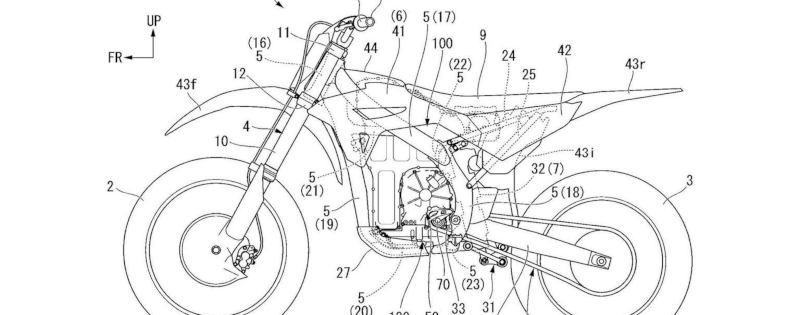
If you ride a motorcycle, you know it is a bit of an art to manage the transmission on a typical bike. Electric motorcycles lose some of that. You usually just have a throttle and a brake. No transmission and, crucially, no clutch. Honda just patented a simulated clutch for those who want the old-school experience, according to [Ben Purvis], writing for Australian Motorcycle News.
This isn’t just a do-nothing lever on the handlebar. There’s haptic feedback to feel when the clutch engages. The motor responds to your actions on the lever. If you pull the clutch in part of the way, the motor loses power up to the point where there is no engine power with the clutch fully in.
Most interestingly, the software understands that when you raise the throttle with the clutch in and then release the clutch, you expect a sudden burst of torque, and it will accommodate the request.
If you are a casual driver, this may seem like a gimmick. However, according to the post, motocross racers rely on precise power control like this.
If you do your own conversion, you could probably do something similar. Or, we suppose, a new build, if you prefer.












Finally, this will mean we’ll be putting the rear brake back on the foot again. Hopefully they add simulated gears as well.
Hahahaha, just a bunch of extraneous gears spinning in a gearbox full of oil that don’t connect to anything. “Electric motorcycle go brrrrrr!”
it seems to include as part of the invention ‘haptic feedback’ — a rumble pack for the handlebars. It’s possible they’ve stumbled onto the pinnacle of next generation motorcycle control but i think it’s far more likely that they’ve failed the task of applying user feedback.
I’m thinking of the infamous New Coke survey that briefly killed Classic Coke. Honda has clearly made a ‘serious e-bike’ and they gave it to a bunch of ‘serious riders’ and of course for their first hours of exposure to this new instrument, they are feeling all kinds of shock. They say, “i can’t feel the motor, i can’t feel the road, i can’t feel the power.” And i imagine Honda is rather idiotically saying, that means they need to reproduce the feel of an ICE motor.
But what it means is the riders need to learn the new bike, which has many new characteristics. They need to forget trying to feel the gas engine and learn how to feel the power of electric. It has plenty of power and plenty of feeling, they just aren’t atuned to it yet.
I have no idea what people really want in an e-bike but anyone who is trying to reproduce the UI of an ICE engine with a fake clutch pedal and a rumble pack obviously has less idea than i do. They need to sponsor a small group of elite riders to actually learn the new technology early in their careers and then learn from their experience after they’ve mastered it.
I could see why you might want it to feel more familiar, and it really doesn’t seem like a big problem to fake it to a good enough level so why not do so.
I agree the rider almost certainly can adapt, but given how physical 2 wheelers are a serious change in how it feels is more like learning to walk on a prosthetic leg or stilts I’d suggest – a rather big learning curve, that might have you falling on your arse a few times. It is not like moving the indicator stalk to the other side of the wheel where the muscle memory reaches for something that then feels wrong and reminds you – that sort of difference is annoying but has no bearing on your control of the vehicle.
I could see legitimate use off-road. Trying to manage torque while running up a rocky cliff face only by rolling the throttle back and forth sounds very tricky… Sometimes it helps to have a lever that cuts it off quickly and then allows you to slip and get a nice blast of torque at just the right moment.
something that can’t be overcome or faked around is the inertial changes resulting from the massive battery pack
Is the battery pack heavier than an ICE?
i oculd be wrong but i am pretty sure the answer is yes. in an ICE car, the battery typically weighs at least 1000 pounds, whereas an ICE engine in a Honda Civic (no longer a small car, remember) only weighs 400 pounds at most
Rather depends on the comparison devices, some bikes have really really heavy engines, for bikes anyway and the question of just what endurance is required, a very small battery would be enough for many folks. So some electronic motorbikes are going to vastly lighter than some ICE ones though probably not with a fair comparison.
In most cases I’d suspect the comparable designed role battery bike will end up heavier, but probably not by very much.
But E-motor also has more torque.
The question is: is that torque usable? You want to be able to control the torque, because that means that you control the grip and wheelspin. With a motorcycle with a clutch and gearbox, you control the torque through the clutch. How do you control the torque on an electric motor?
It’s not just about having loads of torque to your disposal, it’s also about how you can control that torque. How do you control torque on an electric bike?
Well, Honda thinks they have an answer to that question.
Maybe you need to be a rider to understand this?
The bottom line is that any conventional bike has TWO controls to control the speed and acceleration of the bike: throttle and clutch. You probably won’t understand this until you start riding a motorbike yourself.
You might think an e-motor has more torque, but it’s still not enough in some applications. Yamaha adds a flywheel and mechanical clutch to their electric trials motor bikes in order to dump even more instantaneous torque into the rear wheel.
these aren’t familiarity bikes, they’re sports bikes. and we’ve seen in practice in sport, people who do learn to use a prosthetic perform much better if they use a prosthetic designed to help them run than if they use one designed to mimic their missing limb.
Somebody training to be an athlete or overcome their injury as a para athlete is very different to the guy riding a bike for fun, or to herd sheep or something similar – just because its not a regular commuter bike doesn’t mean the only folks using bikes like it are serious competitors.
If it is their profession spending months changing their brains wiring and falling off plenty of times along the way as they master the new control behaviour is perhaps acceptable, even ideal if the potential performance is vastly higher. But how many hobbyist or folks for which this bike is a tool really want to dedicate that much time or put up with fighting the unintuitive machine.
yeah and for commuter bikes no one cares about popping the clutch to generate a burst of torque
There’s two reasons why a manual gearbox ICE has a better UI
1) your gear selection scales your throttle response predictably
2) clutch is instant torque off, both ways (no engine braking)
Number 1. is about feedback. You can hear and feel what your engine is doing, and know how it’s going to respond to throttle a lot more accurately. Number 2. is about what happens when you let go of the throttle. Sometimes when you have marginal traction, not enough to steer and accelerate/brake at the same time, you want to disengage the drive train and coast. This is not an option if your motor is constantly engaged to the wheels. Even if the motor is technically free-wheeling, its inertia will offer extra resistance that can cause your wheel to slip while you’re trying to steer, which can end up in the ditch.
yeah this isn’t a real clutch though, it’s a mode control switch for an ESC
Reply to Greg A from someone with 17,600 miles on a Zero FX and enough off-roading to be rebuilding skills from my years off in college: I miss the clutch and gears zero. I climb non-muddy hills in 30PSI 90% dual-sport tires and full road gear better than in 15PSI knobbies because I have absurd torque control and am never “off the power”.
I’m sure a more skilled rider than I would need a couple months or so to translate skills, but Yamaha already made an electric trials bike (this one has a clutch… until the tech advances) and Stark’s Vargs are already out racing sans clutches.
I don’t care if you want a twist grip, a thumb throttle, a faux clutch lever, or even a pedal – do what you want, but I will spend a long time skeptical of the value in mixing two throttle inputs.
Having driven off-road I can say this system actually sounds useful for technical riding where some of these techniques take a fair while to learn and use effectively – if you ignore the word “clutch” and treat the extra lever as a way of communicating to the motor controller what sort of response you want it’s an entirely sensible idea, sometimes you really want a sharp jolt of power from dumping the clutch, other times you may want to feed power in incredibly gently to avoid losing traction.
A system that just tries to respond based on how far & how fast you twist the throttle may not be as responsive as one that lets you signal your intention with a secondary input.
For guys doing things like trials where they exhibit bike control that would embarrass a mountain goat I can see this really taking off.
If it upsets you, just don’t use the lever.
specifically, i’m skeptical of the idea that you can avoid that learning curve with such a different machine, and i’m downright certain that if you do go through the learning curve with a truly novel control mechanism then you will be far ahead of anyone riding around on an ICE emulator
They should make it easy to disable and remove the fake clutch, I rode an ebike and thought it was okay, I still like my klr650 thumper best but if I was to buy an ebike I would want it as simple as possible and easy to repair (Murphy’s law)
Just unplug the switch
I loved my KLR600! 😁👍
The Hyundai Ioniq 5N is an electric car which apparently has simulated gear changes and engine sounds, which one old-style racer says is necessary as an auditive and haptic speed feedback.
” Hyundai’s e-Shift uses the same formula. It is not the way of the future, but the way of the past applied to the future. ” although he acknowledges this will probably not be applied to any car in the 2050’s.
Source: https://insideevs.com/reviews/716661/hyundai-ioniq-5-n-shift/ (Pay-or-accept-ads)
electric AE86 with everything simulated, https://youtube.com/shorts/hk5J_e0gUCI?si=FFy3ec2M2ZX7DsQZ
Cool! Thx!
Actually somebody get Elon on the horn, simulated coal smog on the cybertruck would be incredible
I thought of plumbing a fog machine into the wheel wells of my EV for simulated burnouts while driving in tight circles. I guess there’s still time.
Yes, it would go well with the simulated ability to actually go somewhere.
Actually I see a future hackaday article where someone uses 50 vapes to simulate exhaust fumes! HAHA!
And for a small additional fee you can have the “British Experience” upgrade. A small bottle of (tinted biodegradable vegan oil) will drip on the pavement under it when the motor’s not operating. Additionally the Lucas option can be enabled that creates a pseudorandom intermittent failure trajectory in the electrical system, but only among parts that are irreparable and unobtainable. This is based on AI analysis of location, time of day, weather, and social contacts nearby in partnership with your phone provider.
Happy motoring!
Does the upgrade come with a brake cylinder that leaks fluid and that has internal springs that are specially designed to go flying into dark corners of the garage when doing the annual rebuild?
The digital springs are part of the upgrade package that encrypts your brake cylinder until they’re retrieved from an obscure corner of the Dark Net. Bring rubles.
“small bottle of oil”… And if you get the Harley upgrade, in addition to the oil, they have a motor installed in the steering column that fights you when you try to turn. But it goes “blaaat” in the straights.
also need an unbalance the motor to get the right amount or vibration
I can’t believe this can be patented.
This +1
Literally just a a software patch
electric motors have torque curves too! So why not put a real clutch/gears on it?
Exactly, if control of the torque is what you need/want, would a normal motorcycle clutch be of any value in an electric motorcycle?
Don’t believe the gears are required, not unless the motor has a small effective RPM. And if that was the case a single automatic 2-speed drive could do
I assume that most people making fun of this “invention” don’t actually ride motorcycles.
All electric motorcycles I have seen so far have the motor set to slightly brake and recover some of the kinetic energy if you let go the “throttle”, to simulate engine braking and save juice.
In racing settings this can be catastrophic and can be adjusted even in modern ICE based motorcycles (“Engine Brake Control” as most ECUs call it). A full drive train disconnect mechanism is an advantage in serious competition riding, regardless of the energy source, at least in off-road competition.
It makes perfect sense to me: release throttle to experience a preset drag, pull clutch to fully disengage immediately, regardless of throttle position. That it will meet the expectation of an experienced rider is another boon.
You said it – people love to jump on stuff like this but if you actually think about it, adding an input to the motor controller that tells it what you want it to do, not just a 0-100% throttle but also the way it’s delivered or the way it behaves when you let off, is a really good idea.
The grumblers can just not use the lever – or more likely never buy or ride one in the first place and just complain about new things that don’t affect them on the internet.
This is precisely the point in the patent. You want the instant response of dumping the clutch on a spinning engine, but you don’t want it to jerk around unstably when you’re trying to be smooth.
The inertia/clutch system is familiar, so they’re going for that. But for a newer generation, there may be more intuitive or even more flexible possibilities out there. After all, it’s just mapping controls to motor torque in math. An “instant torque” switch? Or something more clever?
(My car does this in “eco” mode. It just makes the pedal response curve less steep, and for most driving, I actually prefer the feel.)
I think you’re putting too much emphasis on “dumping the clutch” as if that’s what you normally do.
What the clutch is usually for is slipping. The issue is that your throttle has all the engine torque on tap, and it’s difficult to control exactly how much you’re applying by tiny differences in throttle position, so you’re modifying the response curve with your clutch as needed so you don’t wipe yourself out. Of course it’s fun to dump the clutch and throw gravel, but more often it’s for smoother takeoffs.
It’s the same with cars. If you dump the clutch in the winter, the wheels just spin in place on the icy ground and you go nowhere. You put it in second gear and ease the clutch gradually, and that limits your available torque and applies it more smoothly.
Newer automatic cars need all sorts of clever sensors and slip control systems to guess how much torque you want, and then they end up fighting against you when they get it wrong. It works “ok” most of the time, but really makes you into a passenger in the driver’s seat because you no longer have the control, or the feedback to feel what’s happening with the wheels on the road.
“What the clutch is usually for is slipping. The issue is that your throttle has all the engine torque on tap, and it’s difficult to control exactly how much you’re applying by tiny differences in throttle position, so you’re modifying the response curve with your clutch as needed so you don’t wipe yourself out. Of course it’s fun to dump the clutch and throw gravel, but more often it’s for smoother takeoffs.”
HUH? have you ever ridden or driven ANY vehicle with a clutch? Because your talking out your ass.
The clutch is usually for disengaging the engine between gear shifts so you dont grind your gears. You do not “modify the response curve with your clutch” Car or motocycle, either or, is controlled by modulating the throttle. The clutch is not fiddled with endlessly as you accelerate and decelerate, And it certainly isnt meant to slip.
The closest thing to what you so incorrectly imply would be the application of the TORQUE CONVERTER in an automatic transmission.
Yes, it is for that too, but that’s just a coincidence of having manual gears that need to be shifted. That’s besides the point of the clutch as a control input, for instance when you have no gears to select on an electric bike.
Correct, you don’t slip the clutch while driving and if it does slip then it’s broken. What I’m talking about is modulating torque with the clutch when you start moving. That should have been obvious from the context.
Dumping the clutch when you start off is usually the wrong thing to do.
The idea is that when you’re moving at very low speeds near stopping, and need finer control, you don’t want the full range of the engine throttle. You got the full power of the bike on the throttle ready to go, but you only need 1% of it, so obviously it’s going to be too coarse to adjust with throttle alone.
You instead control the bike’s movement by careful application of the clutch and brakes:
https://youtu.be/8MzsHfj096g?t=288
Of course the usual suspects are going to complain “But you’ll burn out the clutch!”. No you don’t. It will wear some every time you slip it, but your clutch plates are ultimately a consumable item. That’s how it’s meant to be used.
Funny how americans thinks that driving manual shift is a work of art?
It is the original way of driving an ICE.
Pedantry corner: Well, technically… The first ICE car, the Benz Patent Motorwagen didn’t have gears. However, the first car /sold/, the Benz Patent Motorwagen Model 2 did have two gears, so you’re mostly right! ;-)
A work of art? Never heard anyone come across as such.
A skill, sure. An increasingly rare one, even in America.
Superior to automatics, in many cases yes. Many Automatic transmissions are poorly tuned, imprecise, and overly complex making them prone to failures.
Funny how nonAmericans are so obsessed with trying to mock Americans. When most of us dont even care enough about you to know where in the world you are.
“If you are a casual driver, this may seem like a gimmick.”
No, no, no, not at all. You have these small Honda motorcycles, Honda Cub. 125CC. Great as a commuter as it pretty much never breaks and runs just on fumes at all times.
The problem with those things is that it has no clutch lever so you have to learn over a long time how to drive it. It has 4 gears, but no clutch lever as the clutch is built into the gear shifter. It’s frustrating. Now maybe, for someone who has driven one around the world 20 times, it feels natural. But I can’t even.
A clutch lever is, as far as I’m concerned, a very important part of the motorcycle and I think it should be mandatory and a part of safety regulations.
I wouldn’t want any casual driver to get on a motorcycle without a clutch. That’s just asking for a serious accident.
I have driven a lot of crazy stuff and I easily adapt, from weird Italian bikes with the rear brake on the left and the gear switcher on the right, to trikes, to vintage customs. But not having a clutch is just bad.
It all depends on the application. The Honda CUB was designed for simplicity and utility. Its semi-automatic clutch design allows the rider to hold their cargo (or just smoke a cigarette) with the remaining free left hand while riding. The CUB has throttle and front brake on the right hand, shifter and rear brake on both feet. Another very clever design by Honda!
i am not a motorcyclist by any stretch (i ride pedal bikes a lot though), and i spent maybe half an hour on a CT70 and it was the most foreign thing in the world for me, to control my torque by moving my hand instead of putting real power through my feet. i was notably unsafe, because i had no way to cut off power instantaneously that i understood. it didn’t have a clutch but if it did, it wouldn’t’ve done me any good because i wouldn’t’ve known how to use it. only clutch i know how to use is a bicycle freewheel.
every motorcycle should have pedals you have to spin to tell it to keep torqueing. as a safety feature.
When you consider that Honda sold 10s of millions of the Cub and its descendants (Wave, Innova etc.), not to mention all the Chinese copies they spawned, have you considered that,in your case, the problem might be the rider?
I don’t understand why automotive companies think people want things like simulated shifting and simulated IC engine sounds. Is it for all those people requesting windshield wipers on the inside of their vehicles to clean off the spittle when they make their own simulated vroom vroom noises?
Are the auto companies are trying to appeal to millennials to sell more vehicles to a demographic that doesn’t drive or even have licenses?
I refuse to buy EV’s at this point because the insurance costs 2x more than a comparable ICE vehicle. It’s still cheaper to by an HEV or PHEV and pay for gas than it is to insure an EV. I can buy two ICE motorcycles for the same price as an equivalent EV motorcycle that only comes with a peanut sized “fuel” tank that takes 8 hours to refill. Fix that and I’ll buy an EV, I don’t care about simulated shifting and ICE sounds.
I think the real reason for these patents are corporate job creation and job security for deadwood employees trying to avoid being replaced by AI.
I want engine sounds. I’m used to hearing how fast the car is moving, instead of constantly checking the speedo for drift. When you decouple the engine speed from the road speed with an automatic gearbox, my speed regulation starts to go all over the place.
Ever work on the electrical wiring of a Honda motorcycle from the 80’s? They’ve been perfecting “complicate” for a long time.
If you want the “best of both worlds” (for whatever measure that is for you – might also be the exact opposite) the Horwin CR6 Pro is electric with a manual transmission. Was tempted to try one but they are pricey for what they are and don’t appear on the second hand market often.
I’ve ridden a lot of bikes over the last 30+ years – on the road and racetrack, two stroke and four stroke, singles, twins, triples, and fours.
I’ve ridden a few electric bikes over the last 6 years, and can say that there’s little I miss since ditching the Ducati a couple of years ago and going electric only. I dont miss the clutch, despite occasinally flailing around for it through muscle memory.
About the only thing I miss is clicking down a couple of gears on a supermoto going into a corner and having the back wheel skipping out but under control into the corner. Then again I’m getting a bit old for that sort of stuff anyway.
First Toyota with the EV ‘virtual transmission’ AE86 and now Honda with a ‘virtual clutch’. If they would just concentrate on making the Hybrids feel like sports cars I might believe they were serious. They had an opportunity to allow a sport mode that could accelerate a Prius like a 454 SS Hot Rod, or a Liter Bike, depending on your style. It’s just software and a Lithium pack that is designed for high peak amp draw. This gimmicky junk is just not where it’s at for me.
First they should fix ICE bikes and make their UI behave like horses, because that is what real riders are used to. /s
Well as a 58 year old, 27 year motorcyclist, the last thing I want on my EV bike is a clutch, at bike 7 I switched to a Honda Dual clutch, NC700, went through 4 variants of that before my first Zero FX and now a Zero SR/S, it has more than enough controllable torque for my commute.