
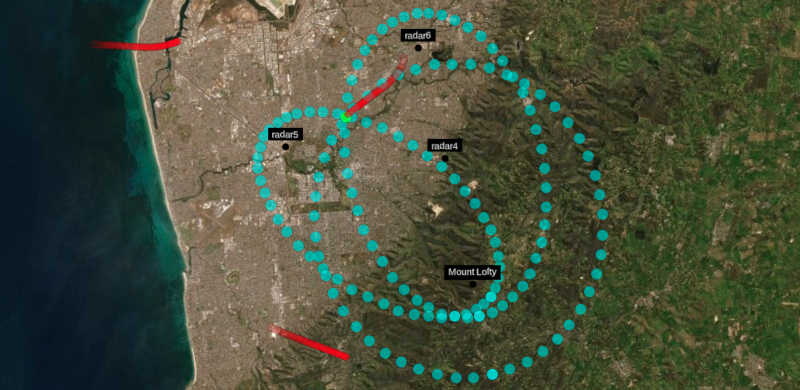
It is an old trope in submarine movies. A sonar operator strains to hear things in the ocean but dares not “ping” for fear of giving away the boat’s location. Radar has a similar problem. If you want to find an airplane, for example, you typically send a signal out and wait for it to bounce off the airplane. The downside is that the airplane now knows exactly where your antenna is and, these days, may be carrying missiles to home in on it. In a recent post, [Jehan] explains how radar, like sonar, can be passive.
Even if you aren’t worried about a radar-homing missile taking out your antenna, passive radar has other advantages. You don’t need an expensive transmitter or antenna, a simple SDR can pull it off. You don’t need a license for the frequencies you want to use, either. You are just listening.
The key is that radar uses two different effects. One is how long it takes for the echo to return. The other is how much the Doppler effect shifts the frequency. Suppose you are using an FM radio station as a passive radar “exciter.” You can pick up the signal directly and also detect the same signal bouncing off the target. You can compare these two and determine the delay added by the reflection and the Doppler shift.
This does have one limitation. In a regular radar installation, you know that a certain signal delay means the target is somewhere on a circle a fixed distance from your antenna. With passive radar, you wind up with an ellipse instead of a circle. You can’t “scan” a passive signal like you do an active one, either.
But all is not lost. Similar to stellar navigation, you just need to get multiple ellipses by using different broadcast stations. With two stations, you’ll probably narrow the position down to two points where the ellipses intersect. Three different fixes are often enough to get a particular point.
Build your own? Of course. Don’t forget that the best transmitter to use might not be on the ground.
Title image from the post sourced from https://github.com/30hours/3lips.











Similar to stellar navigation…. you mean celestial navigation.
It is only considered ‘stellar navigation’ if the navigator does a good job.
Play around with passive radar, but be REALLY careful about how you release code. It often falls under ITAR restrictions, and is considered a “munition” and can lead to “criminal fines up to $1 million per violation and 20 years in prison, or both. Civil penalties can exceed $1 million per violation”
Has this happened to anyone?
Has ITAR been used to justify prison terms or simply ruining someone?
Yes.
rtl-sdr dot com had software on GitHub to do exactly this with their HydraSDR hardware. And they removed all the relevant repositories. The rumor at the time was that since they were hosting on Infrastructure owned in the US and their hardware could potentially be used in active war zones that they were given some kind of ITAR warning. Strong enough for them to scrub everything related to this from GitHub.
In the USA, the first amendment has been shown to offer strong protections for source code and documentation. See, for example, the whole “This shirt is a munition” campaign in the mid 90’s regarding encryption.
I was in college on block release in 1980-1982 from my employer. There was an article in Omni magazine entitled “will encryption make gentlemen of us all?”. It was about the RSA algorithm, and the US government and NSA views on who should be allowed to access it. It was argued that criminals with encrypted communications would be bad, but the NSA wanted it for the military/government only.
Except a shirt is not a reasonable munition.
Many things in ITAR are either weapons systems, or components of weapon systems.
There is a BIG difference between arguing in court about whether your Encryption or Security Auditing tool is really a weapon, and “This software is can locate my jets and help shoot them down”.
I’m not agreeing with ITAR. I find a LOT of it stupid, and worthless to enforce.
Limiting American made thermal cameras to 9fps is not a meaningful defense when bib0limited ones are produced at-scale for pennies and readily available on the open market.
You might want to google Microsoft Word in relation to this. Rules beget rules.
For those that care the linked article is a written article (not you tube video). And a good one at that. So that is nice.
.
And if you, like me, were wondering how you passively listen for radar to something that isn’t emitting radar waves, the article talks about listening for reflected FM broadcast or digital TV signals so not radar frequency per se.
Huhn. Almost didn’t recognize Adelaide. Old family home on one side.
It’s been a while. The place has grown.
Cool to see this stuff come out of there.
I remember reading somewhere about muon-based navigation (I think it is called “muometric”).
I lost the link, but the gist was that muons from cosmic rays are detectable with the scintilator crystals, and potentially can serve as the replacement for the GPS signals that are weak or unreliable. This seem to be a fork from tomography that relies on muons as well.
You’ll have to connect the dots here for us. What do muons or navigation have to do with passive radar?
Muons are detectable everywhere on Earth and triangulation using known standard candles can be done with merely Raspberry Zero amount of computing power. Average GPS, btw, has even less than that, around Arduino Mega.
Navigating using beacons has been around longer than these. Decca, etc, but celestial navigation is even older.
Navigation in general is not taught in one reply paragraph on HD, so I won’t even try. Sorry.
RE: passive radar, sorry, was assuming the dots are already connected – cosmic rays have been battering Earth for billions of years. In a sense, those are the ever-present ping signals, and, IMHO, in many ways are better than the artificially-generated radar ping signals.
There’s something very much missing here in the explanation of how muons might work for detection and tracking of a remote target.
First, how would you detect when a target gets illuminated by a muon shower?
Second, a muon shower from a cosmic ray event covers only a few dozen meters, with a long low amplitude tail out to a few hundred meters. If you and the target are more than a few dozen meters apart any events you see will be uncorrelated with any events the target sees.
So I’m missing how this can work. Can you explain?
I am not interested in illuminating some kind of target, so I stand corrected.
“cosmic rays have been battering Earth for billions of years.” Given that cosmic rays are particles not EM radiation, how are they germane to passive radar?
You should not need two transmitting stations to listen to. You need two listening stations with some separation
You know the bearing and range to one transmitting station. The echo gives you a range ellipse on each station. Where the ellipses intersect are the only possible positions for your target. That is only going to be two points.
From there, just like with celestial navigation, you can use some common sense logic to determine which point is the real echo.
If you shield your listener (so it can only hear from a limited bearing range) and scan it (mechanically or electronically) you can use this to directly determine range and bearing too.
On the other hand, you should not provision two receivers and two listening sites, and expose yourself by communicating between them, when you only need one.
IIRC there was a certain amount of dismay when it was found that “stealth” aircraft could be tracked by the signal loss they created by absorbing RF from cell towers. Sort of an inverse passive radar.
https://web.archive.org/web/20101115070627/https://www.telegraph.co.uk/news/uknews/1309952/Mobile-telephone-masts-can-detect-stealth-bombers.html
I used to wonder about that. A stealth aircraft that returns the signal of a small bird – surely birds don’t move at hundreds or even thousands of km per hour?
Depends on whether they’re five-ounce swallows carrying a one-pound coconut, obvi.
It’s not that the plane masquerades as a bird. No — the small radar cross section just means it’s harder to detect at long range than a conventionally non-stealth plane.
The problem is that, despite the ‘stealth’ coatings being radar-absorptive, the majority of the stealthiness is got by making the plane shaped so as to not reflect radar back to the transmitter, but instead make the portion not absorbed be reflected somewhere else.
So if you happen to have a countryside full of millions of transmitters (cell phone sites), then a field full of receivers can catch some of those reflections off surfaces of the wannabe-stealth plane that are reflecting those radio waves not back to the transmitter sites, but to other random locations, which includes your receiver sites.
That would take a lot more computing power though. Obviously not an insurmountable obstacle for a nation-state, but a large number of receivers constantly processing the noise of cell towers etc looking for anomalous spikes of reflected signals and then equating those back to a fast-moving object is a substantial undertaking.
And yet it is still affordable by Great Britain and even “fits in a Land Rover”, per the fine article.
Fun factoid. There is a theory this was used to shoot down the F117A in the Yugoslavia conflict. They less homed in on the airplane as they did the air wake disturbing terrestrial radio stations. Then, they knew where to fire a missile which would then get close enough for a lock.
That is absolutely not what I heard they did.
Either lost in translation or fancifully misinterpreted.