
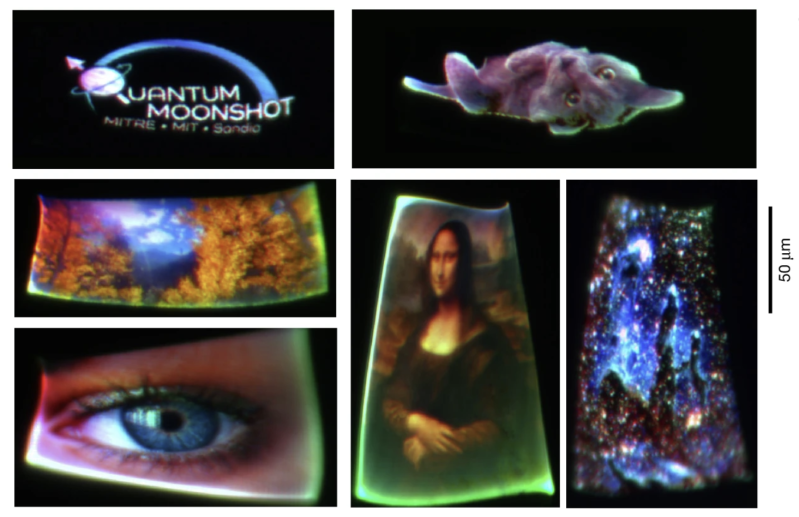
Lasers are cool and all, but they can be somewhat difficult to control at times. This is especially true when you have hundreds, thousands, or millions of lasers you need to steer. Fortunately, the MITRE Corporation might have created exactly what’s needed to accomplish this feat. While you might expect this to be done in a similar fashion as a DLP micro mirror array, these researchers have created something a bit different.
A ski slope like a MEMS array is used to contort light as needed. Each slope is able to be controlled in such a way so precise that entire images are able to be displayed by the arrays. This is done by using a “piezo-opto-mechanical photonic integrated circuit” or (POMPIC). Each slope is constructed from SiO2, Al, AlN, and Si3N4. All of these are deposited in such a way to allow the specific bending needed for control.
While quantum computing hasn’t hit these slopes yet, that doesn’t mean you can’t look into the other puzzles needed for the quantum revolution. Quantum computing is something that people have been trying for a long time to get right. Big claims come from all the big players. Take Microsoft, for example, with claims of using Majorana zero mode anyons for topological quantum computing.












“Here we report a photonic ski-jump—a nanoscale waveguide monolithically integrated on a piezoelectric cantilever—to overcome these limitations. It passively curls ~90° out-of-plane within a less-than-0.1 mm2 footprint, emits a submicrometre, broadband diffraction-limited beam, and exhibits kilohertz-rate mechanical resonances with quality factors of over 10,000.”
I would have been much less confused if that were included.
No kidding!
Thank you for posting it.
“A ski slope like a MEMS array”
ski-slope-like MEMS array?
MEMS array shaped like a ski slope?
Is this article about projecting onto ski slopes at night? Or arranging lasers like a ski slope? I’ve read about this elsewhere so I understand, but this article gives no clue to what they are actually talking about, or why quantum computing is mentioned at all.
Paper
https://phys.org/news/2026-03-photonic-efficiently-free-space.html
The article portion should lead to the paper, but I shouldn’t have to read the paper to make sense of the description of it.
Complete failure of purpose.
While reading I had several “oh, that’s what is being described here” moments. In the end I think I know what’s happening but have absolutely no idea why the term “ski slope” was chosen (and by who – the article author or the designers of the technology?).
What?
Yeah, I’m not normally into negative commenting, but this article is so short on explanation that the only reason I want to look at the links is to try and work out what its on about! It reads like an effort-free contribution.