New Display For Old Multimeter

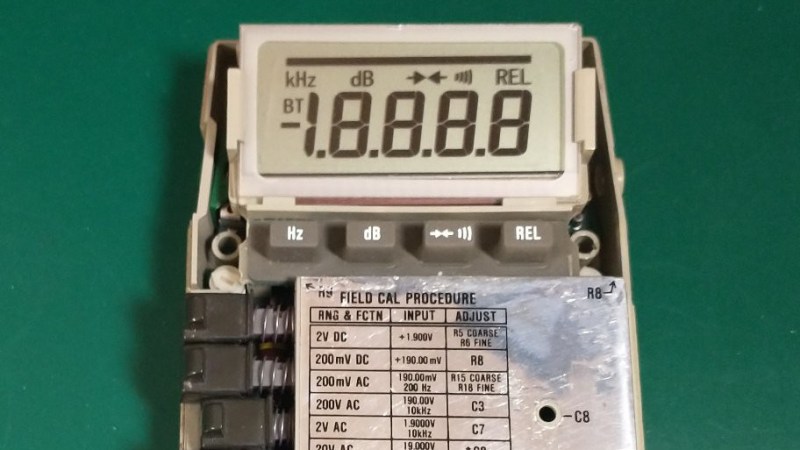
As a company, Fluke has been making electronic test equipment longer than the bipolar junction transistor has been around for. In that time they’ve developed a fairly stellar reputation for quality and consistency, but like any company they don’t support their products indefinitely. [ogdento] owns a Fluke meter that isn’t nearly as old as the BJT but still has an age well outside of the support window, and since the main problem was the broken LCD display they set about building a replacement for this retro multimeter.

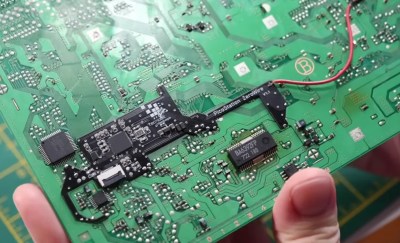
Initially, [ogdento] had plans to retrofit this classic multimeter with a modern OLED, but could not find enough space for the display or a way to drive it easily. The next attempt to get something working was to build a custom one-off LCD using a drill press as an end mill, which didn’t work either. But after seeing a Charlieplexed display from [bobricius] as well as this video from EEVblog about designing custom LCDs, [ogdento] was able to not only design a custom PCB and LCD display to match the original meter, but was able to get a manufacturer in China to build them.

The new displays have a few improvements over the old; mostly they are more stylistically inspired by later Fluke models and have a few modern improvements to the LCD itself. There were are few issues during prototyping but nothing that was too hard to sort out, such as ordering the wrong size elastomeric strips initially. For anyone who needs to replace a custom LCD and can’t find replacement parts anymore, this project would be a great starting point for figuring out the process from the ground up.

A 3D-printed, split-flap display-having calculator with a Raspberry Pi Pico inside.

By Our Calculations, You’ll Love The Flapulator

Oh sure, you’ve got calculators. There’s that phone program of course, and the one that comes with your OS, and the TI-86 and possibly RPN numbers you’ve had since high school.

But what you don’t have is a Flapulator, at least not until you build one. Possibly the be-all, end-all of physical calculating devices, the Flapulator does its calculating live on a split-flap display. It’s kind of slow and the accuracy is questionable, but the tactility is oh, so good.

This baby boasts a 6-digit display, where the decimal point and negative sign each require one digit. Inside is a Raspberry Pi Pico, which can calculate for around 4 hours on a full charge. But the coolest part (aside from the split-flap display, naturally) has got to be the 24-key, hand-wired mechanical keyboard. There’s also a couple of LEDs that light up to keep track of the current mathematical operation.

The story behind this one is kind of interesting. [Applepie1928] found out that one of their favorite mathematician-comedian-pi-lovers who is known for signing calculators was coming to town. With four weeks to whip something up, this was, amazingly, the result. Check it out in  action after the break.

Need something that’s a whole other kind of fancy? Here’s an open-source graphing calculator.

Continue reading “By Our Calculations, You’ll Love The Flapulator”

Flattening The Exhaust Of A Laser Cutter To Save Space

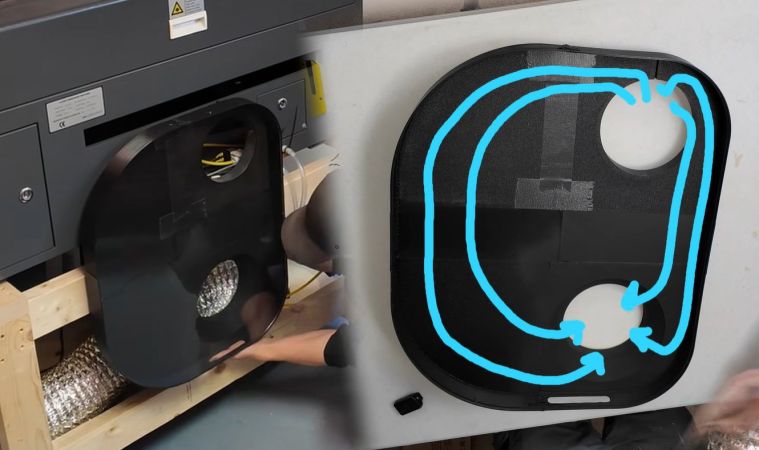
From laser cutters to 3D printers, having an exhaust duct at the back of a machine is a very common sight. However, these tend to be rather bulky, claiming many centimeters of precious space behind a machine even if you’d want to push it right up against a wall. This issue annoyed [TheNeedleStacker] over on YouTube so much that he had a poke at solving this problem with angled exhaust ducts, all hopefully without impairing its basic function.

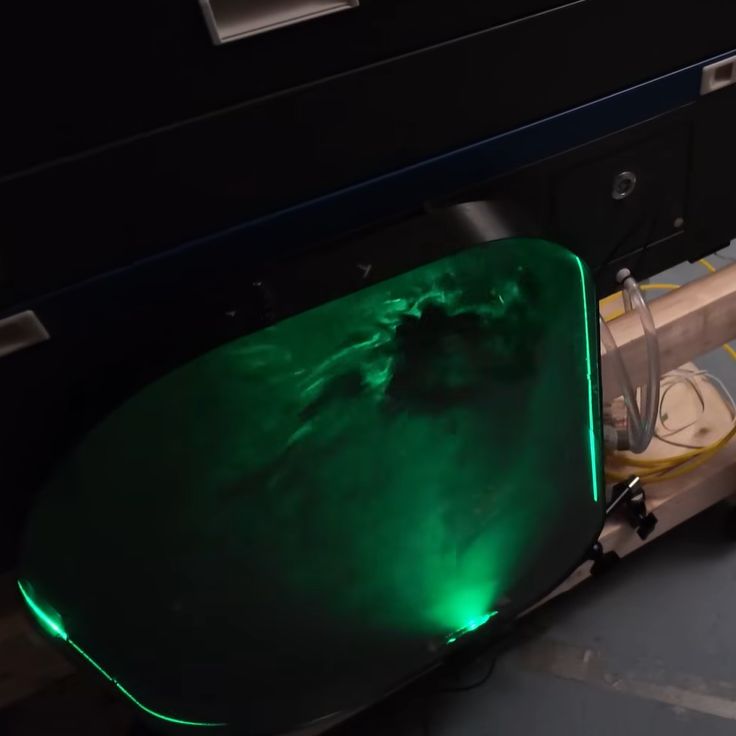
Smoke machine and laser for some air ducting rave vibes. (Credit: TheNeedleStacker, YouTube)
Smoke machine and laser for some air ducting rave vibes.

Although there are some online offerings for angled exhaust port extenders, these do not quite fit the required 6″ diameter. Reducing the problem to just a matter of cross section area for simplicity’s sake, that means a 19″ wide duct at a depth of 1.5″. Making sure the transition from the tube to the flat duct doesn’t become an impediment is the tricky part, so the approach here was to mostly ignore it and just make a functional prototype to get an idea of how a direct approach worked.

Installing the contraption worked out fine, and subsequent testing showed that although it seems to slightly reduce the effective airflow compared to the flex tubing, it is absolutely rad to look at with the transparent cover and some laser light to illuminate all that’s happening inside.

While some optimization work on the duct transitions can undoubtedly eke out more performance, it’s certainly not bad for a quick project.

Continue reading “Flattening The Exhaust Of A Laser Cutter To Save Space”

China Is Shooting For The Moon Sooner Than You Think

Humanity first reached the moon in 1969. We went back a few times, then lost interest within three short years, and we haven’t been back since. NASA has just flew a quartet of astronauts around the moon last week, and hopes to touch lunar soil by 2028. But the American space program is no longer the only game in town.

China has emerged as another major player in the second race for the Moon. Having mastered human spaceflight 23 years ago, the country’s space program has been moving from strength to strength. A moon landing is on the cards, with the country hoping to plant its boots, and presumably flag, in 2030.

Continue reading “China Is Shooting For The Moon Sooner Than You Think”

Ski Slopes For Laser Imaging

Lasers are cool and all, but they can be somewhat difficult to control at times. This is especially true when you have hundreds, thousands, or millions of lasers you need to steer. Fortunately, the MITRE Corporation might have created exactly what’s needed to accomplish this feat. While you might expect this to be done in a similar fashion as a DLP micro mirror array, these researchers have created something a bit different.

A ski slope like a MEMS array is used to contort light as needed. Each slope is able to be controlled in such a way so precise that entire images are able to be displayed by the arrays. This is done by using a “piezo-opto-mechanical photonic integrated circuit” or (POMPIC). Each slope is constructed from SiO2, Al, AlN, and Si3N4. All of these are deposited in such a way to allow the specific bending needed for control.

While quantum computing hasn’t hit these slopes yet, that doesn’t mean you can’t look into the other puzzles needed for the quantum revolution. Quantum computing is something that people have been trying for a long time to get right. Big claims come from all the big players. Take Microsoft, for example, with claims of using Majorana zero mode anyons for topological quantum computing.

Continue reading “Ski Slopes For Laser Imaging”

Four Choppers And A Blimp: The Bizarre Piasecki Helistat

Over two decades after it was last deflated, detached from its gondola, and crated up at Lakehurst, the gas bag of an N-class ZPG-2W blimp was broken out and dusted off for what might have been the most bizarre afterlife in aviation history: as a key building block for the U.S. Forest Service’s Piasecki PA-97 Helistat.

Just look at it! It’s an antique blimp gas bag, four war-surplus helicopters pulled from the boneyard, and a whole maze of aluminum tubing. That the U.S. Forest Service, of all agencies, was the one building what amounts to the airship version of an X-plane is also weird enough to be called bizarre. Getting Frank Piasecki to design this thing, a man who did as much as almost anyone else to kill the airship, might be considered ironic, but to stay on theme, I’ll call it bizarre.

If you’re not already a quadrotor-blimp afficionado, we have some explaining to do.

Continue reading “Four Choppers And A Blimp: The Bizarre Piasecki Helistat”

New Linux Kernel Rules Put The Onus On Humans For AI Tool Usage

It’s fair to say that the topic of so-called ‘AI coding assistants’ is somewhat controversial. With arguments against them ranging from code quality to copyright issues, there are many valid reasons to be at least hesitant about accepting their output in a project, especially one as massive as the Linux kernel. With a recent update to the Linux kernel documentation the use of these tools has now been formalized.

The upshot of the use of such Large Language Models (LLM) tools is that any commit that uses generated code has to be signed off by a human developer, and this human will ultimately bear responsibility for the code quality as well as any issues that the code may cause, including legal ones. The use of AI tools also has to be declared with the Assisted-by: tag in contributions so that their use can be tracked.

When it comes to other open source projects the approach varies, with NetBSD having banished anything tainted by ‘AI’, cURL shuttering its bug bounty program due to AI code slop, and Mesa’s developers demanding that you understand generated code which you submit, following a tragic slop-cident.

Meanwhile there are also rising concerns that these LLM-based tools may be killing open source through ‘vibe-coding’, along with legal concerns whether LLM-generated code respects the original license of the code that was ingested into the training model. Clearly we haven’t seen the end of these issues yet.