
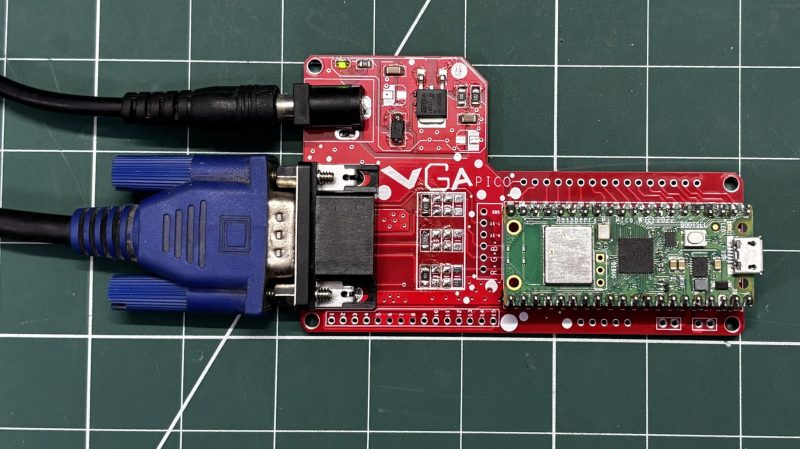
Many microcontrollers can spit out simple analog video signals if that’s something you desire. However, it normally requires a bit of supporting hardware and, of course, the right connectors to work with your other video equipment. [Arnov Sharma] took that into account when whipping up this neat VGA board for the Raspberry Pi Pico.
VGA output in this case is achieved via judicious use of the Pi Pico’s PIO subsystem, which is perfect for clocking out the signals for red, green, and blue along with HSYNC and VSYNC as needed. The Pico slots right into [Arnov’s] custom PCB, which makes it a cinch to hook everything up. Supporting hardware is minimal, requiring just a few resistors between the Pico and the DE-15 VGA connector. There’s also a nice LM317 regulator on board to supply power to everything. [Arnov] also whipped up a modified version of the VGA library from [Pancrea85], which allows the Pico to output VGA in a way that’s more accepted by more recent TFT displays as well as older CRTs. The system is demoed with a few basic Hello, World programs, as well as a neat recreation of Conway’s Game of Life.
If you want to get a Pi Pico hooked up to a big screen quickly, whipping up a board like this is a great way to go. If you’re wanting something more advanced, though, you could always explore DVI and HDMI on the same platform. Video after the break.












if ya dont need USB…. use the USB PLL to generate the VGA frequencies..this gives you exact frequencies at any core frequency ..perfect for every resolution ya can thinks of
I havent tried it yet but for HDMI output this project is also promising: https://github.com/fliperama86/pico_hdmi
How do I get one of these boards? Am I missing the link to the gerbers or design sources?
I made a Pico->VGA board a while ago and I sell it on Tindie: https://www.tindie.com/products/matzelectronics/vga-adapter-for-raspberry-pi-pico-esp32-etc/
A description and blurry schematic are on the I’ble, so it’s not hard to replicate. It’s pretty basic, though. 1-bit per channel, so only eight colors. Oddly, four resistors are used per output, but just connected in parallel, not as a ladder or anything. Might be an OK jumping-off point for your own project, though.
Pimoroni Pico VGA does that already, not?
Pimoroni has another neat board, PicoVision, with two RPs onboard, on sale now, btw.
There is also the Fruit Jam from Adafruit which works well for DVI output.
I don’t have any displays that accept VGA anymore.