
Electric discharge machining (EDM) may be slower than alternatives like laser cutting, water jets, or a milling machine, but for some applications there’s no alternative: it can cut through any conductive material, no matter how hard, and it leaves no mechanical or thermal stress in the workpiece. Best of all, they’re relatively accessible for a resourceful hacker, such as [Inofid], who recently built the second iteration of his desktop wire EDM.
The EDM’s motion system comes from a cheap desktop CNC router, which had a water tank mounted in its workspace and had the spindle replaced with a wire-management mechanism. The wire-management mechanism needs to continuously wind a tensioned brass wire from one spool through the cutting zone onto another spool. The tensioning system uses two motors: one to pull the wire through, and one to maintain tension by slightly counteracting it, with a tension sensor and Ardunio to maintain the proper tension. If it detects that the wire has broken, it can stop the CNC controller. To keep the wire from breaking or short-circuiting with the workpiece, a current monitor counts sparks between the wire and workpiece and uses this to predict whether the wire is getting too close to the metal, in which case it slows down the movement.
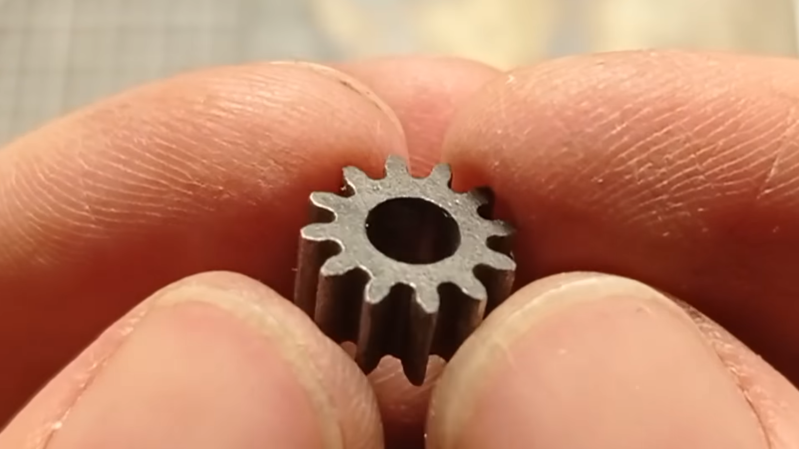
As a first test, [Inofid] cut through a five by three centimeters-thick block of aluminium, taking two hours but producing a clean cut. To speed up the next cut, [Inofid] added a pump and filter to remove sludge from the cutting area. The next cut was an aluminium gear, and then a meshing steel gear, which took about ten hours but turned out well.
EDMs of various kinds appear here from time to time, particularly since the popularization of 3D printers. We’ve even seen one built into a lathe.
Thanks to [Keith Olson] for the tip!












Electrostatic?
A shocking error.
I’ll resist to laugh at this.
Fixed! I honestly thought that was what the acronym stood for.
Working in a company that uses EDM to make some of our components, seeing it done at home is neat! Well done! As the guy hints in the video, it is more rudimentary so not as quick or as clean cut as industrial machines, but for domestic purpose, I wouldn’t be sorry to have this at home. Quite a bit of hardware required though, which equates to too much investment for me.
I hope the guy will upload everything needed on Github or something.
The site https://gedm.org has into and links to other places you may find interesting.
He put the project files on Google drive: https://drive.google.com/drive/mobile/folders/1FRyReGSj41KO7YQjFtufhRQo8P7PIP0p?usp=drive_link&pli=1
One downside is hydrogen embrittlement. See wing leading edge anti-ice piccolo duct failure reported on CL-600-2B19 (CRJ) aircraft & https://www.federalregister.gov/documents/2009/11/05/E9-26592/airworthiness-directives-bombardier-model-cl-600-1a11-cl-600-cl-600-2a12-cl-601-and-cl-600-2b16
Hydrogen embrittlement is usually more of an issue with high pressure or high temperature exposure to hydrogen. Post EDM heat treatment should eliminate most if not all hydrogen infiltration in the majority of alloys and applications.
In general, the phenomena was discovered in subway rails and oil pipelines exposed to anaerobic or acidic conditions. The effect happens when hydrogen diffuses into the metal alloy crystal boundaries, and forms H2. The larger H2 then rips small defects in thicker metal parts to eventually form small cracks.
If I recall most ferrous alloys over 10mm and aluminum alloys over 20mm will readily exhibit these micro-fractures to form stress risers in larger structures. I don’t think heat-treating below sintering temperatures would do much to mitigate detected damage. Rather the rate of diffusion and exposure time will set how much H2 forms internally to possibly damage the component.
Accordingly, EDM dielectric fluid is not always deionized water in cutting processes.
It has been about 14 years since I looked at the process, ymmv =3
“. I don’t think heat-treating below sintering temperatures would do much to mitigate detected damage.”
Your thinking is incorrect.
https://www.wisoven.com/blog/hydrogen-embrittlement-relief-and-treatment
“A common way to reduce the hydrogen in the metal is to perform an embrittlement relief or hydrogen bake out cycle. This is a powerful method of eliminating hydrogen before it begins causing damage to the part. To be effective, bakeout must be performed within 1 to 2 hours after introduction of hydrogen to the material. Hydrogen embrittlement relief is performed in an industrial oven at a specified temperature which bakes the hydrogen out of the part. This method of hydrogen embrittlement relief is preferred in the aerospace industry.”
https://ecofinishing.com/our-services/other-services/hydrogen-embrittlement-relief/
“Baking plated components at temperatures between 375 to 430 °F (190 to 220°C) within a few hours of the plating process prevents hydrogen embrittlement. During baking, the hydrogen diffuses out of the metal, restoring ductility and strength.”
Did you even read your own cited source?
“eliminating hydrogen before it begins causing damage”
That sounds dangerously misleading in this context, as contact with Hydrogen will restart the phenomena.
“process prevents hydrogen embrittlement… restoring ductility and strength”
Best of luck, =3
Noted – I shall not make safety-critical aircraft parts on my home-made EDM machine without proper precautions.
Adding this to my list of the things I want my neighbor to own and let me use but not personally deal with. Really cool project though
If Prusa make a desktop EDM then I’m in.
The next step is to be able to move the top and bottom of the wire independently. I interviewed with a company that made EDM machines. One of the guys that a part on his desk that looked like the numeral 2 from one side and 3 from the other.
The UK hobby magazine “Model Engineer” published a design for a homebuild EDM machine in the mid-late 1970s, before Arduinos or other DNC controllers were available or affordable, so users had to have copper negative tools (usually electrodeposited) to perform gear cutting or shaping jobs, avaiability of high-discharge capacitors was another limiter. That machine was mostly used to remove broken drills, bolts and studs, all it had to do was peck and withdraw, with wire advance to progress.