
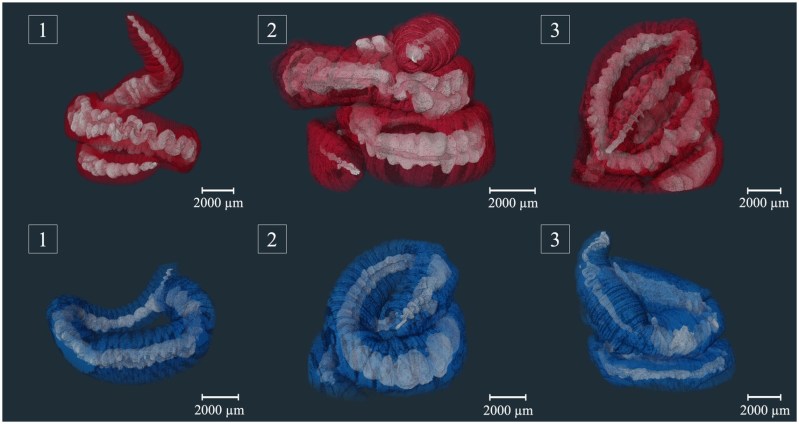
Microplastics absolutely saturate the Earth’s environment, and that’s probably not a good thing unless you’re looking for a sediment marker for the Anthropocene period. On the other hand, environmental contamination only becomes a really big problem if it bioaccumulates– that is, builds up in the tissues of plants and animals. At least when it comes to worms, that’s not the case with microplastics, according to new research from the Canadian Light Source at the University of Saskatchewan.
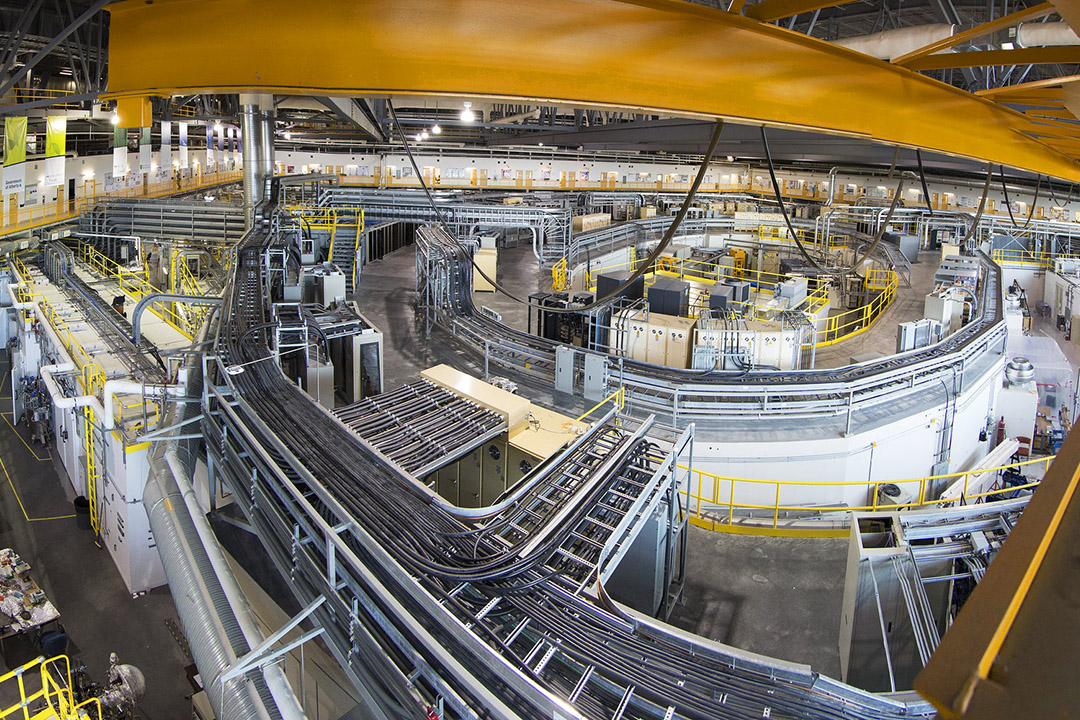
Credit: David Stobbe / Stobbe Photography, via University of Saskatchewan
The Canadian Light Source isn’t just some hoseheads in an igloo with a flashlight– it’s a 2.9 GeV Synchrotron tuned to produce high-energy photons. Back when Synchrotrons were used for particle physics, Synchrotron radiation was a very annoying energy sink, but nobody cares about 2.9 GeV electrons anymore. So rather than slam them into each other or a static target, the electrons just whip about endlessly, giving off both soft- and hard X-rays for material science studies– or, in this case, to observe the passage of polyethelyne microplastic particles through the guts of some very confused earth worms. To make them detectable by x-ray, the polyethylene was bonded to barium sulfate, an x-ray absorber. Equally opaque barium titanite glass microspheres were used with different worms, as a control.
Despite being fed soil enriched with far more plastic than you’ll find outside of a 3D print farm, it seems the worm’s digestive system was able to reject the particles, even those as fine as 5 microns. That’s a good thing, because if the worms were absorbing plastic from the soil, it’s likely their predators would absorb it from the flesh of the worms, so and so forth up the food chain in the sort of cascade that made DDT a problem and makes mercury compounds so serious. If the worms are rejecting these compounds, there’s a chance other creatures can too– and at the very least, it means they aren’t building up on this bottom rung of the foot chain. If you’re looking for a more technical read, the full paper is available here.
It’s too early to say what this means for how microplastics get into humans and other animals, but it’s hopeful. Equally hopeful was the recent finding that studies that don’t rely on football-field sized X-ray machines might be picking up on microplastics from lab gloves, skewing results.
Header image: the digestive systems of earth worms as imaged by the Canadian Light Source. Credit Letwin, et al,
Environmental Toxicology and Chemistry, vgag072, https://doi.org/10.1093/etojnl/vgag072












So, what you’re saying is, to avoid eating microplastics we should eat worms? Ok. Got it.
Or alternatively, feed your poultry those worms and eat tastier protein. :)
sounds like a conspiracy from Big Bird
Now I’m curious about plankton and krill.
In the Netherlands, people with free-roaming hobby chickens are warned not to eat (too many) of the eggs because they contain a too high amount of PFAS. In a study, this was attributed to the earthworms and other soil fauna that had accumulated the PFAS from the soil. Since this seems to conflict with the Canadian findings, I asked Gemini for a deep research comparison, but it’s too much outside my knowledge space, so I can’t say anything about the result:
https://g.co/gemini/share/4da91900a2bc
“Rather than link to an actual study on the Netherlands, I made some AI slop for you.”
Gee, thanks!
At this point I’m more worried about the accumulation of micro-slop.
Study:
https://www.rivm.nl/en/news/worms-are-important-source-of-pfas-in-home-produced-eggs
https://www.rivm.nl/bibliotheek/rapporten/2025-0170.pdf
Ask Grok:
Critique this: https://www.rivm.nl/bibliotheek/rapporten/2025-0170.pdf
Then ask:
Link to studies that show that a very large percentage of the results of modern scientific studies are not reproducible.
PFAS are simple molecule. This article is about polymer, or very very long molecule. It’s very likely unrelated.
PFAS are polymers right? Like teflon. Or is the PFAS in the environment a monomer?
I asked Gemini, but I am not smart enough to understand the answer, or even if the answer is actually correct.
Good job. You burned a town’s worth of energy and drained a small lake to do that.
AI critiques are typically easy to understand.
And can be confidently wrong
Cooling water goes in a loop, and in the EU they use a lot of wind and solar power.
And Now get into your XL SUV to pick up a can of beer, I’m sure that’s suddenly NOT an issue.
But all that does not mean that asking an AI for conclusive info on something you don’t know isn’t a silly pointless thing to do, in that you are absolutely right.
Oh and in the EU (and Netherlands) they have huge issues with there not being enough cable/transformer capacity to supply the power demand because they didn’t prepare for the surge in demand and did not expand the infrastructure. So there is admittedly that real issue. Perhaps they should have used AI to advise them.. AI: to supply power that is twice as much you need twice as thick or twice as much cabling! (Freaking duh, goddamn humans are stupid as Eliza, if you excuse my french).
PFAS– which stands for Per- and polyfluoroalkyl substances– are not exclusively or even mostly polymers or plastics. Just like PCBs, it’s a whole family of chemicals you don’t want around you that people used for all sorts of stuff. Certainly the precursors for making Teflon are PFAS, and I think as the plastic breaks down it releases PFAS but for some reason I don’t think the polymer itself counts.
Around here, I think the biggest single source of PFAS contamination is firefighting foams from the airport and airbase. PFAS are very stable so great for firefighting! Pity about the water supply. There are lots of tiny sources, too– from fancy ski waxes to GorTex coating on fabrics.
Because of that we’re advised to avoid eating freshwater fish, because they’re accumulating PFAS from the water. If fish bioaccumulate some PFAS, worms could too– but PFAS aren’t microplastics.
Of course, depending on the plastic ingested by the worm, it could potentially leach some PFAS into the worm’s digestive system during the day or so of dwell time found in this study. It’s not exactly apples and oranges, but… it’s a little bit like apples and oranges. Gemini should have caught that.
If the PFAS are building up in your local likely residential area enough for the hobby free-range chickens to end up with that accumulation given their relatively short lifespan I find it rather dubious that ALL eggs from every source are not – your egg factory chicken might not be eating it directly from nature but whatever you are feeding them is almost certainly still contaminated and accumulating the stuff. Quite possible even at worse rates in some cases because all that transportation packaging and mass production of their feed is likely in and around other sources of PFAS – you don’t tend to get high PFA use in your garden, and most folks don’t live on industrial estates, but the industrial sites under and around the mealworm farm or chicken shed…
There might well be a difference, and the study sounds like it really doesn’t have many answers (yet anyway) just a few interesting data points, which may well only apply to the relatively local area too. Their commercial egg production that has lower levels might just be a fluke in the methodology of battery hens there. Also as assuming C’s study is the one you were referencing only 31 of the 60 sites in the Netherlands tested had really high rates it seems and the follow up sites comparing earthworm to egg at those locations seems to only show some correlation not a particularly direct one – location C compared to H for instance really show a different trend to each other with with C having high levels in the egg compared to many locations, and an earthworm that is worse than most and yet less than H in which the earthworm was even more polluted…
Way to early to draw conclusions, so for now IMO at least avoiding your own eggs if you are keeping chickens is a foolish idea – so many ways you will be exposed and if accumulation is an issue you won’t really be able to avoid it, and that healthy balanced diet you should be eating isn’t all eggs!
May be the plastic particles don’t accumulate in their body, but that doesn’t mean that other chemicals contained into plastic (a lot of different additives added to give them various properties) are not released in the body during the transit. And these additives can have various nefarious effects, and some can may be accumulate…
Is this the modern equivalent of soaking your logs in wood?
Is this a euphemism for something?
Is googling not an option?
No, it’s an old meme about a self-feeding fire. There was an image of logs, on rails, feeding down into a fire as the previous logs were consumed. What, exactly, the poster who suggested “maybe soak logs in wood” in a comment on said photo meant has been lost to time, but it is a the same sort of error I made in the article when I said the plastic had been enriched with plastic– I think it counts as a malapropism.
Good catch. One of those instances of “plastic” should be soil. Hard to tell the difference in some places, sadly.
Fixing now.
I’m just glad that the “large plastic spoon” equivalent of microplastics in the brain has been nixed. I couldn’t understand how that could be so without major negative effects SSofkokjv-v-b9u-u–99bdbdb.
Or maybe don’t mill plastic foil into the soil, like a lot of Bio farmers do currently? Also, there’s biodegradable “plastic” foil; cost a bit more, but that’s what the higher price for Bio is for, no?
^food not foot.
I’d say sack the AI editor, but I’ve been reading HaD since it went live.
It’s not a bug, it’s a feature.
I do now wonder if a worm’s digestive system is not influenced by the barium sulfate. I mean did we even study that?