
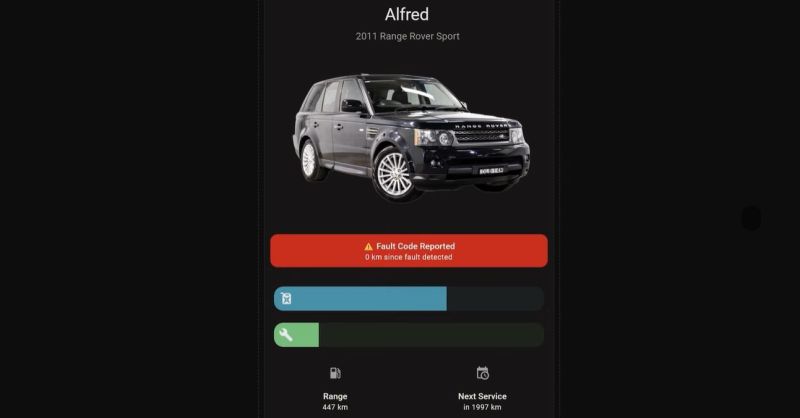
With how much time many of us spend in our cars, it makes perfect sense to consider them a second home. Yet even if that’s not the case, there are still good reasons to connect a car to one’s smart home solution like Home Assistant, such as to keep track of certain parameters for easy monitoring and reminders. This is what [The Stock Pot] channel recently demonstrated using a widget that connects to the OBD-II port inside the car, as not every car comes with its own app yet.
The used dongle is the ESP32-S3-based WiCAN from Australian company MeatPi. This device runs the open source WiCAN firmware. After plugging the dongle into the OBD-II port of the car, the device powers on and can be configured via Wi-Fi like any other smart device these days. After that it’s just another Wi-Fi device on the network.
Since each car’s ECU will represent data differently, you need a car-specific configuration, which can take some tweaking. The idea of integrating with Home Assistant is directly supported by MeatPi, with a handy documentation page. Of course [The Stock Pot] shared their configuration if you want to feel inspired. Among the parameters monitored you get things like fuel level, days to service and coolant temperature.
Although you could make the argument that it mostly saves you from having to waddle over to the car to check the data there, being able to remotely access the OBD-II port of a car does seem rather practical even outside of home automation concepts, such as gathering performance statistics and early failure warnings, especially for aspects like tire pressure and unhappy engine or BEV battery conditions that can quickly go from an inconvenience to very expensive.











If it’s a newer car, it’s much easier to use something like Smartcar: https://github.com/wbyoung/smartcar
It works great for me
Maybe it’s me but it doesn’t seem like WiFi is the right choice. It consumes more power and you can’t reach larger distances with it, compared to Zigbee.
Even if I could use this with my car (my car doesn’t have enough electrical stuff on the OBD2 port to justify it), I still wouldn’t use it because it’s WiFi. I would have to put access points outside my house and I really don’t want to do that. I park between 20M/65Ft and 100M/328Ft from my house.
I’m the type that refuses to buy non Home Assistant compatible appliances. I had to buy a new dishwasher a few months ago and spend more to get a Bosch because of their compatibility.
They are also making a cell based addon so that it can communicate in real time no matter where :)
Where/when is this addon made available :) ?
Ok that is a lot better and would provide consistent connectivity.
But in my case, with my car, it still has no purpose. Vehicles are pretty much the only thing I want disconnected from anything. Most of these modern cars, if you take off the front bumper, you can’t drive anymore. Everything is connected, the bumpers, the lights, everything. You can’t work on it, can’t modify it, can’t do anything. And it’s all connected, you have no control over it and it sends out data to whoever wants it with where you are, how fast you are driving and they log all the video footage (there was a local lawsuit about that where the police had video footage without the driver giving it. if my memory serves me right it was a ford). I’m not doing any of that. I bought my Toyota to have a car that doesn’t throw errors when you change something. The first day I got it was the day I removed the stock radio. My next car will have a carburetor.
I technically have OBD2 but no TPMS, GPS or anything else interesting.
So you won’t use it. That’s okay. We are not all compatible with everything. We understand
why has your dishwasher wifi in the first place.
Hopefully it won’t disable itself if you put in “non-approved” dishwasher detergent!
Lol. WE have a Bosch and our hack is to fill the “rinse aid” reservoir with water (it shortens the cycle by more than ten minutes–we don’t power dry, so don’t need it). I can totally see them doing something like checking viscosity to make sure you use an approved product.
Hey thanks for the idea. Our Bosch always overdoses the rinse a aid and leaves bitter blue stuff on the cutlery. We have been leaving the reservoir empty, but as you say, that increases the wash times. Time to give it a try with plain water.
Oh and just to be clear. Ours doesn’t have wifi and never will, and it uses whatever detergent is cheap this month.
I have not bothered to connect either of my “smart” appliances to my network. I’m not sure what I would gain by doing so.
The only thing I’ve thought of as a benefit is an alert that the wash cycle is done and my laundry is ready to be dried.
You can use a smart plug for this. Measure the current and create automations around it. No need for a smart appliance that just calls back to its own cloud account (yuck).
My LG washing machine plays a tune to say it’s finished, but then doesn’t unlock the door for another 3 minutes. So what the tune really means is “your laundry isn’t ready yet.” I can only conclude it was designed by a young engineer who has never done his own laundry.
This is a good question and I really hope Bob the builder will give his reasons.
I can imagine having all appliances connected to some central control that would schedule their work. For example when energy costs are lower.
Well… I have an AP in the garage because it’s my workshop and I don’t have any zigbee stuff now (and i still produce more electricity than i use) so… I can see the value. Even if I only use it to open the garage door
Home Assistant already provides some cloud integrations that basically do the same.
Our Opel and Volvo are connected that way.
Besides the OBD of Volvo is encrypted AFAIK.
Yeah, I had a great mechanic… Until I got a Volvo, and he couldn’t do anything with it. Never doing that again
I use esphome-tesla-ble to modulate my Model 3’s charging based on my solar production. Along with the water heater and the pool filtration system, this allows me to achieve a very high self-consumption rate.
i have an off-grid Adirondack cabin with 5kw of solar panels on the roof, and i drive a chevy bolt. i have my own homebrewed energy allocation system (it is not HomeAssistant or, for that matter, HomeAlone), and it’s great for determining when it is best to flip a massive relay controlling the car charger (as well as other relays for the hot hot water and the boiler). i got started on a little ESP8266-based system for the Bolt allowing it to upload telemetry via WiFi, and it was able to report battery charge stats. but i’m still working on making the system energy efficient (it shouldn’t report to the server more than once every ten minutes). my WiFi system accepts as many as four different sets of SSID credentials, so in theory it should be able to check in at both ends of my drive to an from the Adirondacks. while in transit, of course, there would be no data. but that’s fine.
when I saw the title, i thought it was about the “vw datagate”. vw is actively messing up its api, breaking a home assistant integration. See this issue with just 649 comments and counting: https://github.com/robinostlund/homeassistant-volkswagencarnet/issues/967
might be worth an article on HA
Slight paranoia about risk of outputting to car. (OBDII-li, OBDII-la, life goes on, Jah…)
Yeah, funnily enough, my neighbor has two canbus to bluetooth dongles that seem to be permenantly connected. Given that you can pair keys over canbus, this seems very unwise!
Something I’d sure love is a little OBD2 passthrough widget that pings me every 5000 miles to remind me to change the oil. It doesn’t even need any interfacing: it doesn’t have to check if I’ve done it, I don’t need to tell it I’ve accomplished the task, I don’t need a starting distance, I don’t even need it to have a wireless connection honestly just a nice bright flashing light maybe.
Yepyep, I had that (and other) similar ideas for the last I’d say good 30 years in total.
Stuff that I’d need told (transmitted, emailed, messaged, told in pleasant female voice, whatevah, WHATEVAH) should be of use to me, the legal/rightful owner of the vehicle, first and foremost. Mentioned time to change oil, washer liquid running low, three doors unlatched themselves whilst I slammed the driver door shut, etc etc.
The rest of data should stay put where it is needed the most (injection timing, muffler temperature, etc etc) and generally be offline for all purposes. Those seeking to harvest that for profit should be given non-negotiable contract giving me – 1 – permanent non-negotiable share in their profits, say, 30% up front, set up fees for establishing THEIR interface (their own expenses, not mine), punishment fee to terminating the contract, exit fee for ending the contract, entire enchilada – 2 – complete control over the data being sent, and a required dump of such in the format that I can read, JSON, for example, together with the mandatory GMT date/time stamps – 3 – 100% non-negotiable rights to abruptly call of entire arrangements, data obtained so far deleted PERMANENTLY, no backups from their private databases – 4 – review and update as I see fit, for example, I may opt NOT to let them know the average speed I am driving, but they can see if the doors are closed.
Since we are seen as for-profit strip-mine resource, we should be treated as one, contracts that are written with out interest in mind first. Oh, also, any and all fees incurred absolutely CANNOT be passed back to me in form of the higher pricing, hidden fees, whatevah. They are ALWAYS covered by the for-profit entity mining us for profit. Always.
I like your contract. I might print it out as an “alternative” and produce it next time someone asks me to sign their stripmining contract.
I’m a big-time Home Assistant user, but I’d never heard of the WICAN. I was running out of things to automate.
I placed my WICAN orders. Gotta have it
It‘s a great device – I‘ve been continously using it for 2+ years now in my VW e-Up to read the car‘s SOC.
Since I reallly like ESPHome (and the WICAN‘s own software support back then had not been as good as it is now), I had decided to use plain ESPHome with it‘s built-in CAN component to report the car‘s SOC to HA for PV surplus charing. By now I use ESPHome‘s built-in MQTT connectivity since push seemed a better choice since the car sometimes only has a few seconds to report before the driver pulls the key (and then the ESPHome goes into standby after a few seconds to save energy from the car‘s starter battery).
And yes, I have installed an extra AP inside the wallbox, but it‘s a small GL.iNet GL-AR300M16-Ext that does not consume much power and does the job just fine.
Here‘s my stub for ESPHome: https://gist.github.com/felixstorm/18f8ad9fb31ca71bbf62ba32801c34ae
You can also use any GPS tracker and connect it via flespi with the component https://github.com/dexif/ha-flespi In my case with Teltonika FMC003, this is about 120 indicators. ;)
Some R+D is in progress :)
https://github.com/pasqualehun/esp-can
Ahh can you glitch the CANbus over wifi? Toyotas can be stolen over CANbus from the front headlight for example. Toyota UK sells a CANBUS shield. Why did Toyota extend the CANbus to the lights/sensors instead of making them dumber? “It seemed like a good idea at the time” seems like inadequate justification. Why can’t security be designed ab initio and baked in/tested thoroughly? Do these people live in a fairy tale where everyone is good? If these MBA bean counters were practical they’d push for best security practices to avoid future expenses and embarrassment