
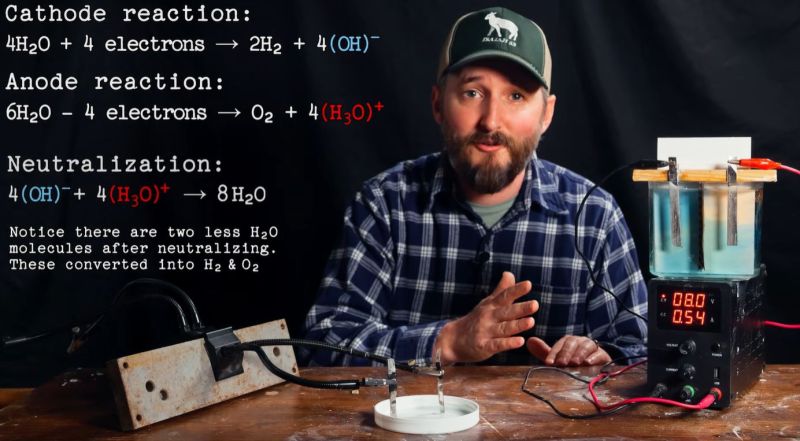
When the topic of ‘electrolysis’ is mentioned, people typically think of just splitting plain old dihydrogen monoxide (hydric acid: H2O) into its constituent atoms, but this barely scratches the surface of what is going on during electrolysis. Once you understand the full picture it also becomes obvious how electrolysis can be used for other tasks, including metal refining, flow batteries and more, as covered in a recent video by [NightHawkInLight].
On a fundamental level electrolysis is what it says on the tin: a way to lyse (i.e. split apart) using electrons, which is what the anode and cathode provide or remove. This can be used to break down the bonds between hydrogen and oxygen, but also those of iron ore, like Fe3O4. Stripping the oxygen from the iron atoms is commonly done in a reduction process using the CO from coke or hydrogen,
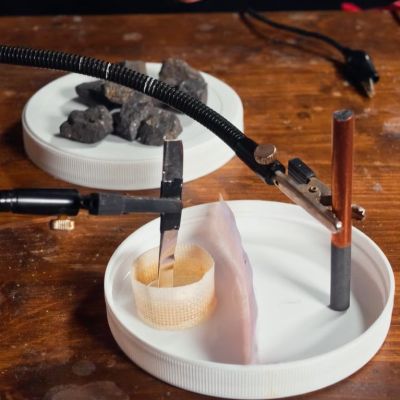
By instead dissolving the iron ore in acid, electrolysis can then be used to separate the two. In the example, the acid is created by one side of the electrolytic cell, with both electrodes separated by an ion-exchange membrane barrier that prevents the chemical processes on each side of the cell to affect the other side while still enabling the cell to work. How to make these membranes is also demonstrated in the video.
Through a careful arrangement of these membranes and the electrodes, you can guide which reactions can occur where, and which – negative or positively charged – ion can pass through which membrane, giving a lot of control. It can also be used to prevent undesirable reactions from happening, such as in this case the generating of chlorine gas from the NaCl being lysed.
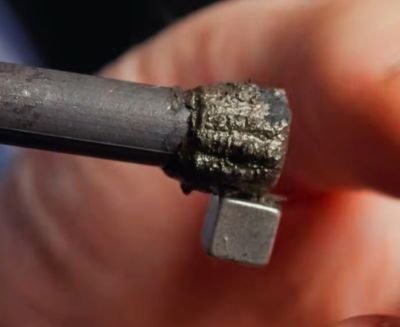
Acidity indicator dye is used to show in great detail how the cell works, including its preparation of getting the acidity just right before the crushed iron ore is mixed with some of the generated acid and the resulting liquid added to the cell. Following this you get a closed-loop chemical process to which only fresh iron ore slush has to be added and electrodes swapped out for fresh ones as the build-up of iron becomes sufficiently thick. In addition to supplying the cell with electricity, naturally, though you can even invert the cell and use it as a chemical battery akin to a lead-acid one if that’s more your thing.
Next the video moves on to how to make your own ion-exchange membranes, as developed by [Rowow] who used a scientific paper as the basis for such membranes using off-the-shelf parts accessible to the average hobbyist. Essentially it involves finely grinding up resin beads, to turn it into a sludge that can be put on a fabric and left to dry.
At this point the iron ore refining example provides a blueprint for how to make a flow battery. This involves graphite electrodes in the form of graphite rods and DIY graphite felt, starting with fireproof welding blankets, which are graphite felt. These are made conductive through exposure to fire to remove volatiles and then heating it up significantly hotter in a microwave. All done outside, obviously.
The flow battery chemistry is based on iron sulfate with citric acid as stabilizer. The cell voltage is 1.2 V, with the demonstrated bucket battery providing up to half an ampere. There are ways to improve this chemistry, but of course with all the gotchas of adding various fun kinds of acids.
As a final demonstration things go sort of back to basics with a hydrogen generator, but using a membrane to make it more efficient than the typical open setup and with compressed hydrogen coming out.











I know about nothing about mining and I’m curious if there’s any exemple of cascading treatments to get valuables byproducts in addition to the main ore.
Most of it? If you watch some mining channels on Youtube, you will see lots of acid treatments to separate elements out of ore. One really neat treatment involves dissolving silver into an acidic solution from mixed ore, decanting the blueish resulting liquid, then dropping in a piece of sacrificial copper to replace the silver ions in solution. The silver ends up precipitating out and can be filtered out and then melted in a furnace.
Rowow’s big advancement are in his membranes making several processes simpler and cheaper.
let’s see someone make proper hypochlorous acid using a membrane. Those cheesy HClOgenerators don’t work so well.
Cation exchange membranes such as Nafion, Fumasep, etc. are often difficult for hobbyists to get hold of and can very expensive depending on type and thickness. The thinner ones are usually the most expensive.
I really like NightHawkInLight because he really makes an effort to make all of his home experiementation accessible and reproducable. This would be a great science fair project.
Dude is the king of cool homebrew material science.