
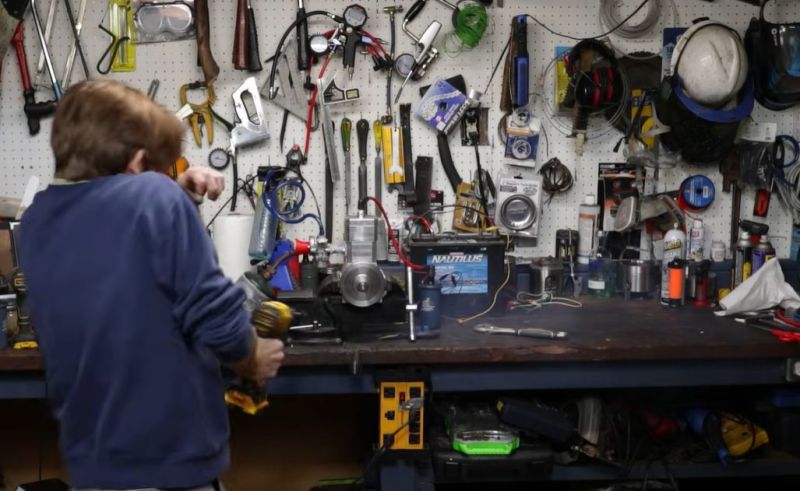
Recently [Camden Bowen] took a swing at machining a two-stroke engine out of billet aluminium, following adventures in 3D printing such an engine, as well as building one out of parts largely sourced from a hardware store. The sketchiest part here is probably the use of only a basic mill and lathe, making the milling of certain shapes a definite OSHA violation.
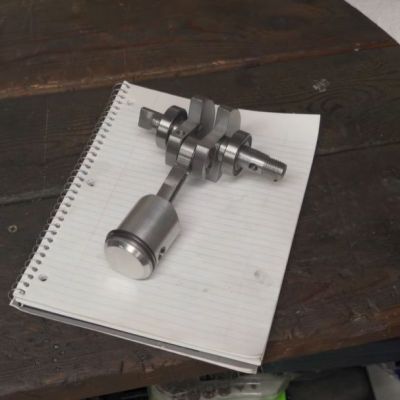
Two-stroke internal combustion engines are pretty simple from a mechanical point of view, with designs readily available. Add in a suitable material to machine and a modicum of machining and welding skills, and presto, you got yourself a not too shabby looking engine.
Of course, back in reality things are a bit more hairy. Not only are there many different ways to produce the parts – with some coming with a time penalty, monetary penalty, or both – but there are also myriad ways to hurt yourself and/or others. Fortunately [Camden] scraped by with just some (expensive) lessons learned and a major ruined part.
The final design features a single cylinder, with an initial pressure test showing a solid 150 PSI (10 bar) of compression. With that encouraging sign, a coil pack and contactor were added for some spark and a test run with the usual premixed gasoline-oil fuel.
Boringly, the engine mostly just runs and work as it should. This is of course not unexpected, much like how following the recipe for a pie produces said pie. But it does demonstrate how easy things are when you do not stray off the beaten path. The only significant issue was the flywheel wobbling slightly, likely due to a small manufacturing glitch, but this should not cause too many issues.












“The sketchiest part here is probably the use of only a basic mill and lathe, making the milling of certain shapes a definite OSHA violation.”
The only thing my Fadal 4020 can do that my bridgeport cant do is operate unattended. And there isnt a thing a cnc lathe could do that I cant do on my hardinge. Im really not sure why you would need anything more than a basic mill and lathe for this project.
People have made engines with nothing but lathes forever. I agree this statement is deeply ignorant of machining work.
I think this sentence refers to actions like 1:30 into the video. This IS very sketchy to say the least haha
There are $50-100 appropriate tool options available. Thats just an example of a HAD style kludge that many home machinists are guilty of committing when their preparation falls short of their intentions.
Enjoy the ads. Or don’t bother watching, I wish HaD hadn’t once again duped me into watching without warning.
Just use an ad blocker, problem solved. µBlock Origin is a good one for Firefox, in my experience.
I use that exact combination but it was part of the vidro stream.
run sponsorblock, then
as long as you’re on a computer that you own, running an OS and browser that work for you, you do not have to consent to running code other people want you to run. That includes web pages designed to show ads. They send you code, you choose what runs.
uBlock Origin + Sponsorblock is your friend. TBH, I’d quit YT completely is those weren’t available
Aluminum crankshaft?
Bearings?
Connecting rod?
I know aluminum cuts like butter, but GD, that ain’t the easy or right way.
Engine isn’t really hack, similar to many, but worse.
Material choice is ugly awful hack, good lesson on what not to do, in line with previous clickbait.
Production process appears to show that Camden Bowden’s purpose in life is to serve as a warning to others.
Of course, I didn’t watch the clickbait.
That would be like RTFA.
WTFCB?
BTW I live in CA, still rocking my 2 stroke lawn mower.
It’s indestructible TORO, Yamaha engine.
If I wanted to make my own 2 stoke motor, I’d start by deeply understanding that design.
For the limies:
‘iiiiiieeeeeeuuuuuuaaaaaaphphphphqqqqqqq’
Distribute as needed, ya daft spelling foreigners.
Not sure where you got the idea that this engine was entirely aluminum,
if youre too lazy to watch a video you probably should refrain from posting unqualified uninformed criticism.
This maker used built his crankshaft by welding steel plates to a steel shaft
But the 1935 Škoda 935 Dynamic featured a highly advanced, lightweight 2.0-liter 55 hp (40 kW) flat-four engine that incorporated an experimental aluminum crankshaft.
This makers connecting rods started their lives as 1/2 STEEL rods.
BUT the stock connecting rods for the 1940-1963 BSA A10 (650cc twin 35 hp) were made from aluminum alloy.
This maker used standard steel bearings.
But early Volkswagen Beetles featured solid, non-split aluminum bearings on the end mains (specifically often the center main), not the split steel-backed bearings common in later engines. While they were effective for longevity when properly lubricated, these solid aluminum bearings were prone to seizing if the engine ran dry.
Modern engines frequently use aluminum-silicon or aluminum-tin bi-metal bearings for connecting rods and main bearings because they are cost-effective, durable (often lasting 200,000+ miles), and provide high seizure resistance. They are widely used in modern OEM passenger car engines, including Toyota, Lexus, and General Motors engines.
The first line of TFS says ‘machining a two-stroke engine out of billet aluminium’.
You should never watch videos posted on this site.
That would encourage hackaday’s business model.
“Machining a two stroke engine out of billet aluminum” doesnt say “built a two stroke engine out of nothing but billet aluminum”
Are you one of those who though Repraps were fully 3d printed motors, controllers and all?
If you cant be bothered to watch the videos,
If youre so opposed to hackadays business model,
why dont you go play on reddit instead?
I think their business model is more driven by acidic comments than any of the articles themselves…
It’s a very effective business model, and has been studied extensively. You can make a lot of money by creating a situation wher people get triggered and then do predictable actions.
Hackaday makes money primarily through display advertising and sponsorship. I highly doubt the commentary drives much traffic here, Especially given the steady decline of relevance over the years.
Also if the acidic comments were their model they wouldnt have such aggressive moderation. Its not uncommon to find more than half the comments to a post suppressed.
Bearing shells with copper backing, in the hope of saving the c’shaft if the worst happens. BTW A10, and derivatives had Duralumin rods, which occasionally bent when 10.5 /1 pistons were fitted! Ciaran N. IRELAND
Life Lesson for the day:
Countless turbocharged 1000+HP LS engines still using the stock production cast crank and stock production powdered metal rods would kind of make you think that making every single part out of the highest-spec material that’s ever existed with no concern for what those parts might cost is a really dumb and pointless thing to get hung up over. Just make it work and if it does what it needs to do with crappy parts, then what is the problem?
When I was a kid our Jacobsen lawnmower had an aluminum block engine
My 1984 Porsche 944 has an aluminum block engine, so does my 2000 Boxster. My younger brother has a 2024 corvette with an aluminum block engine. My cousin has a 2020 ford f150 with an aluminum block engine.
Aluminum engine blocks are pretty common.
Not to mention that honestly, aluminum blocks are almost universal in the sort of small single-piston commercial engines this is analogous to, whether two or four stroke. Of course (as with the car engines) the cylinder itself tends to be sleeved with something more durable.
12-cylinder B-2 engine used in all Soviet/Russian tanks all the way from WW2 era T-34 to modern T-90 (with exception of T-64/T-80 and T-14) also uses aluminium block. The engine itself is an unlicensed copy of British Merlin engine from Spitfire fighter plane. Unlike Britain or Germany, the USSR didn’t have easy access to gasoline (petrol) but they had almost endless supply of diesel so they adapted head design for fuel injectors instead of sparkplugs.
Static ignition timing will waste a lot of the power potential of the engine. There ought to be a timing advance mechanism (or circuit) to improve ignition timing by adjusting it to engine RPM.