
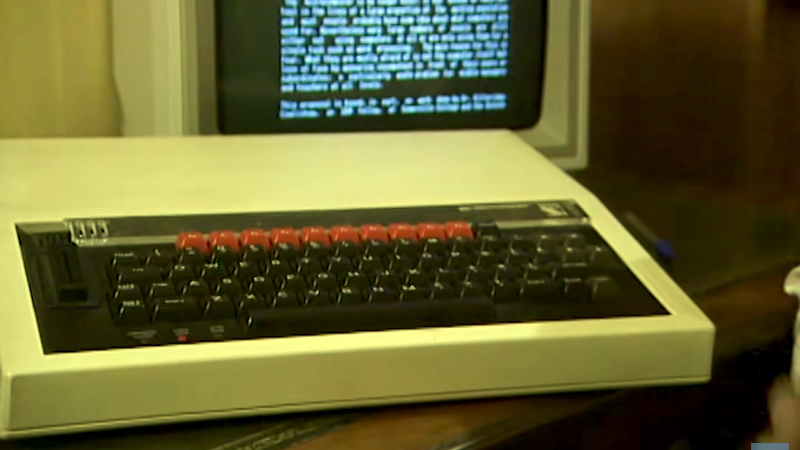
There comes a point in everybody’s life when things that they were a part of are presented as history, and for the 8-bit generation, that time is now. It’s interesting to see the early history of 8-bit home computers presented as history, not from a 2026 perspective but from the early 1990s. The BBC archive has recently posted a retrospective from 1992 looking at ten years of the Computer Literacy Project, a British government programme intended to equip the young people of the 1980s with the skills they would need to approach the information age. It’s a much more immediate history of something which was largely still in place at the time, making it a time capsule in which this past isn’t quite the other country we see it as today.
The Computer Literacy Project was run by the nation’s broadcaster and included a raft of TV programming about computers, as well as the commissioning of a machine specifically for the project. You know this machine as the Acorn BBC Micro, and aside from eventually providing the genesis of what would become ARM, it remains one of the most high-spec 8-bit machines in terms of built-in hardware. We hear from the luminaries of Acorn about the development of this machine, and then the film moves into some of the wider cultural effects.
If you were there, you’ll doubtless remember some of the TV programmes featured, and you might have used a BBC Micro at school. If you weren’t there, it’s an encapsulation of the promise on offer in that era, an optimism that seems sad when you reflect that educational computing descended into learning Microsoft Word during the following decade. It would be another two decades before the Raspberry Pi and BBC micro:bit picked up that fallen torch.
The Beeb, it seems, has long had an interest in home computers. Schools, too.












The Computer Literacy Project (CLP) was the outcome of a panicked UK government in 1979 after the TV series, “The Mighty Micro” revealed we were falling behind in the computer revolution.
The BBC micro was undoubtedly a ground-breaking machine, in many ways streets ahead of the 8-bit Atari, VIC/C64, Apple ][, TRS-80 or Coco and TI-99/4(a). Mostly because of the fast, 2MHz 6502A, and phenomenal 20kB graphics modes along with sophisticated graphics commands to drive it. Oh, and an advanced, super fast, structured BASIC with a built-in macro assembler! Acorn thought ahead and had already implemented a multichannel A/D port (making datalogging trivial); ECONET networking as well as a 1MHz second CPU interface, so that, for example you could attach an 8086 or 68000 or whatever, add a few vectored functions and you’d get a new-generation computer you could interact with. Incredibly clever!
But at £400, most of us couldn’t afford a BBC micro. Instead, most kids bought ZX Spectrums and later other cheaper 8-bitters. Thankfully the CLP broadcasts were general enough to be valuable for all computer users.
By 1984, Brits had more computers per capita than the US. By that measure, the CLP was an incredible success.
One night, my dad brought home a BBC micro from work.
At that time he worked for a British TV company, not the BBC, and they gave their employees the opportunity to get a Beeb and take it home, as part of the UK educational drive. Well, I don’t remember the specifics.
Anyway, my Dad and Mum and I, we sort of learned what having a home computer meant at that time. We would type in programs from the ‘BeeBug’ magazine, my Mum reading it out, and me typing it in. I learned how to type doing that, and as it went on, I became able to predict what the next line of BBC Basic would be, as she read it to me from the magazine. After a while I realised what ‘programming’ meant and I picked up the extensive User Manual, a ring-bound book that came with the thing, and I learned what a ‘computer’ was, about a ‘CPU’ and ‘RAM’ and ‘ROM’, what a ‘bus’ was, and ‘peripherals’ and how to write in BBC Basic, which I later learned was a damn good Basic (you could write things called ‘a procedure’ and do something called ‘call it’ from anywhere in your program, amazing!) and before I knew it I was writing my own code and learning 6502 assembly. We played Collossal Cavern, Elite, Chucky Egg, Jet Man Willy (admittedly this came out on the ZX Spectrum first), Repton, and all those other games. I made a digitising tablet for the thing using two potentiometers and a hinged arm, using the ‘joystick’ port and I learned about something called ‘analog to digital conversion’. Now I think about it, I even learned about ‘sound synthesis’ on that lovely old Beeb. What an amazing machine it was. l, and my parents were putting new ROMs in the thing, giving us a word processor, Pascal, and other new-fangled super-abilities. I learned what a ‘printer’ and ‘disk drive’ were, thanks to Dad and the BBC and the UK gov initiative. The educational drive with this ‘BBC Micro’ machine at the front of it, cannot be underestimated in it’s impact. It was such a successful project and deserves to be recognised as such. Many youngsters like myself learned their craft on these machines. At that time, I imagined that my future as a programmer would mean me being listed in the Yellow Pages after ‘Plumber’, category ‘Programmer’. And when I grew up I went to university and became an EE and a programmer (most of the things I design and turn into products as part my job require programming, face it, you too). I still do this to this day.
And if you know what the Yellow Pages were, then you are definitely showing your age!
My parents were teachers, and when my dad’s school got a BBC, they didn’t want to leave it in the classroom over the holidays, so my dad brought it home.
I still remember typing in the code for a ‘game’, a sort of artillery simulator where you’d input an angle and power, and it would tell you where your shot landed. As I typed it in, I started to twig how the program actually worked, and eventually modified it to allow me to enter single-digit angles. Unfortunately the BBC had to be switched off at night, and we didn’t have any spare discs, so that program disappeared.
Went from occasionally borrowing a BBC for a few weeks, to our own Amiga, and long story short, now I work in IT.
Probably not a very unique story ;)
Granny’s Garden ftw
Yes!
You beat me to it haha…
I won a pair of Beebs for my school, back in 1980. They were amazing
I bought a BBC B for the kids. I kept it in the car until they were asleep. I brought it in and set it up. I then realised I didn’t know how to programme so I set about learning from the manual. Eventually I looked up from the screen having just created a usable fuel consumption calculator. The sun was just rising…
The B was an excellent machine.
My first job was at an Acorn dealership.
I had a BBC Model B, followed by an Archimedes A3010 (the A1200 shaped one) and ended my Acorn ownership with a StrongARM RiscPC which is still on a shelf in the other room.
Fun Fact #403456b – Chris Roberts, creator of Wing Commander & Star Citizen had his first game published in issue #2 of the BBC Micro User magazine – https://www.bbcmicro.co.uk/game.php?id=1524
But who can remember the Hackers Poem incident live in BBC TV.
“Put another password in,
Bomb it out and try again,
Try to get past logging in,
We’re Hacking, Hacking, Hacking.”
Yes, I remember!
I went on my first BASIC programming course at a school in Nottinghamshire that was running them on Saturday mornings. This was on a North Star Horizon machine with 8 terminals (2 of us per terminal). The first thing the teacher said was a poem, probably the best introductory advice ever:
“I hate this dumb computer,
In every little way,
It never does quite what I want,
Just every thing I say.”
He wanted us to understand that a computer doesn’t really understand anything. It just blindly follows the commands you give it.
The original spec. for the BBC Micro was a Z80. I wish I had good things to say about why they went with a 6502 design but I don’t. The Z80 design didn’t work, but was bought up and made to work by a tortuous chain of events related to one Allan Sugar. Thus began the incredibly successful CPC Series.
Disclaimer: Ex-Amstrad, biased as all get-out
The original BBC spec was designed around the Newbury Newbrain, which failed to get into production, because of ULA heat issues. Pretty sure the Amstrad CPC series isn’t very closely related (different graphics, BASIC written from scratch and interpreted vs compiled on Newbrain, 5 years later, different hardware architecture)..
https://binarydinosaurs.co.uk/Museum/Grundy
If you’re curious about a heavily modded BBC, then have a look at the video from MikeElectricStuff’s video.
For a fun watch and lots of nostalgia search YouTube for the 2007 BBC docu-drama “Micro men” ~84 minutes long.
Sorry 2009