
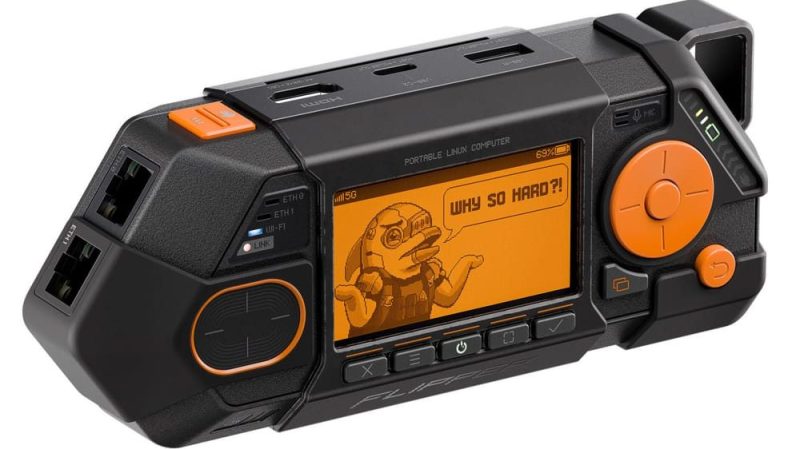
You’ve probably heard of the Flipper Zero, a pocket-sized device that packs in lots of great hacking potential. The team behind it has now turned their efforts towards developing the Flipper One, and they’re calling out for help from the broader community.
The Flipper One is not intended to be a replacement or sequel for the Flipper Zero. Instead, it’s designed to exist as a entirely new device in its own segment. The team is hoping to build “the most open and best-documented ARM computer in the world,” as they attempt to create a Linux cyberdeck of grand capability. Where the Flipper Zero has found great use for interrogating and investigating low level communications, like IR and NFC, the Flipper One is intended to go to a higher level, working with protocols like Wi-Fi, 5G, and Ethernet in the networked world.
The new device will be based around a co-processor architecture, where a microcontroller is paired with a capable CPU for great flexibility. It will also feature all the high-speed interfaces you’d expect, like PCI Express, USB 3.0, SATA, and Gigabit Ethernet. It’s a proper, capital-C Computer in that regard. The intention of the team is also to redefine some of the typical Linux experience, by creating GUI wrappers around certain traditional CLI utilities. It should go a long way to giving the software the same cyberdeck feel that the current prototypes embody in their hardware design.
If you want to learn more and get involved, head over to the Flipper One Development Portal and dive in. Alternatively, you might like to get up to speed with some of our prior reporting on the Flipper Zero. Happy hacking!
[Thanks to Andrew for the tip!]












Given that you still need to buy modules for frequency ranges, the hackrf one/pro/portapack always was the more hacker friendly option and allows to code blocks with signal processing stages.
“frequency ranges”? The F1 isn’t an upgraded F0, it’s a separate device for network layer stuff.
I didn’t imply that. I basically said that you need more than any flipper. There are tons of Sub GHz modules and externally connected parts.
The flipper has its use cases, however I’d like to point people to getting a ham license and just use a hackrf which is capable of transmission or reception of radio signals from 1MHz to 6GHz.
Home my post was differentiated and better explained now. I mean not division.
s/home/hope
my virtual keyboard and lack of sleep ain’t helping me today
Ah yeah, I was quite devastated that “sub GHz” on the flipper zero did not cover 465-466 MHz. (although it does cover 440 and 860 MHz) Weird that it has gaps.
It’s a regulatory thing. Utter villains might install firmware that ignores those regulations, but of course I would never do such a thing.
No, it is actually a technical limitation. The used Sub-GHz RF-Chip does not have full coverage, even with alternative Firmware or similar hacks.
My first wish would be full coverage.
Ah, another toy people will buy en mass because is cute and cool and end up in drawers.
or possibly the Tibetan Center thrift store west of Kingston NY — all the cool kids take their crap there when they are trying to declutter
Now I know where I’m traveling to next
i could write a whole book on thrifting and yard sales. long ago, for example, i learned to boil down the essence of an entire yard sale to what its predominant color is. if it’s black or grey, the stuff is going to be good. if it’s pink, it’s not worth stopping. but i then again, i never had much use for Barbie or that little pony
I have doubts about the form factor of this thing. For hacking on Ethernet, Wifi and similar things, I’d say your most important tool is Wireshark, paired with something like scapy to inject and probe. But for any kind of serious work with these, you need a big screen, mouse and keyboard.
So I would have built this thing as a box that is supposed to be connected to a laptop: a true, bidirectional gigabit ethernet tap, a wifi chipset with firmware that allows meddling with the packets all the way down, same for bluetooth, and so on.
Maybe add one or two SFP-cages with flexible interfacing, for hacking on fiber. Hack the EEPROM of SFP modules of course. But also novel things like talking to GPON OLTs or building a ONT-OLT bridge that can be used to tap into GPON links and sniff data.
The GUI that means you ‘need a big screen, mouse and keyboard’ is very much optional though. Its the way you know how to do such things, and the existing software is designed around those HID options for obvious reasons, but plenty of it could be done otherwise – consider for instance the O-scope covered in the traditional dials and buttons vs the ones that are just a touch screen computer with perhaps a few buttons. The differences do matter, there are tradeoff but both work fine, and are likely better than each other at some tasks.
In this case I can see it being a perfectly useable tool to have in the kit, as assuming the software stack is created to give you the control of the hardware for the tasks its meant for it becomes that pocket sized handy tool that can work stand alone, but also sounds like it would be perfectly possible to use it tethered to a ‘real’ computer.
May I recommend “>CLI”
Subtitle: A Practical Guide to Creating Modern Command-Line Interfaces
by Derick Schaefer
and maybe https://moderncli.dev/timeline/
och!
without AI are not sell
;D
Is there any way I could help this supposedly UK registered company that “fully moved out from russia”
to comply with UK or EU warranty laws?
and actually structure company in a fully legal way so it can B2B in EU/UK without sending money back to russia?
Initially I wanted to help, but then I’ve noticed that 80% of their documentation is definitely AI generated. Then I found they are using CPU manufactured 100% in mainland china.
This is not a hobby device, this is a foreign spy tool disguised as hobby tool. Even if not outright for spying, their choice of Rockchip is extremely questionable.
thanks for pointing that out. iwas not aware.
All modern CPUs are backdoored. I’d rather have the Chinese spying on me than the Americans.
Yours may seem a stupid answer to some but it is not. Assuming we both live in a “western” country, and assuming that all governments these days attempt to spy on their citizens, I would then feel safer being spied upon by a country that does not talk with my own government rather by one that does.
citizens and governments thinking they are their opposites is the problem.
I had a Rockchip rk3288 in a Chromebook and it was awesome. Whenever the CPU was idle, it would barely use any power. It ran cool all the time. Then I had an rk3399 in an SBC from Pine, and it is a bit of a disappointment. I turned off all but one of the cores (keeping a ‘LITTLE’ one), and fixed it to the slowest MHz setting it has, and it is still 30F over ambient while 100% idle. Now, it’s not exactly apples-to-apples because of different heatsinks etc. Maybe i should have been disappointed in the rk3288 too. My point is, you’re not looking at the things that matter. :)
As cool as it looks, i dont think this can be used in a practical way without connecting a screen and keyboard to it, as most of the software required to do “security research” is made for that, imaging using GnuRadio, wireshark or even a terminal with a touchpad and a joystick on a tiny screen.
Having said that – I really like the design, its looks very “cyberdeck”.
This has a tiny orange screen! What more do you need? Foldi-One addressed this earlier, to electronic Eel, but, I suspect y’all may have a distorted view of what “security research” is about. Firstly, a miniature Bluetooth thumb keyboard is good enough, no need to build that in. Then transferring data to a smartphone should also be good enough. Having a larger screen or a small Chromebook kills stealth; it gives everything away to observers, and the battery issues! Having started with DOS; I remember ’99 reading “In the Beginning… Was the Command Line” by Neal Stephenson online, when I was moving from MacOS(not macOS!) to Linux… idk, I would think anyone who needs big color screens is either doing something other than security, or… well, I’m trying hard to keep this light and friendly, but there’s something to be said about later generations having smartphones in their hands 24-7, and still totally forgetting the capabilities, claiming “I would have built this thing as a box that is supposed to be connected to a laptop” if that’s the case; the laptop is your hammer and everything is looking like a nail.
If you already have some pre-scripted attack that you just have to launch and maybe feed it a parameter like a MAC address, then the small screen and buttons are enough.
But in security research you usually have to do a lot of reconnaissance of your target before you go to this step. Just blindly firing off all kinds of attacks you have pre-scripted and hoping something is going to stick will probably set off some alarm and lock you out.
Doing reconnaissance means analyzing lot’s of data, filtering and processing it until you see operating patterns and can deduct possible weaknesses from that. That is much faster with a proper screen and convenient HID. Everything else is just a waste of time and makes it a chore to work on. This is touted as a learning device – making the actual work harder is not going to help that.
Agreed. Plus if you don’t want to attract attention to yourself a three-piece suit and a generic laptop is a way better combination than a hoodie and a Flipper. :)
The flipper zero is useless. These things can’t copy cards or even scan cards or frequencies reliably.
Do not buy or support.
I’m one of the many people that’s helped support the Flipper Zero by opening issues, building apps, and creating pull requests on GitHub. I’m sad to see how much the official firmware has been allowed to stagnate. I have two PRs open right now, and one of them was from June 1st of 2025. There’s been no activity on any of the 87 currently open pull requests in months, no official presence on the official Discord server, and the project feels like it’s been left to die. I still want to come back to the official firmware and bring the features, fixes, and new software I’ve built to the masses, but I’ve been forced to switch to custom firmware to have any hope of my PRs being merged. I’ve since been able to get 8 PRs merged in a reasonable amount of time and am actually able to see my work make a positive impact.
How can I support the Flipper One if this is how it went last time? How do I know that my contributions, my feedback, my support, won’t be ignored again? I fear that many others are also worried about this. The Flipper Zero was built on openness and a symbiotic relationship with the community. Without that, I don’t have high hopes for the Flipper One.
I hope to be proven wrong. I hope to see more involvement from the team at Flipper Devices. I hope to see more openness, and I hope to see a revival in this community. I also hope to see the Flipper Zero get the attention it deserves again, or at the very least, a proper send-off instead of just simply being abandoned.
“We need the help of the community we abandoned!”
Flipper Devices has left their “official” discord without any staff hanging around. Their promises of “community involvement” for Flipper Zero hardware modules never went anywhere. They promised a program to help fund ideas they liked, not a single thing came out of it. Their main developer for Flipper Zero firmware left like 8 months ago, and since then, firmware development has almost stopped. There are just under 90 COMMUNITY MADE pull requests on their firmware that have sat since then. New features, bug fixes, etc., nothing. The Application Catalog has another ~50 PRs pending of again, COMMUNITY MADE applications that are not being made available through their channels. They gave their community manager the boot as well. There is no way for the community to have any input or direction for their existing multitool Flipper Zero.
Flipper Devices asking for community support is laughable after doing nothing but taking from them, screwing over small businesses trying to support the Flipper Zero, and breaking multiple promises they made.
And they can’t even resist using AI to do most of their work.
so they are removing all rf, nfc, and IR hardware…. thats what the paraghraph on different utility means. check out the latte panda 3 delta. a single board computer with a full x86 OS and integrated arduino chip for IO. Arm limitations suck. we already have a raspberry pi. I wont be buying one. Its just another SBC now with “hats” meh.
I think the segment they are aiming at is already going to be well served by the Cardputer Zero and the Zero will be delivered before the Flipper One even starts development.
The Flipper Zero was a nice device when it came out but their team went silent on the Zero and it feels like they are treating it as EOL. These days you need to use community firmware to have any truly useful features.
I definitely encourage people to check out the Cardputer Zero before they make a call on getting the Flipper One.
Comparing the Cardputer zero to the flipper one is completely nutso lmao. One has gigabit Ethernet while the other is 100mbit, one has built in tri band WiFi with monitor mode and injection, the other one is only 2.4 and doesn’t support either monitor nor injection (except with nexmon patches, but that’s very janky and breaks often. External dongles are also a pain). One has a very competent arm cpu, the other barely is able to run a desktop environment
If you don’t see the difference that’s fine, but then don’t talk out of your ass and compare them lmao
They really should have a feature that allows interaction with slot machines to correct the rigging. If slot machines are rigged so that we lose more than we win, wouldn’t a correction in the rigging be making the game fair? It may open the door for legal concerns but how can a casino defend that their machines are rigged without blowing a hole in their own boat? Lol
Built something in a similar spirit, just pure software: an iOS app + a small
daemon that turns a headless Raspberry Pi (no display, no known IP, not even
wifi configured) into something you can shell into over Bluetooth Low Energy
from your phone. There’s also an “agent mode” where you describe a goal in
plain English and an LLM (your own API key – Claude/OpenAI/Gemini) plans and
runs the shell commands for you, showing each one as it goes.
Nowhere near as ambitious as Flipper One – no radio hardware, no networking
ports, just BLE and a shell – but it scratches a similar itch of “why can’t my
phone just talk to this Linux box.” Open source: https://github.com/nekonihq/murmur