
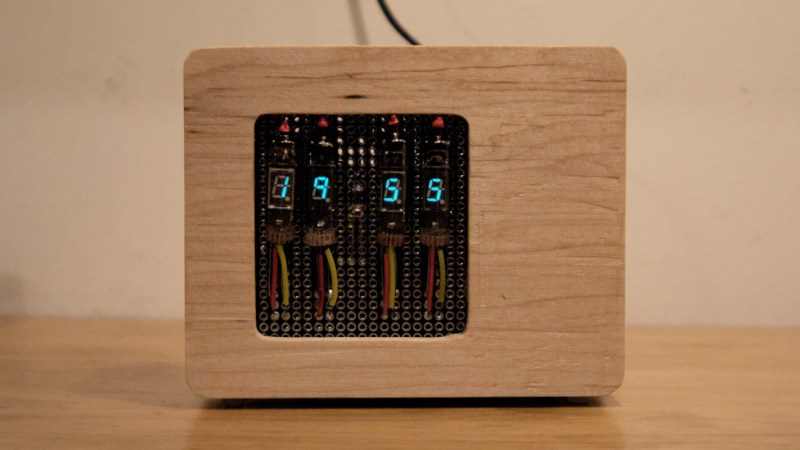
In between the Nixie tube era of the 50s and 60s and the advent of multi-digit vacuum fluorescent displays (VFDs) common in 80s and 90s consumer technology, there was a brief time in the early 70s where single-digit VFDs were commonplace. Superficially these devices look like Nixie tubes, but have a number of advantages to them including lower voltage, lower power requirements, and lower cost. [maurycyz] recently found a number of these salvaged from old calculators and used them to build a retro-themed clock.
[maurycyz] was not able to find datasheets for this display, but was able to reverse-engineer each of the digits. Similar to vacuum tubes there is a heater which has a few ohms of resistance, and from there each of the segments of the digit can be deduced by probing the 13 signal wires. These are analog devices in some respects, so a lot of experimentation had to go into driving the displays to find their optimal conditions. A quartz crystal was used for timekeeping with an AVR128DA28 microcontroller chosen to provide control for the digits, using seven pins as segment drivers and four as grid drivers. Each digit uses around 0.14 watts, so with all four digits on it can consume a little over half a watt. A simple wood enclosure rounds out the build.
As Nixie supply wears thin, VFDs like this can be an excellent stopgap or replacement while still building retro-themed displays like this clock or this calculator which uses similar VFDs for each digit.












Panaplex displays are much nicer look at than VFDs
I had a clock radio with them the phosphors started flaking off years ago it got trashed then. They also get dim with age.
Single-digit VFD tubes were way too laborious to (hand) assemble in products.
They ended up in all the surplus houses in the late 70’s, Radio Shack and Polypaks etc.
This tube sure looks like ISE(ISEDEN)/Itron/Futaba DG8F. DG10A is a bigger one.
Radio Shack 276-065, specs filament 1.4V 22mA, typical 24V grid and segments, 3-4.5mA
You could direct-drive with 15V CMOS.
http://ferretronix.com/tech/vfd/#specs
Huh. Never thought about controlling them in an inverted manner like that. But i guess it makes sense if you don’t the minor voltage drop and want to use discrete components. My go to is to use a high-side array IC like TBD62781 or its siblings. I personally have a bunch of old Soviet IV series VFD tubes. Big and visible, but does require a higher voltage for the plates and grids.
Also shoutout for using an AVR128DA28. I really like the AVR-Dx and think its nice to see them take up the roles normally occupied by the old ATMega*8 families more often.
These look a lot like IV-3 / IV-3A (most likely IV-3) soviet tubes if anyone is looking for more data about them
https://soviet-tubes.com/product/iiv-3-vfd-tube-nixie-luminescent-seven-segment-green-glow-indicator-that-displays-digits-0-9-and-dot/
I have a working Canon Canola L100 calculator with these kind of digits. They are orange, not blue. One mainboard with a similar 13 digit display but no keyboard. Not sure what calculator model it is for.
Also one display module and three tubes of SN75584AN display drivers. I should make a clock of these.