
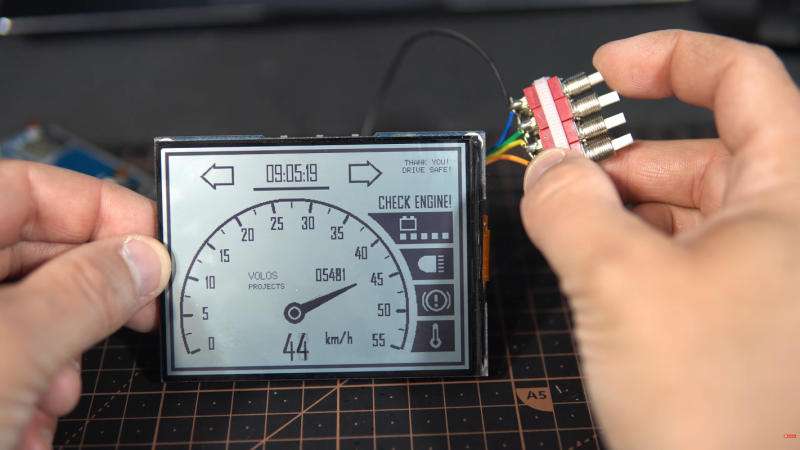
Although LCD displays have been used in almost every type of consumer electronics display over the last two decades, many of these screens have a few downsides that limit their usefulness in certain situations. As any owner of an early digital watch, an early laptop, or an early digital camera will testify, these displays often completely fail in direct sunlight. And, a currently new technology often using inexpensive displays in full sunlight conditions is ebikes, so [Volos Projects] decided to use a unique LCD display to solve this issue.
The display is called a reflective LCD (RLCD) and is actually a fairly old but overlooked piece of technology. Displays like these have a reflective layer that bounces ambient light back to the user, increasing contrast and readability in high light, especially when compared to more common transmissive displays. This build is based on a board from Waveshare, which includes the screen and its driver components, and [Volos Projects] integrated this into a test stand that mimics an ebike’s speed sensor and other hardware like turn signals. The display shows the bike’s speed and a few other indicators, and thanks to the screen, this information can be easily seen in full sun.
Although he doesn’t have it on an actual e-bike yet, he hopes it will be useful for those who want to try out something like this with their substandard e-bike displays. The code he’s used is available on a GitHub page for anyone interested. We’d imagine that a low-cost display like this would pair well with an open-source ebike like this one.












Still needs a backlight for night time / winter evening use! (Yes, commenting without watching youtube! 😱)
The OLPC laptops had a clever dual mode backlight for this.
Pixel Qi (OLPC) had a reflective (white) pixel in addition to the backlit R G B pixels. This reduced the required backlight power somewhat where there was ambient light.
It also meant that they were readable in direct sunlight – but the colour disappeared as RGB only came from the backlight.
Never the less, they were excellent in direct sunlight for what I needed to do.
I have 4 still working in Samsung netbooks. Nothing has replaced them if you need to use your laptop in full direct sun – if they had made full sized laptop screens I would have bought one in a heartbeat.
Unlike other sunlight displays they were made on a standard LCD process, only a mask change was required.
Yet again the computer industry failed to make something useful, unique, cheap and easy to make for no reason.
The OLPC Pixel Qi backlight didn’t have a 4th subpixel – instead the backlight itself was RGB. When reflective every LC segment contributed to the grayscale image. When emissive and RGB it needed heavy antialiasing before display or else you’d get bad moire effects.
I sat down with an OLPC unit and turned the backlight on and off a bunch and got to watch the screen change sharpness. Decided if I had one I’d probably use external lighting instead of the backlight as a result, since color just doesn’t matter that much for the things I want to do.
LCD display? PIN number? ATM machine?
Redundant words in natural language? The horror!
But this is hackaday, not the Department of Redundancy Department.
ah, the famous DRD department!
I prefer the GPS System.
Transflectve displays were common 40 years ago for this sort of use case.
yeah… “unique LCD”… lol
They are still very common. Almost every digital watch uses one because they run for years on a tiny battery.
The first LCD watches used a reflective display and were most readable in full sunlight. I had one in 1975.
Is it the unobtainable Sharp “Memory LCD”?
It’s a chinese variant.
I believe both of these are essentially monochrome TFT displays.
This kind of display has been normal on e-bikes since they entered the market a decade or two ago depending on where you live. I don’t get it …
Love that display. I’ve hoarding Nokia 5110, perhaps this could be my new favorite, if it can be found by itself. Display + ESP… not terrible, but…. ehhh….
But early LCD watches DID have a reflective layer, and were very easy to read in direct sunlight.
Also, cheap LCDs back then were dis-assemble-able, ie, one could open the frame and pull out the reflective panel AND the polarizing filter. One could literally make LCD “negative” by flipping the polarizing filter around, and that was exactly what I did with one of my LCD clocks.