
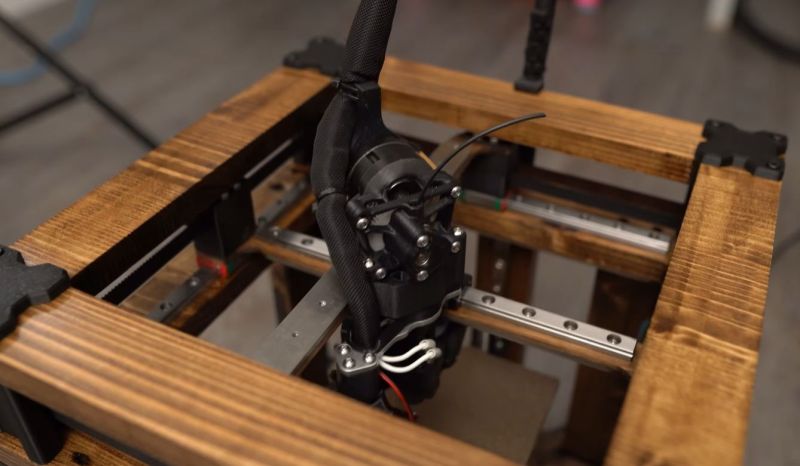
Generally, the frame and other structural parts of an FDM printer use steel or similar, but could you use wood instead for that truly artisan look? As [Mitsu Makes] demonstrates after half a year of work, you absolutely can, and it looks about as amazing as you might imagine.
Naturally, you cannot make everything out of wood – such as the linear rails and lead screws – and there is a fair bit of FDM-printed black PLA in there too, but the wood is both structural and decorative. The stained look does really add something. For the FDM-specific parts, the Voron 0 was taken as the base, including the bed. The motion system isn’t CoreXY but Cartesian for ease of construction and driving the axes, while also providing more torque due to the additional motors.
Since it’s more or less a Voron FDM printer and even has automatic bed leveling, it works basically perfectly after assembly and input shaping. Even if it’s not the most practical way to make your own FDM printer from parts, it definitely makes it look unique and would be the focal point of any printing farm.












across the fibers! ouch!
And not even straight grain. That’s gonna cup and pull the whole thing out of alignment if it doesn’t break first.
https://leancrew.com/all-this/2010/11/cupped-wood/
Just more made-for-youtube crap that’s never meant to work any longer than it takes to shoot the video.
Imagine having a wooden printer… looks at my still working 15 year old Ultimaker Origonal. Yep, works fine.
At least that’s made out of cross-laminated plywood for dimensional stability.
Plywood warps. Remember those awful makerbot machines?
6mm 5 layer ply in a box construction. I can tell you my Ultimaker hasn’t warped a bit.
I hope this printer is stored in a humidity and temperature controlled environment.
Imagine someone needs something printed and you have to say “I’m sorry there is a thunderstorm coming so I can’t print right now”.
You should probably turn off ALL your electronics in the event of a thunderstorm. (Pours one out for my Sony Bravia.)
I play bass, and I have Music Man bass guitar from 1979. Its wood has been perfectly dried and maintained over the past 47 years. It never warped, and is as straight as it should be.
But if I tune it one a nice dry day, I find that if the next day is a rainy day, I have to tune it again. Actually, if I take it to play in a club, and it was tuned perfectly before I took it there, I need to tune it again. And if I tune it too soon, it hasn’t properly adjusted yet, so I’ll have to tune it yet again.
So, even 47 year old, perfectly maintained, wood varies with temperature and moisture conditions.
So how is this thing ever going to perform reliably on a day to day basis?
And come to think of it, even though metal doesn’t expand and shrink with moisture, it still does with temperature. How is that affecting prints in real life?
Is the software able to compensate for temperature changes?
I don’t have a 3D printer (yet), that’s why I’m asking. :)
When the whole printer is changing by perhaps a few degrees, maybe tens of degrees in your not climate controlled garage the thermal changes in the room are not very relevant, and usually won’t matter anyway as the entire printer changes comparably meaning lots of the changes will cancel out.
Even with the heated chamber printers where everything might get near 100 degrees different from a cold to a hot print its pretty much irrelevant to the frame – look up shrink fit guides to see just how extreme the temperature delta needs to be for your two almost matching sized parts as a ballpark to consider. The microns of change the frame is likely to see assuming it isn’t made in crazy zero expansion composite structures will be lost entirely in the noise of FDM 3d printing’s layer lines and squeeze out anyway.
I agree this largely wooden printer is likely to have trouble if it isn’t kept climate controlled, but probably not enough to really matter either – FDM printer can be really quite floppy and imprecise and still do reasonably good prints.
The bit to remember with your musical instrument to a printer comparison is the instrument is really very functionally its frame, change that change the sound, where the 3d printer the functionality comes from its motion works, and while those might end up shifted from where they were the 1 step of the stepper or 3 degrees rotation on the closed loop motor will still equate to very much the same motion relative to itself – the belt and wheels might have a bit more/less tension in them but as long as it won’t slip they still work and the distance moved per step really isn’t very impacted – the shrink rate of the plastic you are printing will dwarf the variation in the printer.
Being floppy is what makes it work – it allows the geometry to adjust so the bearings and rails don’t bind up. If the frame is rigid, and the geometry warps because of expansion, everything stops moving.
The temperature (and therefore the size) of the 3D printer frame shouldn’t change much while you’re actually doing the printing.
With enclosed 3D printers, you usually want to heat up the chamber before you start printing, so that the air is already warm when you start the print, and stays the same temperature the whole time (so that the plastic doesn’t cool down and warp the print until it’s done and everything’s fully supported). This has a side effect of heating up the frame and causing it to expand before the printing starts. You do all your tuning and calibration with an already hot printer frame, so you compensate for any expansion without ever really thinking about it.
For open, non-enclosed printers, the frame doesn’t get much hotter than room temperature, so it doesn’t change much. But you still heat up the bed before you start doing any auto-leveling, so that it takes the temperature-based movement into consideration.
There were some Voron people who made a script for Klipper a few years ago to try to compensate for thermal expansion like you’re saying, to try to start printing early before the printer fully heated up, but I don’t remember it really doing much because the affect was so small.
Wood takes a long time to absorb moisture from air, so it tracks the ambient humidity very slowly, but over a year it can change 1-5% in size across the grain. That’s why cabinetmakers leave space for expansion around large panels.
Metals like steel have a typical thermal expansion of 10-15 parts per million, so you need to heat the linear rails until they’re white hot before it expands as much as the wood does.
Wood frame for a 3D printer? There’s a reason people stopped doing that about 10 years ago.
Printed PLA parts in the structure of the printer? There’s a reason people stopped doing that about 10 years ago, too.
haha yeah everyone’s talking about the wood but i bought a kit printer in 2014 with a bunch of PLA parts and that’s exactly why i had to throw it away in 2024. PLA is so convenient but it isn’t a durable good in my environment
I remember back in 2011-2012 “MattyMatt” was milling Original (Sells) Mendel parts from recycled wood from furniture.
I always wanted to make an Oak/Brass one.
There are good news and bad news if you really want an printer made out of 100 year old oak:
https://www.prusa3d.com/p/prusa-signature-oak/
Good news: its actually possible to let one handmade for you
Bad news: its about $6000
Prusa was typically in the irc channel at the time.
He was likely part of the discussion.
I’ll mill one now if I want one…now that I have capability.
One of the more impressive things (IMO) about the new Cobra X compared to its replacement isn’t the multicolor print head but the care taken to damp out resonances in the structure and the servo loops. The earlier machine relied on brute force — stepper motors, a relatively heavy print head and a relatively slow print speed — to overcome mechanical limitations but the newer, faster, machine needs to control the mechanics in order to get a decent print quality and accuracy while maintaining print speed. (There’s an article about the “Sub 1 minute Benchy” elsewhere on this site that takes printer optimization to extremes.) Anyway, you can build a half decent first or second generation printer out of anything, including printing its own spare parts. It just won’t be state of the art.
Does it damp vibrations like a wooden tripod?
We live in amazing times when you can casually just throw seven motors at a project like this.
I’ve just kept upgrading the electronics, extruders and hotends on my Mendel90-Sturdy for.. I have lost track of how many years.
If MDF counts as wood then wood works great!
I see the comments about humidity.. well.. I don’t like to allow rain clouds to form inside my house. Besides that though.. I have never had a problem with that.
I did use a whole lot of spray painting and wet sanding on it though.. I’m not sure much air actually touches the wood fibers.
My first 3D printer, back in the old days of Reprap, was constructed from MDF – the frame, motor mounts, heat bed, drill rod supports etc. It performed well and accurate enough to print hundreds of parts over 6 or 7 years before I constructed an Ultimaker2 clone to replace it (with an MDF cabinet)!
Since it’s more or less a voron… It’s more or less an Annex K3, not a voron lol. There is nothing voron about this entire printer…