
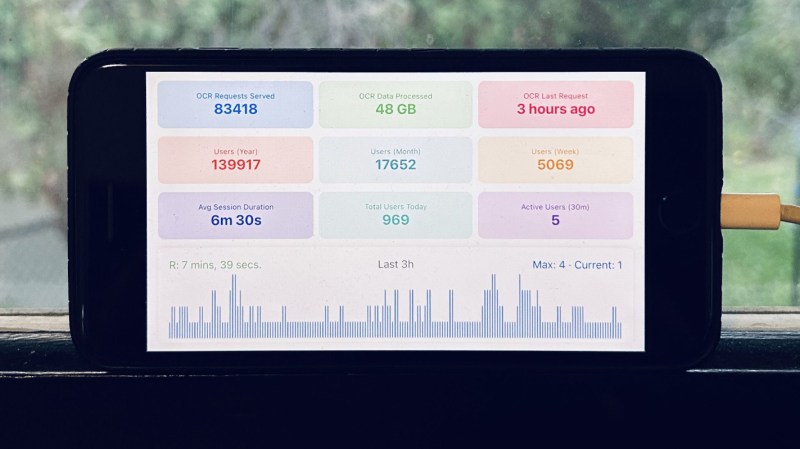
Running an optical character recognition (OCR) server might sound like it would need some powerful hardware, like a rack-mounted, water-cooled machine, or at least a nice desktop or laptop. But if you have the time, anything could be used. [Hemant] has a long-running personal project that processes a lot of image data over a long time, and set up the OCR server on an iPhone 8 running entirely with solar power, rather than turn to more typical hardware.
Part of what makes this task feasible for low-powered hardware is Apple’s Vision framework, which uses machine learning to aid in things like character recognition (among other tasks). It will run on an iPhone just as easily as a Mac. The phone’s built-in battery already provides the first step of an off-grid setup. This build relies on a separate power bank to integrate the phone with the solar panel more easily. On the software side, [Hemant] reports that the true challenge wasn’t setting up the server as much as it was keeping the iPhone from sleeping or stopping his program from running full-time.
A system like this running off-grid, especially considering the costs of the solar panel and power bank, might seem counterproductive. But when comparing electricity costs for running the same software on his server, he estimates he saves about $10 per month with this setup, which has a payback of somewhere around 2-3 years. Not too bad for a phone that would have otherwise ended up in a landfill. Old phones can be surprisingly good choices for servers, too. It helps if they can run Linux, but plenty of phones will support server applications, even when running their native OS.












We were doing OCR locally on lame Windows machines 30 years ago, so it’s hardly surprising that it’s still possible.
And also speech recognition all the same !
I wasn’t (knowingly) doing it that long ago, but the past 10 years have been ocring professionally for work. Its got faster for sure but I’m not really sure I would go the cell phone route.
I was thinking the same thing! I remember running OCR software on my 486 in the nineties!
Yah, I don’t get it. I guess that’s one of the excuses for cloud-everything? “Alexa” or whatever couldn’t possibly process your commands on it’s own hardware locally right?
I too remember playing with both OCR and voice recognition on a Pentium 1. Pre-MMX!
WOW so much work for nothing
Great project. There’s something deeply satisfying about an ancient phone that was built to live in a pocket and burst-render Instagram for three seconds at a time getting drafted into duty as a headless, screen-off server grinding away 24/7, a job it was never designed for but handles just fine. Also goes to show that there is some really clever software going on in these devices with Apple’s Vision framework as example. On-device ML inference that would’ve wanted a GPU farm a decade ago now runs comfortably on aging mobile silicon, to the point that the hard part isn’t the OCR at all, it’s wrestling iOS into not falling asleep.
Ok, using machine learning.
Btw, i’ve just thought of something; couldn’t you just downscale the letter until it fits into a 5×9 pixel mask? This would take care of tolerances.