
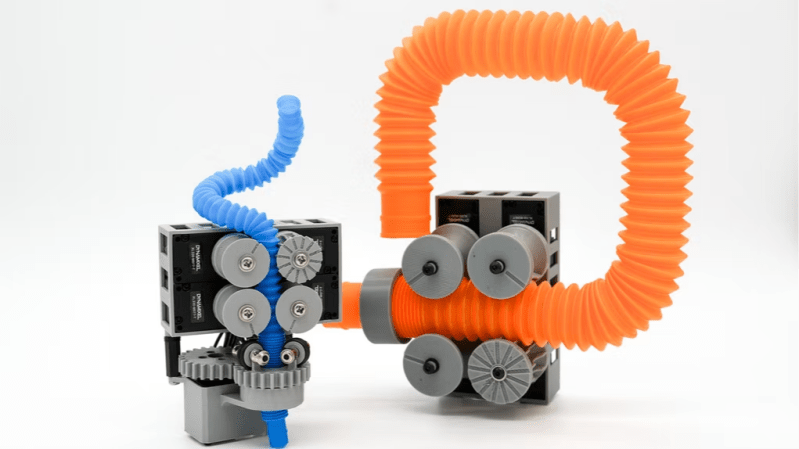
Are you familiar with pop tubes? Resembling the corrugated section of a bendy straw, they are at the core of PopTuber, an intriguing research project from the Actuated Experience Lab at the University of Chicago.
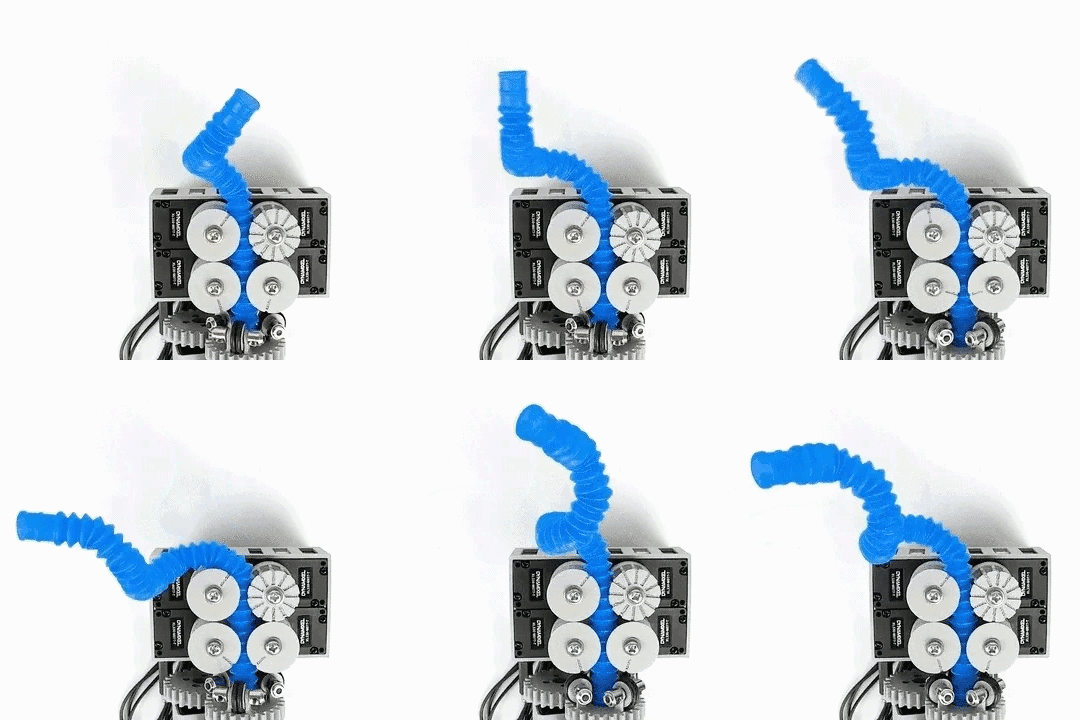
PopTuber shows how five motors and some specialized gears are all it takes to bend pop tubes into complex and stable 3D shapes. One can design the shapes in software, feed a pop tube into the shaper, and watch the device do the work. Importantly, the device can just as easily reset and re-use the tube. Watch the video (embedded below the page break) to see it in action and get a feel for what it can do.
In concept, it’s a little like a wire-bending machine, although wire benders are bulkier in comparison, more complex to scale, and unbending a wire is a separate process with its own hardware.
This project explores possibilities for a machine that can crank out complex curves on demand, such as oddball user interfaces, physical prototyping, and even a strange sort of physical display. But the real forward-thinking and interesting question researchers asked is whether this idea could be a form of programmable matter. The project shows that five actuators in a relatively compact package are all that’s needed to shape (and reset) a pop tube of arbitrary length in a programmable way, and it can scale easily to different sizes.
Using pop tubes in this way reminds us of an origami-inspired method we covered for making a tube form stable, complex shapes. But it’s also different because origami- and kirigami-inspired methods bake the transformation into the material itself, whereas PopTuber can create arbitrary shapes on demand.












This is definitely asking for a bit of post processing that turns this into a digital clock, churning out times and then recycling them into new times as individual digits expire.
been there almost i think i need to use this to revise my previous project https://hackaday.io/project/176659-getula
that is brilliant!
That video composition is 🤌. But other than the silly examples what are the industrial/scientific uses for something like this, I am genuinely curious.
is it turing complete on an endless tube? It can move forth and back, do and undo bends, but the bends may interfere, and I can’t say wether that results in incompleteness or not. (This is purely academic)
make some machine-sized proteins or a protein-sized machine :o) (on second thought, this may be more interesting)
customized unique pasta with hidden messages
protein folding hapticulization (new word!)
agentic rapid rat-maze creating
fractal magnetic coil prototyping
If anyone is interested, you can find the microcode for the arduinos and the GUI interface (I think – didn’t look at it in detail) here:
https://github.com/AxLab-UofC/PopTuber/tree/main/MotorControlGUI
The connection is by bluetooth. Pretty neat.
Now imagine the machjne necessary to do that with 30ft long 18inch diameter steel tubes, as fitted in ships.
I don’t have to: long long ago I spent a couple of days consulting about a problem they were having with one of those machines in a shipyard.
Made me chuckle :-)
I can kinda see it as some sort of interactive art installation. (dunno if that was mentioned in the text)
Cool machine, but those interaction demos were ghastly, the definition of a solution in need of a problem.
Yup, way better than the previous version, which used 11 motors and an automatic transmission.
I kinda love this thing :) It gets that zany wizard bucket filled :) Lots of silly applications :)
wow cool idea now i need to revise my previous project : https://hackaday.io/project/176659-getula